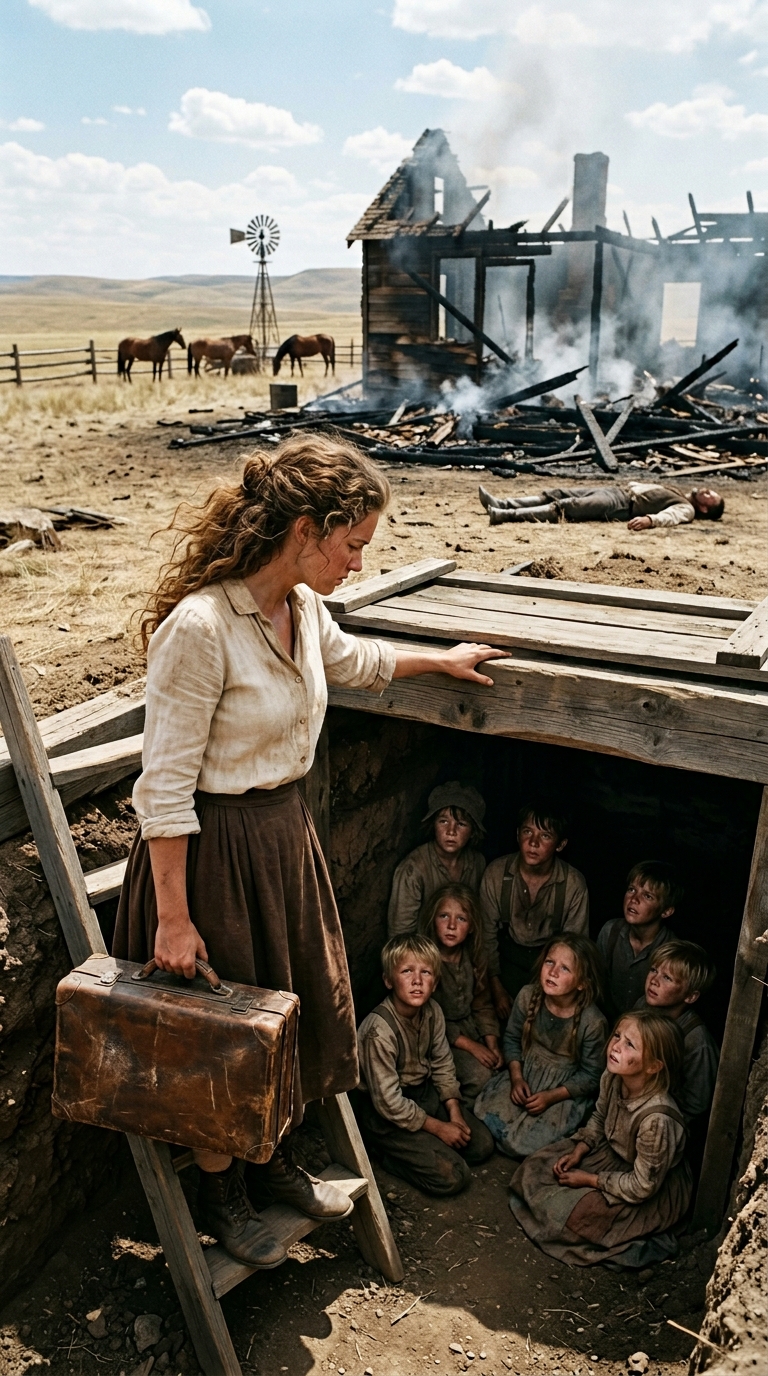
A Mail-Order Bride Arrived To Find Her Husband Dead And His Farm In Ashes—Then 8 Orphaned Children Emerged From A Root Cellar

PART 1
The day Valeria arrived at the ranch to get married, she found the house reduced to ashes and 8 children trembling underground, convinced that she had come to kill them.
Smoke still rose in thin gray threads from the remains of what had once been Julián Armenta’s adobe and wood house. He was a rancher from the Sierra de Durango who had promised her, in long and careful letters, a simple but dignified life. Valeria Robles had traveled from Puebla with a cloth suitcase, two dresses, a small medal of the Virgin of Guadalupe, and a hope that had cost her pride to swallow.
She was 26 years old, and in her neighborhood people already looked at her as if time had run out for her. Her parents had died in a tenement fire two years earlier, leaving her with debts, clothes that smelled of smoke, and a loneliness that no neighbor could mend. When she answered Julián’s advertisement, she did it not out of love, but out of exhaustion. He wrote to her for six months. He didn’t speak like a man looking for a servant. He told her he wanted a companion to build a home, care for animals, plant corn, welcome travelers, and start a family.
But there was no wedding. No husband. No house.
The main building was barely a rectangle of blackened stones. The roof had collapsed. The corral was empty. The chickens and horses were gone. All that remained of the barn were charred posts, and beside a fallen wall Valeria found a piece of a scorched rocking chair. Julián had written that he was making it so she could rest in the afternoons when the sun beat down hard on the mesquite trees.
Tomás Castañeda, the neighbor who had brought her from the town along with his wife Jacinta, came out of the corral with a hardened face.
“This was no accident.”
Valeria looked at him without understanding.
“What do you mean?”
“They took the animals, the good tools, and the food. They burned the rest so no one could start over. This was done by men who wanted to send a message.”
Jacinta crossed herself.
“There are bad people around here. They charge ‘protection’ to isolated ranches. If someone doesn’t pay, they take everything.”

Valeria felt the ground open beneath her. Julián had never mentioned threats in his letters. He had written about nopales, longed-for rains, a table he wanted to enlarge, and a small chapel at the end of the road. She had imagined arriving nervously, finally meeting him, perhaps feeling shy when she looked into his eyes. Instead, she stood amid the ruins of a war she hadn’t known existed.
“Where is Julián?” she asked, though the answer frightened her.
Tomás looked down.
“We didn’t find a body. That’s not always good news.”
Jacinta touched her arm.
“We can take you back to town for a few days. But, child, we have five kids of our own and we barely make it through the winter. We can’t promise more.”
Valeria pressed the medal against her chest. For months she had fled poverty thinking destiny was opening a door for her. Now the door was burned, the man who was supposed to wait for her had disappeared, and everyone looked at her as if the only sensible thing was to give up.
But something inside her refused.
“I want to check thoroughly.”
Tomás frowned.
“I already checked, Valeria.”
“You checked like someone looking for tracks. I’m going to check like someone who read every letter from Julián. He described this ranch to me stone by stone.”
She walked among broken boards, pots twisted by fire, blackened pages of religious books, and torn sacks. She saw bullet marks on a post, dried blood near the well, and a rope cut in haste. Every discovery felt like a slap.
When the sun began to set, Valeria stopped beside what had once been a small workshop. Among fallen beams, she discovered a low wooden door, half hidden under the earth. It hadn’t burned. Beside it, the ground showed fresh scratches, as if someone had crawled in or out.
“Tomás,” she said, her voice breaking. “Come here.”
They lifted the door. From the hole came a smell of dampness, stored beans, and fear. Below was darkness. At first there was no sound. Then a small sob. Then the scrape of feet.
Valeria leaned down.
“Don’t be afraid. We’re not here to hurt you.”
From below, a child’s voice answered, weak and hoarse.
“Please… don’t burn us too.”
Jacinta let out a moan.
“Holy God.”
Tomás climbed down carefully.
“Come up, kids. It’s over. No one is going to hit you.”
One by one, eight children emerged from the root cellar. They were dirty, pale, with cracked lips. The smallest, about three years old, hugged a doll made of dry corn leaves. The oldest, a boy of about fourteen, stood in front of them all as if his skinny body could hold back the world.
“We didn’t steal anything,” he said. “We just wanted to live.”
Valeria knelt in front of him.
“What’s your name?”
“Mateo.”
“And them?”
The boy swallowed, distrustful.
“They’re my brothers and sisters. Inés, the little one. The twins Nico and Toño. Clara. Diego. Rebeca. And Lucía.”
“How long have you been down there?”
Mateo looked at the sky, as if he no longer knew how to count time.
“Three nights. Or four.”
Valeria felt her hands turn cold.
“Where are your parents?”
Mateo held her gaze for only a second before breaking inside.
“We buried them behind the big mesquite tree. As best we could.”
Then, from the back of the cellar, Inés lifted her leaf doll and whispered something that left everyone frozen:
“My dad said that if the woman from the letters arrived, she would know where the truth is hidden.”

PART 2
Valeria did not sleep that night at the town inn. The eight children huddled on the floor of her room, wrapped in blankets borrowed from Jacinta, but none of them truly rested. Inés cried in her sleep, the twins woke up every time a board creaked, and Mateo stayed sitting by the door with a rusty knife in his hand — too much of a child to carry that fear, and too wounded to let it go. Valeria had only 47 pesos, a poor suitcase, and a paper saying she had come to marry a man who might already be dead. At dawn, the town constable wanted to separate the children and send them to different families. He said a single woman could not take care of eight orphans, especially a stranger without land. But he said it in front of Mateo, and Valeria saw how the boy clenched his fists as if they were tearing his family away again. Then she understood she could not allow it. Julián had called her a companion in his letters, and although he never became her husband, his promise still lived in those children. Jacinta begged her to be cautious; Tomás warned her that the men who burned the ranch might return. But Valeria went to the agrarian office and asked if a single woman could claim an abandoned plot. The clerk mocked her at first. Then, seeing the ashes on her dress and the eight children waiting outside, he handed her the papers. Valeria signed with a steady hand. They would return to the ranch. Not because it was safe, but because it was the only thing that could become a home.
The news spread quickly, and with it came poisonous comments. At the market they said Valeria wanted to take land that wasn’t hers. At church, a woman murmured that no decent woman would gather so many strange children under her roof. Worse still, Evaristo Luján appeared — a rich cattleman who owned half the region — accompanied by three armed men. He claimed Julián owed him money and that the ranch, burned or not, belonged to him. When Valeria showed the papers, Evaristo smiled as one smiles at an ant.
That afternoon, while Tomás helped load used tools onto a cart, Mateo confessed that the men who killed their parents wore red handkerchiefs around their necks, just like Evaristo’s men. He also said his father had not died for stealing or for debt, but because he had hidden something of Julián’s before the attack. Rebeca remembered that Julián had visited their parents one night before the fire with a box wrapped in a blanket. Lucía, who knew how to sew, said her mother had told them that if anything happened, they should look for “the woman from Puebla.” Valeria realized that Julián’s letters were no longer just words of affection — they were clues.
They returned to the ranch with fear, but also with a new anger. They slept in the root cellar, used burned stones to build a hearth, and rescued twisted nails from the ruins. Mateo hunted with small traps; Rebeca found wild greens, prickly pears, and nuts; Lucía mended clothes; Valeria treated wounds and taught the little ones to pray without trembling. But on the fourth night, when the wind nearly extinguished all the embers, Inés woke up screaming. Outside, hanging from the mesquite tree where their parents were buried, was a red handkerchief. Beneath it, stuck with a knife, was a message: “Give us the box or we will burn the eight of you alive.”
Then Mateo, pale as ash, led Valeria to the old dry well and showed her a loose stone. Behind it was Julián’s box, intact. Inside there was no money, but deeds, receipts, and a notebook with names of men from the town, including the constable.

PART 3
Valeria understood that Julián had not been attacked for being poor, but for being brave. He had gathered evidence that Evaristo Luján and several men from the town were stealing land from widows, orphans, and isolated ranchers — burning houses to erase claims and then presenting false debts. The constable appeared in the notebook as a buyer of stolen cattle. There was also a letter addressed to Valeria, written in the calm handwriting she immediately recognized. Julián asked her forgiveness for bringing her into a danger he hadn’t been able to explain, and told her that if he was gone, she should trust Mateo’s family, because they had protected the box.
Valeria did not cry at that moment. She couldn’t. The children looked at her the way one looks at a door before a fire. At dawn, instead of fleeing, she tucked the papers under her skirt, took Inés by the hand, and walked to town with the eight children behind her.
Evaristo reached the square first, surrounded by men, shouting that Valeria was a land thief and that those children were invented witnesses. People gathered in front of the municipal building. The constable tried to take the box from her, but Mateo stepped in front. For the first time, he didn’t look like a child hiding underground, but like the son of parents who had died without selling out.
Valeria opened the notebook in front of the priest, the merchants, the market women, and Doctor Benigno, who had come to offer medicine for the children. She read names, amounts, dates, and cattle brands. When she mentioned the constable, the silence was so heavy that even the horses stopped moving. Evaristo ordered his men to advance, but Tomás appeared with other ranchers who had also lost animals, tools, and brothers in “accidental” fires. Jacinta, with her black shawl, pointed to the red handkerchief and shouted that they had had enough of living in fear.
The crowd shifted. Those who had once murmured against Valeria began to surround the children to protect them. Doctor Benigno took the evidence and promised to send it to Durango with a federal judge who was his cousin. That same afternoon, the constable was locked in his own cell, and Evaristo fled toward the sierra, though two days later he was captured on a dirt road with cattle bearing marks that weren’t his.
Julián never returned. Weeks later they found his body near the dry river, wrapped in a blanket, with a medal just like the one he had described to Valeria in his last letter. She buried him beside the big mesquite tree, near Mateo’s parents — not as a lost fiancé, but as the man who, without knowing her, had left her a mission.
The ranch took months to rebuild. It wasn’t pretty at first: uneven walls, a borrowed tin roof, doors made from salvaged wood. But it smelled of beans, comal bread, and living children. The neighbors who had once judged Valeria brought seeds, chickens, blankets, and willing arms to work. Doctor Benigno paid her a small monthly amount to turn the ranch into a stop for aid to travelers and families wounded by the region’s violence.
Mateo remained serious but put away the knife. Rebeca planted medicinal herbs. Lucía sewed curtains from scraps. The twins laughed again. Inés placed her leaf doll on the new rocking chair that Tomás finished using the remains of the one Julián had started.
One night, while the sky filled with stars over Durango, Valeria heard Inés tell a traveler that this was their home. She didn’t say “Mrs. Valeria’s house.” She didn’t say “the burned ranch.” She said “our house.”
Then Valeria understood that she had not traveled there to lose a future, but to find eight reasons to rebuild it. And every time the wind moved the branches of the mesquite tree, it seemed as though the dead could finally rest without fear.
