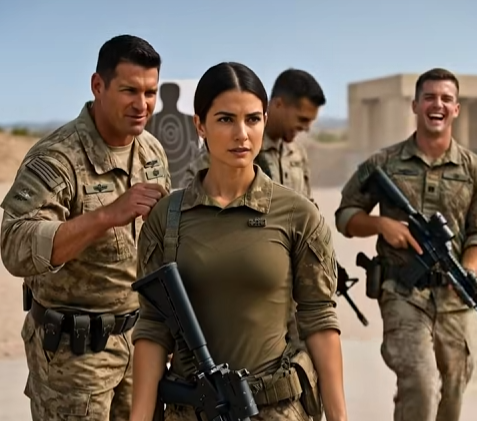
He Thought She Missed the Target. He Never Realized He Was the Target.
The soldier who’d mocked her first—Specialist Nolan Briggs, tall, red-faced, cocky in the way that came from never being corrected hard enough—stepped sideways so more people could see him grinning. “Ma’am,” he said, mock respectful, “seriously. Were you aiming at the target or at Arizona?”
A few more laughs broke loose.
Mara turned her head just enough to glance at him. Her face gave them nothing. No embarrassment. No temper. No wounded pride. Just a flat, unreadable stillness that made the laughter thin out at the edges, if only for a second.
Then footsteps hit the concrete behind her.
Not hurried. Not uncertain. Heavy, clipped, authoritative.
Lieutenant Colonel Dean Rourke moved onto the line with the kind of presence that changed air pressure. He was broad-shouldered, close-cropped gray at the temples, jaw locked tight enough to show white near the hinges. Every soldier within twenty feet straightened on instinct. Rourke was the ranking officer overseeing the live-fire assessment that morning, and he carried himself like a man who believed competence was the only mercy the world owed anyone.
He stopped inches from Mara’s shoulder.
“Drop the rifle,” he said.
The wind snapped a loose strap against a nearby gear case. The laughter behind them shrank into scattered breaths.
Mara didn’t move at first. Her eyes stayed forward, out toward the untouched target.
Rourke took one more step, crowding her space. “You heard me, Captain. Drop it. You’re done.”
No one said anything. Even Briggs stopped smiling so broadly.
Slowly, Mara turned toward the lieutenant colonel. She was not physically imposing. Five-foot-seven, lean, dark hair pulled back tight beneath her cap, the kind of face people underestimated because it was composed instead of theatrical. The kind of face that gave away almost nothing. There was dust on her sleeve. Sun on the bridge of her nose. And not a trace of apology.
“Done?” she repeated.
Her tone was so quiet that people leaned in to hear it.
Rourke’s eyes hardened. “You missed a stationary silhouette in broad daylight on my range. I don’t need to see a second shot. We are not turning this into a circus.”
Behind them, the rest of the firing detail stood in a crooked half-circle, pretending not to watch as openly as they were. A few junior NCOs exchanged glances. One range safety officer looked down at his clipboard like it might rescue him from the moment. No one stepped in.
Mara looked back toward the target. “Are you sure that’s what happened, sir?”
That should have been a harmless question. On another day, under another officer, it might have been.
On Dean Rourke’s face, it landed like a challenge.
He reached forward, yanked the rifle out of her hands with a violence that made two people flinch, and hurled it onto the concrete. Metal struck hard, loud, ugly. The sound rang across the range and then disappeared into a silence so abrupt it felt staged.
Two military police officers at the edge of the lane started forward on reflex.
Rourke pointed toward the exit gate without taking his eyes off Mara. “Get off my range before I drag you off it.”
The MPs came closer, boots grinding grit.
Somewhere behind them, Briggs muttered, “Damn,” under his breath, half thrilled and half nervous now that the scene had gone past humiliation and into spectacle.
Mara looked down once at the rifle lying on the ground.
Then she looked back up.
She did not bend to retrieve it.
That, more than anything, unsettled the crowd. If she’d lunged for the weapon, if she’d argued, if she’d snapped and given them something messy and human, the story would have stayed ordinary. A failed shooter. A furious superior. Another public correction on a hot range in the American West.
Instead, she slid one hand slowly into the right pocket of her field jacket.
The closest MP stiffened. Rourke’s voice sharpened instantly. “Don’t.”
Mara ignored the warning.
Her fingers moved inside the pocket, unhurried, and when she finally spoke, it was softer than the desert wind.
“You skipped verification.”
For a second, nothing in the world seemed to move.
No one understood the sentence except, perhaps, the one person who should have. And even he looked at her as if she had suddenly begun speaking a different language.
Rourke’s brow furrowed. “What did you say?”
“You even aiming at the target?”
The crack of the rifle was still rolling across the range when the laughter started behind her, sharp and mean and too comfortable. Downfield, the paper silhouette thirty yards out looked untouched, clean through the chest and head, as if her round had vanished into open air.
Captain Mara Quinn did not lower the rifle right away.
She stayed in her stance for one beat longer, cheek still near the stock, shoulders square, breathing even. A hot Nevada crosswind tore through the open training lane and kicked red dust against the concrete firing line at Nellis Annex, just outside Las Vegas. Somewhere behind the line, a row of soldiers let out the kind of laughter that only happens when people think someone else has just been humiliated beyond recovery.
One of them snorted. “No way she missed that bad.”
Another voice came quick on top of it. “I’m telling you, she never should’ve been on this line.”
Mara clicked the safety on and lowered the rifle with calm hands.
That calm did more to provoke them than anger would have. It made people feel cheated. Men who wanted a reaction always hated discipline most.
The soldier who’d mocked her first—Specialist Nolan Briggs, tall, red-faced, cocky in the way that came from never being corrected hard enough—stepped sideways so more people could see him grinning. “Ma’am,” he said, mock respectful, “seriously. Were you aiming at the target or at Arizona?”
A few more laughs broke loose.
Mara turned her head just enough to glance at him. Her face gave them nothing. No embarrassment. No temper. No wounded pride. Just a flat, unreadable stillness that made the laughter thin out at the edges, if only for a second.
Then footsteps hit the concrete behind her.
Not hurried. Not uncertain. Heavy, clipped, authoritative.
Lieutenant Colonel Dean Rourke moved onto the line with the kind of presence that changed air pressure. He was broad-shouldered, close-cropped gray at the temples, jaw locked tight enough to show white near the hinges. Every soldier within twenty feet straightened on instinct. Rourke was the ranking officer overseeing the live-fire assessment that morning, and he carried himself like a man who believed competence was the only mercy the world owed anyone.
He stopped inches from Mara’s shoulder.
“Drop the rifle,” he said.
The wind snapped a loose strap against a nearby gear case. The laughter behind them shrank into scattered breaths.
Mara didn’t move at first. Her eyes stayed forward, out toward the untouched target.
Rourke took one more step, crowding her space. “You heard me, Captain. Drop it. You’re done.”
No one said anything. Even Briggs stopped smiling so broadly.
Slowly, Mara turned toward the lieutenant colonel. She was not physically imposing. Five-foot-seven, lean, dark hair pulled back tight beneath her cap, the kind of face people underestimated because it was composed instead of theatrical. The kind of face that gave away almost nothing. There was dust on her sleeve. Sun on the bridge of her nose. And not a trace of apology.
“Done?” she repeated.
Her tone was so quiet that people leaned in to hear it.
Rourke’s eyes hardened. “You missed a stationary silhouette in broad daylight on my range. I don’t need to see a second shot. We are not turning this into a circus.”
Behind them, the rest of the firing detail stood in a crooked half-circle, pretending not to watch as openly as they were. A few junior NCOs exchanged glances. One range safety officer looked down at his clipboard like it might rescue him from the moment. No one stepped in.
Mara looked back toward the target. “Are you sure that’s what happened, sir?”
That should have been a harmless question. On another day, under another officer, it might have been.
On Dean Rourke’s face, it landed like a challenge.
He reached forward, yanked the rifle out of her hands with a violence that made two people flinch, and hurled it onto the concrete. Metal struck hard, loud, ugly. The sound rang across the range and then disappeared into a silence so abrupt it felt staged.
Two military police officers at the edge of the lane started forward on reflex.
Rourke pointed toward the exit gate without taking his eyes off Mara. “Get off my range before I drag you off it.”
The MPs came closer, boots grinding grit.
Somewhere behind them, Briggs muttered, “Damn,” under his breath, half thrilled and half nervous now that the scene had gone past humiliation and into spectacle.
Mara looked down once at the rifle lying on the ground.
Then she looked back up.
She did not bend to retrieve it.
That, more than anything, unsettled the crowd. If she’d lunged for the weapon, if she’d argued, if she’d snapped and given them something messy and human, the story would have stayed ordinary. A failed shooter. A furious superior. Another public correction on a hot range in the American West.
Instead, she slid one hand slowly into the right pocket of her field jacket.
The closest MP stiffened. Rourke’s voice sharpened instantly. “Don’t.”
Mara ignored the warning.
Her fingers moved inside the pocket, unhurried, and when she finally spoke, it was softer than the desert wind.
“You skipped verification.”
For a second, nothing in the world seemed to move.
No one understood the sentence except, perhaps, the one person who should have. And even he looked at her as if she had suddenly begun speaking a different language.
Rourke’s brow furrowed. “What did you say?”
Mara withdrew her hand. Between two fingers sat a slim matte-black credential card, no larger than a hotel key, unmarked on the visible side except for a seal embossed so dark it only flashed when the light hit it.
She didn’t offer it to Rourke.
She extended it toward the nearer MP.
The officer hesitated, then took it.
The moment his thumb turned the card over, the color left his face.
His throat worked once before sound came out.
“Sir…” He looked up at Rourke, and for the first time all morning there was real fear in a uniformed voice. “This is JSOC authorization.”
Nothing on the range made noise after that.
No wind.
No shifting boots.
No whispered joke from the line.
Even the cheap laughter that had followed her missed shot seemed impossible now, like it had happened in some other place to some other people who had not yet understood where they were standing.
Rourke stared at the card in the MP’s hand as if it might change if he kept looking long enough.
Mara took one step forward, not toward the rifle, not toward the exit, but into the silence he had created.
“This wasn’t a shooting test,” she said.
She let the words settle.
Then, lower, with no triumph in her voice at all, she finished it.
“It was a command test.”
No one breathed.
The story could have ended there for the people watching. In a way, for most of them, it did. They would carry that frozen image for years: Lieutenant Colonel Dean Rourke standing rigid on his own range while the officer he had just tried to throw off it turned out not to be a failed shooter, but the standard by which he had been measured.
But for Mara, that was only the point at which the scene stopped belonging to the crowd and began belonging to the truth.
She held out her hand, and the MP almost snapped the credential back into it. She slipped it into her pocket again.
Briggs found his voice first, though only barely. “JSOC?” he said, too stunned to keep the word from cracking. “What is this?”
No one answered him.
Rourke’s face had gone still in a way Mara had seen before on men who were realizing, moment by moment, that the ground beneath their authority was not as solid as they believed. He was a good officer on paper. Decorated. Efficient. Demanding. The kind of man headquarters liked because his reports were clean and his training numbers looked immaculate.
But numbers had a way of flattering the wrong people.
Mara had spent the previous three days in borrowed insignia, traveling under a temporary assignment order that only two people on the base were supposed to verify before she ever touched the line. One was the operations duty officer, who had done his part. The other was Dean Rourke.
He had not.
He had seen a woman he didn’t recognize step into his process, assumed incompetence before inquiry, then used humiliation where procedure should have gone. He had let subordinates mock her openly. He had escalated to force without completing authentication. And, most damning of all, he had done it while believing he was demonstrating strength.
Mara watched him work that out in real time.
The desert sun pressed down harder. Heat shimmered above the range like invisible fire.
Finally, Rourke spoke, and his voice was careful now. “Captain Quinn.”
“No,” Mara said.
That one word landed harder than anything she had said yet.
His jaw flexed.
“You will address me by my assigned role for this assessment,” she continued. “Observer is sufficient.”
A muscle jumped near his temple. Around them, the listening soldiers were trying very hard to disappear without moving.
Rourke took a breath. “Observer,” he said, the word rough in his mouth. “There appears to have been a misunderstanding.”
Mara’s eyes did not leave his. “No, Colonel. There was an assumption. Those are different.”
One of the MPs looked down. The other kept staring at a point somewhere over the mountains, as if eye contact with anyone might get him court-martialed by proximity.
Rourke glanced toward the target line, perhaps reaching for something salvageable. “If this was an assessment, then the target setup was irregular.”
“It was deliberate.”
“Why was there no impact on the silhouette?”
Mara let a few seconds pass before answering. “Because I wasn’t aiming at the silhouette.”
The soldiers behind him exchanged confused looks.
She turned slightly and pointed downrange, not at the paper target but beyond it, toward a steel verification plate mounted low and offset near the berm where few people ever looked unless they knew it was there.
“Call cease and send optics.”
Rourke did not move.
Mara’s tone cooled another degree. “Now.”
The range safety officer nearly stumbled over himself getting binoculars up. A sergeant took a spotting scope and crouched behind it. He adjusted focus, then froze.
“There’s a strike,” he said.
No one reacted at first.
He swallowed and tried again, louder. “There’s a single hit on the verification plate. Dead center.”
The words moved through the formation like an electrical fault.
Briggs’s mouth actually fell open. Someone whispered, “No way.” Another muttered, “She saw that plate from here?”
Mara didn’t correct them. She hadn’t just seen it. She had counted on the fact that Rourke wouldn’t.
The verification plate existed for one reason: to confirm whether an observer on a concealed audit had the freedom to execute alternate instructions without telegraphing them to the chain of command. It was a detail buried in the briefing packet Rourke had been required to review before the exercise began. If he had done so, he would have known a miss on the public target meant nothing until verification was complete.
Instead, he had chosen instinct over process and ego over control.
He had failed before her round ever left the barrel.
Rourke’s gaze shifted toward the berm, then back to Mara. And in that look, for a brief honest instant, she saw something more painful than rage.
Recognition.
Not of her authority.
Of himself.
That was the moment he understood the test had been underway from the second she walked onto the line. The mockery, the impatience, the public correction, the snatched weapon, the threat to drag her off—all of it had not ruined the exercise. It had completed it.
Mara had been doing this too long to mistake silence for remorse, though. Men like Dean Rourke did not break in public. They rearranged themselves. They searched for exits.
He straightened. “You should have identified yourself sooner.”
There it was.
The shift of blame came so predictably it almost made one of the sergeants wince.
Mara folded her hands behind her back. “And you should have followed your own verification protocol before laying hands on an armed officer.”
The sentence hung like a blade.
Briggs took half a step backward.
Rourke lowered his voice. “This doesn’t need to become theater.”
She looked past him at the soldiers who had laughed. At the NCOs who had watched. At the MPs who had moved on command without question. At the range itself, still buzzing with the afterimage of what had almost happened.
“You made it theater the second you decided humiliation was leadership.”
No one moved.
For the first time, a few of the faces in the crowd weren’t just shocked. They were ashamed.
Mara knew what they were seeing because she had once stood in their place. Not literally. Not on this range, not under this man. But under others like him. Men who treated correction like performance. Men who believed fear sharpened people more cleanly than respect ever could. Men who made examples out of subordinates and called it standards.
Years earlier, in North Carolina, she had watched one of those officers publicly strip a promising young lieutenant down to almost nothing after a training error that turned out not to be the lieutenant’s fault. The officer’s career had survived. The lieutenant’s confidence had not. Mara had learned something then that no manual said plainly enough: once an entire room is taught to enjoy someone else’s humiliation, discipline is already rotting from the inside.
That memory pressed against her now, hot and unwelcome.
She stepped around the rifle still lying on the concrete.
“Pick it up,” Rourke ordered one of the MPs, desperate now to restore ordinary motion to the world.
“Leave it,” Mara said.
The MP stopped midway through bending.
Again, she hadn’t raised her voice. She didn’t need to.
Rourke’s stare followed her as she paced slowly toward the edge of the firing lane. “What exactly is your intent here?”
She turned back. “To assess command judgment under ambiguity. To examine procedural compliance under social pressure. To observe how quickly a senior officer mistakes control for competence.”
The words hit in measured intervals, each one more suffocating than the last.
“And?” he asked.
“And to see what kind of culture grows around a leader who performs authority instead of exercising it.”
Now the sting reached beyond him. You could feel it in the faces around the line. This was no longer only about a colonel losing his footing. It was about every laugh, every glance, every safe silence that had made his behavior easier.
Briggs looked at the ground like it might open.
One of the sergeants cleared his throat. “Observer, permission to speak?”
Mara turned.
The sergeant was in his forties, compact, disciplined, the sort of man who’d spent half a career holding units together under officers above and soldiers below. He had laughed earlier—not loudly, but enough.
“Granted.”
His voice was low. “We didn’t know.”
“I know,” Mara said.
The answer was not mercy. It was worse.
He lowered his eyes.
A radio crackled somewhere at the admin table. No one touched it.
Rourke took one careful step closer, no longer crowding her, no longer reckless. “This evaluation can be continued privately.”
Mara studied him. “Why?”
His mouth tightened. “Because public damage helps no one.”
That might even have been true. But it wasn’t why he wanted privacy.
He wanted insulation.
He wanted this moment reduced to paperwork and classified channels and language sterile enough to hide what had actually happened in front of subordinates.
Mara had no interest in spectacle for its own sake. She also had no interest in helping officers sanitize their instincts after those instincts had already exposed the people beneath them.
She glanced at the line again. “They were public when you decided I was disposable.”
The sentence struck harder than shouting could have.
One of the younger soldiers actually closed his eyes.
Rourke said nothing.
Mara let the silence work. A desert range could teach a lot about sound. How far it traveled. How quickly it vanished. How one sharp thing could split a wide open space and leave people hearing it long after the echo was gone.
Finally, she walked back to the rifle, crouched, and lifted it herself. She checked it with clean economy, then handed it to the range safety officer.
“Secure it.”
“Yes, ma’am.”
She faced Rourke again. “From this point forward, you will complete the exercise under observation. Your authority on this range remains operational until formally suspended. That is not exoneration. It is part of the assessment.”
A flicker crossed his face. Gratitude, maybe. Or humiliation sharpened into something quieter.
Mara knew what he heard in that decision: she could have buried him on the spot, and she hadn’t. Not because he deserved softness. Because consequences were more useful when people had to keep functioning beneath them.
“Understood,” he said.
It was the first honest thing he had spoken all morning.
She nodded once. “Then start by correcting the line.”
Rourke turned.
This, Mara thought, would be the real measure now—not the credential, not the revealed plate, not the frozen silence after JSOC. Not even the written report that would go upstairs by nightfall.
This.
A leader with no script left.
He looked at Briggs first, perhaps because Briggs had been the loudest, perhaps because some part of him recognized his own reflection there. “Specialist,” he said, voice flat. “Front.”
Briggs obeyed, suddenly all stiffness and swallowed fear.
Rourke surveyed the formation. “What happened here was a failure of protocol and bearing. Mine first. Then yours. Mockery on a live range is not discipline. Assumption is not verification. Anyone who thought that laughter was harmless is wrong.”
Shock moved across the line in waves. No one had expected that. Least of all Mara.
There it was—the unexpected shift before collapse. Not redemption. Nothing that clean. But the first crack in a man’s certainty.
Rourke continued, and his voice seemed to cost him something now. “The observer’s presence was authorized. I failed to confirm that. I escalated before establishing facts. That error is on me.”
No one breathed.
Briggs looked as if he wanted the desert to swallow him whole.
“Specialist Briggs,” Rourke said, “you will report to your first sergeant after this exercise for corrective action regarding conduct. The rest of you will remember this range the next time you’re tempted to confuse cruelty with confidence.”
He stopped there.
It was not a perfect statement. It did not undo the threat, the shove, the public degradation. But it was also more than many men of his rank would have said with witnesses present.
Mara watched him carefully. She did not mistake admission for transformation. People could say the right words and still remain dangerous in private. Still, the soldiers would remember those words too. And sometimes the beginning of institutional pressure was simply forcing truth into the open where junior people could hear it.
The wind returned all at once, sliding across the berm and tugging at uniforms and loose paper.
Life on the range resumed in tiny sounds: a case latch snapping shut, someone exhaling, a radio clipped back to a vest. The spell broke, but not fully. Scenes like this never really ended. They embedded.
Rourke turned back to Mara. “Will your report reflect that statement?”
She considered him for a long moment.
“My report will reflect what happened,” she said.
He gave a single restrained nod, accepting the answer for what it was: no promise, no shield.
The rest of the exercise continued, but the rhythm had changed forever. Commands were sharper, yes, but quieter. Checks were repeated. Verification was spoken aloud. No one laughed again. Every order carried the memory of what one unchecked assumption had cost.
Hours later, as the sun dropped lower and painted the Nevada dirt copper, Mara stood near the administrative trailer finishing her notes on a tablet. Vehicles moved in the distance. A helicopter crossed far off toward the city. The range smelled of hot dust, spent powder, and metal left too long in the sun.
Rourke approached alone.
He stopped several feet away, careful now with distance.
“Observer.”
Mara didn’t look up immediately. “Colonel.”
He stood with his hands behind his back, less like a king of the range now and more like a man waiting outside a verdict.
“I won’t insult either of us by asking how bad it is,” he said.
That almost earned him a glance of respect.
Almost.
When she looked at him, his expression had shed the raw anger from earlier and settled into something harder to name. Not peace. Not exactly regret. More like the first hours after an impact, when a man is beginning to understand that the shape of his future has changed and there is no argument left strong enough to push it back.
“It’s bad,” Mara said.
He nodded once.
“But not because you were fooled,” she added. “Good officers get surprised. Good officers get tested. Good officers even get manipulated. That’s not the real failure.”
His eyes stayed on hers. “Then what is?”
“You enjoyed being certain before you were correct.”
The words hit him harder than the credential had.
She tucked the tablet under one arm. “That kind of certainty bleeds people. Quietly, over time. Sometimes worse than one bad decision ever could.”
He looked past her toward the range where his soldiers were clearing equipment under a reddening sky.
For a moment, Mara thought he might say something defensive. Something about standards. About pressure. About years in uniform and impossible expectations and the brutal arithmetic of command.
Instead he asked, “Did I fail before I touched the rifle?”
Mara answered with the honesty the job required.
“Yes.”
He closed his eyes for a second.
When he opened them again, there was no dramatic collapse in him, no sudden moral awakening, no speech begging understanding. Just a man standing in the long aftershock of being seen clearly.
“That’s what I thought,” he said.
Mara started toward the waiting black SUV by the trailer steps. Her driver had already opened the rear door. The sky over the desert was draining from orange into iron blue.
Behind her, Rourke spoke one last time. “Captain Quinn.”
She stopped but didn’t turn.
His voice was quieter now than it had been all day. “You never missed, did you?”
Mara looked out toward the darkening range, where the hidden verification plate sat beyond the untouched silhouette like a truth no one had bothered to look for.
“No,” she said.
Then she faced him at last.
“You just weren’t the only one being tested.”
She got into the SUV and closed the door.
As the vehicle rolled away from the range, the last light caught the training lane in long broken bands, turning men and targets into shadows stretched thin across the dirt. In her lap rested the report that would travel farther than gossip and last longer than embarrassment. It would not ruin Dean Rourke in a day. Careers like his rarely broke that cleanly.
But somewhere behind her, on a rifle range outside Las Vegas, an untouched target was still standing in the dusk—perfect on the surface, empty at the center—and that was the part no one who witnessed it would ever forget.
