She Pointed At The Tattoo We Buried With Her. Then She Said Her Mother Was Still Alive.
“My mommy has that too.”
The words landed like a gunshot.
Five grown men—trained, hardened, conditioned to move through chaos without hesitation—froze in place inside a cramped diner booth in Ohio.
The heater rattled overhead, blasting dry, suffocating heat. Grease clung to the air. Somewhere behind us, a cook shouted an order. Plates clattered. A bell rang.
But at our table—
Nothing moved.
Todd’s arm was still half-raised, flannel sleeve rolled back just enough to expose the faded black ink on his forearm.
A shattered anchor.
Not regulation.
Not official.
Not something that existed anywhere except in memory—and on the skin of exactly five men.
And now, apparently… somewhere else.
I felt the air drain from my lungs as I slowly turned toward the girl.
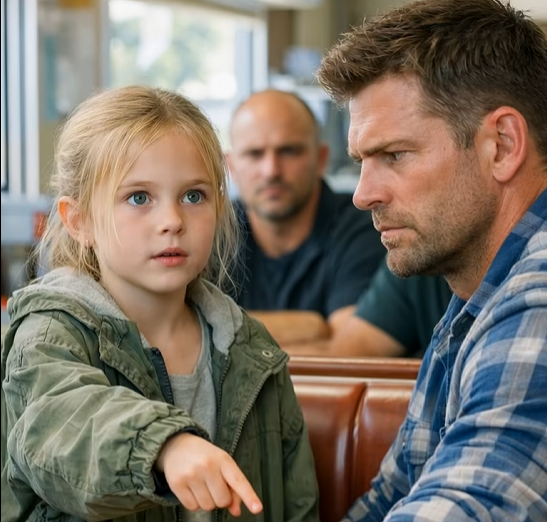
She couldn’t have been older than eight.
Too small for the weight in her eyes.
Too thin for the oversized, dirty windbreaker hanging off her shoulders. Her fingers trembled as she pointed at Todd’s tattoo like she was reaching for something dangerous but necessary.
“My mommy has that too,” she repeated, softer now. Fragile. Certain.
No one spoke.
Todd forced a smile—the kind you give children when you’re trying to soften something too sharp for them to understand. But I knew him well enough to see it.
The tension.
The fracture beneath the surface.
“I think you’re mistaken, sweetheart,” he said gently. “Our friend… she’s gone.”
The girl didn’t blink.
Her eyes stayed locked on his.
“No,” she said.
Not louder.
Not emotional.
Just… firm.
“She told me you would say that.”
Something cold slid down my spine.
Across the table, Dane slowly lowered his coffee cup. Mason shifted in his seat, shoulders tightening. No one reached for a weapon.
But every instinct in that booth had just sharpened.
“What’s your name?” Dane asked, voice controlled, careful.
“Hannah.”
“Where’s your mom, Hannah?”
A beat.
Then—
“I ran.”
The word hit harder than anything else she’d said.
Todd leaned forward, lowering himself slightly to her level. His voice softened, but his eyes stayed razor-sharp.
“Who told you to come here?”
“My mom.” She hesitated, then added quietly, “Well… I call her Mom.”
That landed.
Not my mom.
My mom.
A choice.
A bond.
I exchanged a look with Todd. He caught it. Understood it.
“Did she send you to find us?” I asked.
Hannah nodded quickly, like she’d been waiting for the right question.
“She said if the men in dark suits ever came back to our house, I had to leave through the laundry window and go to the diner with the red sign.” Her small hands tightened into fists. “She said I had to wait until I saw the anchor.”
Todd’s jaw clenched.
“And then?” Mason asked.
“She said only then I could talk.”
Silence again.
Heavy.
Intentional.
“What men?” Dane pressed.
“I don’t know.” Hannah’s voice dropped. “They said they were from the government.”
She swallowed hard.
“But Mom said real government people don’t break the porch light first.”
Every single one of us felt that.
Because Valerie used to say the exact same thing.
If someone wanted to control the scene—
They killed the light first.
I felt my pulse spike.
“Did she tell you anything else?” I asked.
Hannah nodded, reaching into her pocket. This time, she pulled out a crumpled photograph and slid it across the sticky diner table.
It stuck slightly before stopping.
I grabbed it.
My hands were already shaking.
And the second I looked down—
My heart stopped.
Because the woman crouching beside Hannah—
Wasn’t Valerie.
It was Emily Mercer.
Valerie’s younger sister.
Everything after that felt unreal.
Like the world had tilted five degrees off-axis and nothing quite lined up anymore.
Emily.
Alive. Present. Smiling in that photo.
Valerie used to talk about her in fragments. Rarely. Carefully. Like she was protecting something sacred.
“If anything happens to me,” she once said, staring into a dying fire overseas, “Emily disappears. No one goes looking for her.”
We thought it was paranoia.
Now it felt like a warning we’d ignored.
Hannah’s voice pulled me back.
“She said there would be a note.”
My chest tightened.
“A note for the one who carried the box.”
Everything inside me went still.
I unfolded the paper she handed me.
One line.
If Hannah found you, then I was right about the fire. Don’t trust the men who signed my death. Bring only the five. – V
My vision blurred.
Todd stood up so fast the table rattled.
“We move now.”
“Or we think,” Mason snapped.
But it didn’t matter.
The decision had already been made the moment we saw the signature.
V.
Valerie.
The house was exactly how Hannah described it.
Porch light shattered.
Door splintered.
Inside—disturbed, but not chaotic.
Not a robbery.
A search.
Professional.
Targeted.
Emily had packed.
Fast. Selective. Intentional.
She knew they were coming back.
We found the second note behind a photograph.
If the house is clean, go to the first place she taught you to breathe underwater.
The quarry.
Valerie’s place.
Her origin point.
Her hiding place.
The cabin door opened before we touched it.
And for one impossible second—
Time stopped.
She stood there.
Scarred.
Thinner.
Changed.
But unmistakable.
Valerie.
Alive.
Hannah broke first.
“Mom!”
She ran.
Valerie dropped to one knee and caught her, arms wrapping around her like she’d never let go again.
And then—
She cried.
Not quietly.
Not controlled.
Not like a soldier.
Like a mother who had been holding her breath for four years.
“I knew you’d find them,” she whispered. “I knew you would.”
We stood there, frozen.
Because the impossible had just stepped out into the light.
Inside the cabin, the truth unfolded slowly.
Painfully.
Deliberately.
The fire wasn’t an accident.
It was a cover-up.
Valerie had discovered something buried beneath the mission—something tied to corrupted intelligence, manipulated operations, and a network of people inside the system profiting from it.
She was never supposed to walk out.
But she did.
And the moment she realized her death had been confirmed before it could have been—
She disappeared.
Because she had something to lose.
Hannah.
Her daughter.
A secret she had carried alone.
Even from us.
Emily had raised her.
Protected her.
Loved her.
And Valerie had stayed in the shadows, building a case strong enough to survive the truth.
Todd’s postcard.
Dane’s hidden connection to a federal judge.
Every thread we thought was random—
Was part of the same web.
The takedown wasn’t loud.
It wasn’t cinematic.
It was precise.
Files delivered.
Names exposed.
Arrests made quietly, then publicly.
Men who once stood at podiums with flags behind them—
Now stood in handcuffs.
Valerie stayed out of the spotlight.
Officially dead.
Unofficially—
Rebuilding.
Slowly.
Carefully.
Months later, the world felt quieter.
Not healed.
But steadier.
We sat on Valerie’s back porch as the sun dipped low over Ohio fields.
Hannah laughed in the yard, chalk in her hands.
Emily leaned against the railing, watching her with a softness that hadn’t existed before.
Valerie sat beside me.
Real.
Present.
Alive.
“I’m sorry,” she said.
Not for the mission.
Not for surviving.
For leaving us behind.
I nodded.
“I know.”
That was enough.
Not forgiveness.
Not yet.
But something close.
Later, Hannah walked over with a small strip of bandage and a marker.
She climbed into Valerie’s lap and carefully drew something before pressing it over the scar on her neck.
A tiny anchor.
Not broken.
Whole.
Valerie stared at it.
Then at Hannah.
And something inside her finally—
Let go.
No speeches.
No closure wrapped in perfect lines.
Just a quiet evening.
A porch light glowing.
Unbroken.
And five men who had buried a ghost—
Sitting in silence…
As they finally watched her come back to life.
Read more story 
He Thought the Poison Was Meant for Him. The Truth Was Worse Than Betrayal.
“Don’t drink that!”
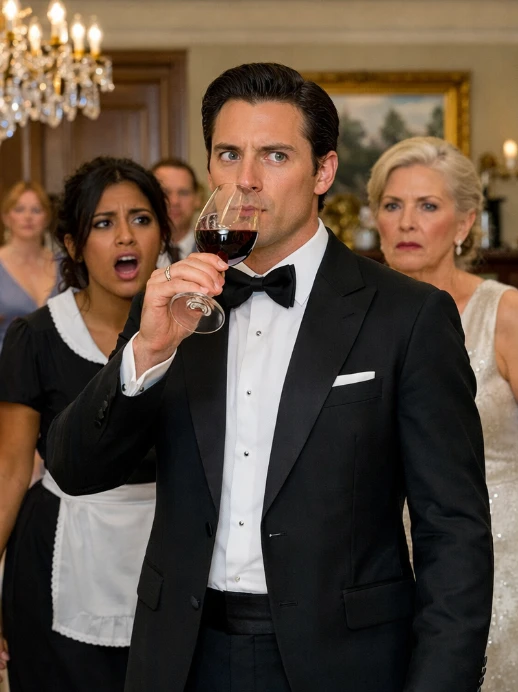
Rosa’s scream tore through the room so violently that it seemed to strike the crystal before it struck Ethan. His glass had already reached his mouth. The red wine touched his lower lip, and then he stopped—mid-motion, mid-breath, mid-ritual—as if someone had reached into the room and snapped a wire inside him.
The entire gathering froze.
Conversation died in pieces. A laugh clipped short. A chair leg scraped once and went still. The string quartet in the adjoining gallery faltered, one violin hanging on a note too long before silence swallowed it. Every face turned not toward Rosa first, but toward the wineglass in Ethan Vale’s hand.
He stood at the center of the private reception room like a man interrupted inside a sacred act. One hand held the bowl of the glass. The other rested loosely at his side. The lights from the chandeliers above caught the dark red liquid and made it look almost black.
Rosa stood near the doorway, trembling so badly she had one hand pressed against the carved wooden frame to keep herself upright. She was pale beneath the warm lighting. Her breathing came in short, panicked pulls. The tray she had been carrying lay crooked on a side table, abandoned at an angle that suggested she had set it down without knowing she was doing it.
No one spoke.
Then Ethan lowered the glass an inch.
Not much. Just enough for the room to exhale and tighten at the same time.
His eyes found Rosa’s.
“What did you say?” he asked quietly.
That was somehow worse than if he had shouted. Ethan almost never raised his voice. The room knew that about him. It was one of the reasons people watched him so carefully. A calm man in a room full of power was often more dangerous than an angry one.
Rosa swallowed hard. Her throat worked visibly.
“I said don’t drink it,” she whispered.
A woman near the fireplace let out a nervous breath. Someone else muttered, “Jesus.” No one moved closer to the drinks table. No one reached for a glass.
Margaret Vale rose so abruptly from the chaise near the windows that the silk of her gown hissed against the upholstery. “Rosa,” she said, sharp and controlled, “explain yourself.”
Rosa looked at Margaret as if permission itself frightened her.
“In the study,” she said, voice shaking. “Earlier. I was bringing in the dessert menus, and the door was open just enough and I saw—I saw someone near the decanter. They put something in it. I know what I saw.”
That landed in the room like a dropped blade.
Nobody asked her to repeat it. Nobody laughed immediately. Shock had not yet had time to become disbelief.
Then Julian gave a soft, unbelieving scoff from beside the marble mantel.
Of everyone there, Julian Hart looked the least rattled, which made him more noticeable, not less. He stood with one hand in his pocket, tuxedo immaculate, expression tilted toward amusement in a way that felt deliberately insulting to the panic gathering in the room. He was handsome in the polished, forgettable way power often was. He wore composure like another accessory, cuff links and smile and all.
“A servant’s hallway fantasy,” he said. “At a party full of half-drunk investors. Perfect timing.”
Margaret turned on him with a look sharp enough to draw blood. “No one drinks anything else,” she said. Not loudly, but with absolute command. “Put every glass down.”
That did it.
The room obeyed.
Crystal touched tabletops. A guest at the drinks console slowly set the bottle opener aside. Another stepped back from the silver ice bucket as though it now contained something alive. The silence after that was unbearable, dense and pressing, broken only by Rosa’s unsteady breathing and the distant murmur of the event continuing elsewhere in the estate, unaware that this room had become its own sealed chamber of suspicion.
Ethan looked down at the wine in his hand again.
Everyone watched him.
His expression did not change, but something in it cooled. Not fear. Not even outrage. Calculation. The kind of stillness that made other people more nervous because it suggested the real reaction was happening somewhere deeper, somewhere hidden.
Rosa took one step forward, hand half-raised. “Sir, please—”
And Ethan lifted the glass and drank.
Gasps broke across the room in a jagged wave.
He didn’t sip. He didn’t hesitate. He tipped the glass and emptied it in one measured swallow, throat moving once, twice, until the bowl was dry. Then he lowered the glass and held it loose between two fingers as if he had only just demonstrated a point in some trivial debate.
Rosa’s face went white.
Margaret lurched toward him. “Ethan!”
Several guests spoke at once.
“What the hell are you doing?”
“Call someone.”
“Is he insane?”
“Get a doctor—”
But Ethan raised one hand, and the room silenced itself out of old habit.
He set the empty glass on the table beside him.
Then, without a word, he crossed to the antique walnut cabinet built into the wall near the study doors. Its brass handle clicked softly in the silence. He opened it and reached inside.
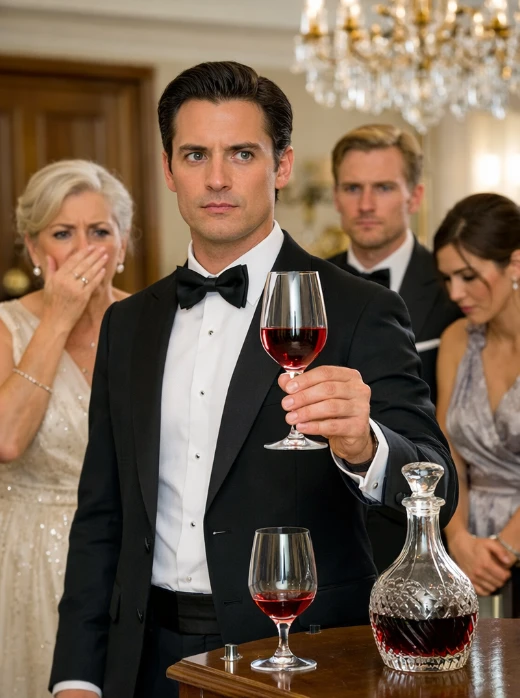
When he turned back, there was another wineglass in his hand.
He held it up.
“This,” he said, “is the glass that was poured for me.”
Confusion moved through the room like a current.
For one full second, nobody understood.
The glass in Ethan’s hand was untouched, a measure of wine still resting near the base, darker than garnet in the low light. There was no mistaking it. It had been set aside before the evening began. Prepared. Waiting.
Ethan glanced at the now-empty glass on the table, then back at the room.
“I never drink from a glass I did not pour myself,” he said.
The words hit harder than Rosa’s scream had.
A murmur went up, stunned, disoriented. A guest near the doorway frowned as if trying to rearrange the last thirty seconds into something that made sense. Julian’s smile disappeared—not all at once, but enough. Margaret stared at the second glass as though it had just invalidated the floor beneath her feet.
Ethan’s gaze moved over the faces in front of him with unnerving calm.
“You all saw me take a drink,” he said. “You assumed it was from the tray service. It wasn’t.” He lifted the untouched glass an inch higher. “This is the one that was placed for me. I set it aside before any of you arrived. I poured my own from a different bottle.”
Rosa stared at him, stunned. “Then… then you’re not—”
“Poisoned?” Ethan finished.
No one answered.
He set the untouched glass down with exquisite care.
“For years,” he said, almost conversationally, “people have made a spectacle of trusting me, betraying me, flattering me, asking me to invest, asking me to forgive, asking me to forget. The one habit I never lost was this.” He touched the stem of the glass. “I do not trust what is handed to me.”
The sentence was not loud. It did not need to be.
The room absorbed it in silence.
Julian shifted his weight. “That’s dramatic, Ethan, even for you.”
Ethan looked at him. “Is it?”
Julian spread one hand. “A maid panics. You decide to turn it into theater. Someone probably tampered with nothing. Or Rosa saw something she didn’t understand.”
Rosa flinched, but before she could speak, Ethan’s eyes moved back to her.
“Did you see who it was?” he asked.
Rosa’s lips parted. For a moment she looked too frightened to answer. Then she shook her head once. “No. I saw a hand tipping a packet into the decanter. I heard footsteps after. I hid before they came out.”
“Convenient,” Julian said.
“Enough,” Margaret snapped.
The command startled even the guests who had no stake in the family. Margaret’s composure had thinned; it showed now at the edges of her mouth, in the strain around her eyes. She was elegant even frightened, which made the fear sharper somehow. She crossed to the sideboard and put both hands on its edge, steadying herself.
“No one leaves,” she said. “Not yet.”
Avery made a small sound from beside the piano.
Until then, she had been nearly invisible, swallowed by the greater force of the others. Ethan’s younger sister had always been like that in crowded rooms—present but withdrawn, graceful but slightly removed, as if some part of her remained outside whatever scene she occupied. Tonight she wore silver-gray silk and a diamond bracelet she kept touching with restless fingers. Her face was too composed, the way fragile surfaces often were before they broke.
“No one leaves?” one of the guests echoed nervously.
Margaret turned toward the assembled circle. “I’m sorry. I understand what this looks like. But if Rosa is telling the truth, then someone attempted to poison a member of my family inside this house.” Her voice almost cracked on the last word. “Until we know what happened, I will not have anyone touch another drink.”
Ethan’s eyes stayed on Rosa.
“You interrupted me at the exact moment the glass touched my mouth,” he said. “Why?”
“Because I thought I was too late,” Rosa said, and now the panic in her seemed too raw to be manufactured. “I saw you lift it from across the room. I thought if I didn’t scream, you’d swallow it.”
“You’re sure it was the decanter in the study?”
“Yes.”
“You told no one before this?”
“I tried to find Mrs. Vale, but the guests had already been called in and I—” She swallowed. “I didn’t know what to do.”
Julian laughed once under his breath. “So instead you wait for the most theatrical second possible.”
Rosa’s head snapped toward him, startled by the cruelty in his tone.
Ethan noticed. Ethan noticed everything.
He turned, slowly now, and set his hand on the back of a chair. “You seem very committed to the idea that she is lying.”
Julian’s smile returned, thinner than before. “I’m committed to not letting panic be mistaken for truth.”
Margaret drew in a breath. “Julian.”
“No, say it,” Ethan said. “Go on.”
Julian met his gaze. “I’m saying this room is full of people who know exactly how much you enjoy suspicion. A whispered threat, a poisoned toast, the noble act of self-pouring your own drink.” His eyes flicked to the untouched glass. “It’s almost too fitting.”
For a moment Ethan said nothing.
The silence stretched.
Then he smiled.
It was not a warm smile. It was the kind that made the guests begin to understand they were no longer attending a celebration. They were standing inside an autopsy.
“You think I staged this?” Ethan asked.
“I think you mistrust everyone so completely that you’d be capable of humiliating an innocent girl to prove a point.”
Rosa recoiled as if struck.
Margaret stepped forward. “Julian, stop.”
But Ethan was no longer looking at him. He was looking at Margaret.
And the shift was so sudden, so subtle, that only a few people noticed it immediately.
“Were you aware,” Ethan asked softly, “that Rosa was watching the study?”
Margaret went still.
Julian’s expression altered a fraction too late.
Avery looked from one face to the other, confused, then afraid.
Rosa’s hand tightened against the doorframe.
Margaret did not answer.
Ethan waited.
One second. Two. Three.
The air changed.
“What exactly are you asking me?” Margaret said at last.
Ethan’s gaze did not move. “I’m asking whether Rosa was in that hallway by chance. Or because someone told her to be.”
Rosa’s eyes flew to Margaret.
The room noticed.
And just like that, suspicion widened, then pivoted.
Julian straightened. “This is absurd.”
“Is it?” Ethan said.
The old rhythm of the evening had broken beyond repair. Guests looked at one another not as companions now, but as witnesses—calculating what they had seen, what they might later have to recount, whether they were standing too close to disaster to leave clean.
Margaret lifted her chin. “I told Rosa to keep an eye on the decanter.”
The confession landed with a strange flatness, almost too calm after so much tension.
Julian turned to her. “Margaret—”
She ignored him.
“I noticed this afternoon that one of the cellar logs didn’t match the bottle brought up for tonight,” she said. “It could have been nothing. A clerical mistake. A switch by the staff. But this house has not been… steady lately.” Her eyes flicked to Ethan, then away. “I didn’t want to embarrass anyone. I told Rosa to watch the study when the bottles were moved.”
“Embarrass anyone,” Ethan repeated.
“Do not do this,” Julian murmured, warning threaded beneath the words.
Ethan’s head turned toward him. “Do what?”
Julian’s calm began to crack. “You’ve had your performance. Enough.”
“My performance?” Ethan said. “My mother just admitted she had one of the staff spying on the wine in my own house.”
“Our house,” Margaret said sharply.
A dangerous quiet followed that.
Ethan stared at her for a moment, and when he spoke again, his voice was lower.
“No,” he said. “Not in any way that matters.”
Avery closed her eyes briefly, as if the line had wounded her in a familiar place. It was the kind of exchange that made outsiders realize there were older fractures beneath the current crisis, hairline cracks running through polished family portraits and inherited furniture and every annual gathering where everyone smiled too carefully.
Margaret’s face hardened, but her hands had begun to shake. “I told Rosa to watch because I was worried.”
“About whom?” Ethan asked.
She hesitated.
Julian stepped in. “This is insane. We need the bottle tested. That is all. Not a family tribunal in front of half the city.”
Ethan’s gaze returned to him.
Something colder entered the room.
“No,” Ethan said. “Now I’m interested.”
Julian took a step forward. “Interested in what?”
“In why you are losing your composure before anyone has accused you.”
Julian’s jaw tightened. “I’m losing patience, not composure.”
“Close enough.”
The guests were no longer trying to hide their discomfort. Two of them edged toward the door. One elderly donor sat down abruptly as if his legs no longer trusted him. Another whispered to her husband, but he didn’t answer. Everyone understood, with increasing dread, that whatever began with a scream about poisoned wine had slid into something more private and more lethal than scandal.
Ethan walked to the sideboard and lifted the decanter by its neck.
The deep red wine inside rolled against the cut glass.
“This,” he said, “is what Rosa says was tampered with.”
No one contradicted him.
He examined the decanter in the light, turning it slightly. “Do you know what I find most interesting about rituals?” he said. “People stop seeing them. The repetition numbs them. A gesture can happen a hundred times in front of witnesses and still go unnoticed.”
Margaret stared at him now with growing alarm. “Ethan—”
He set the decanter down.
“When did you first suspect something?” he asked her.
“This afternoon.”
“That’s not what I asked.”
She pressed her lips together.
Avery spoke for the first time, voice thin. “What is happening?”
No one answered her.
Ethan looked at Margaret, not with anger yet, but with dawning precision. As if pieces that had floated separately in his mind were drifting toward one another and beginning, at last, to lock.
Then he asked the question that changed the shape of the room.
“Mother,” he said, “when I make a toast… when do you drink?”
Margaret’s face emptied.
Julian went very still.
Avery frowned in confusion. “What?”
Ethan barely seemed to hear her. He kept his eyes on Margaret.
“When I raise my glass,” he said, “what do you always do?”
Margaret shook her head once, almost imperceptibly, as if refusing the direction of his thoughts could stop them from arriving.
But memory had already started moving through him. It showed in his expression—not theatrical, not sudden, but terrible in its clarity. The kind of recognition that made the body go cold before the mind finished naming what it knew.
He spoke more slowly now.
“At every family dinner. Every donor gala. Every anniversary. Every year since Father died.” His voice roughened slightly at that. “I speak. I drink first. Then you drink after me.”
Avery stared.
Julian said nothing.
Ethan turned to the untouched glass that had been set aside for him and then to the decanter Rosa had named.
“From the same source,” he said.
The sentence barely made a sound. Still it seemed to crack through the room.
Margaret’s hand flew to her mouth.
Rosa looked between them, not understanding yet but sensing the edge of something vast.
Avery took one step backward. “No.”
Ethan did not look at her.
“He poisoned the glass that would be assumed to be mine,” Ethan said, the realization forming as he spoke it, becoming more monstrous with each word. “But if the wine came from the same decanter…”
He stopped.
Not because he did not know, but because he did.
The room knew too.
The silence that followed was unlike the others. Not suspense. Not confusion. A kind of dread so complete it felt reverent.
Julian’s face had lost all color.
Margaret’s eyes brimmed suddenly, violently, as if tears had been waiting for years and needed only this exact understanding to force their way out.
Avery whispered, “No, no, no…”
Ethan finally turned to Julian.
And now the power in the room shifted.
Until then, Ethan had been a man standing in suspicion, surrounded by watchers, maybe a target, maybe a manipulator, maybe both. Now he stood inside something worse: truth that had turned its head. Truth that no longer pointed toward him.
“You didn’t aim it at me,” Ethan said.
Julian did not answer.
“You knew the ritual,” Ethan went on. “You knew she always drank after me. You counted on everyone assuming the obvious target was the son who lifted the first glass.”
“Stop,” Margaret said, but there was no force left in it. Only grief.
Ethan’s voice sharpened. “You aimed it at her.”
Avery made a choking sound.
Several guests looked from Julian to Margaret with the horrified, almost ashamed attention people wore when intimate evil revealed itself too plainly to ignore. This was no longer a vague attempt on a wealthy heir. That version was easier. Cleaner. Familiar. Ambition, inheritance, business rivalry. Society knew how to discuss that over breakfast.
This was different.
This was a pattern. A ritual observed. A family habit used as a weapon.
Julian’s mouth opened, then closed. For once, charm did not arrive to save him.
Margaret began to cry.
Not delicately. Not the controlled wetness of a woman determined to remain composed in public. Her breath broke apart. She bent slightly at the waist as if the force of what she understood had struck her physically. One hand covered her face; the other reached blindly for the back of a chair and missed.
Avery rushed to catch her, but halfway there she faltered, staring at Julian with naked disbelief.
“You—” she said, then stopped because there were too many endings to the sentence.
Julian found his voice. “It isn’t what you think.”
Ethan let out one harsh, disbelieving laugh.
There was no warmth in it. No victory either. Only disgust.
“That sentence,” Ethan said, “is almost never said by innocent men.”
Julian’s eyes flashed. “You want a monster because it gives shape to everything you already hate about this family.”
“No,” Ethan said. “I already had shape. You’ve merely filled it.”
“Ethan,” Margaret whispered, but whether she meant to stop him or beg him or apologize, even she may not have known.
Rosa stood frozen by the doorway, tears in her own eyes now, as though she understood she had not just prevented a death but uncovered something much older and darker than poison in a decanter.
Avery finally looked at her mother. “Did you know?” she asked.
Margaret’s head snapped up. “No.”
The answer came instantly, fiercely, wounded to the bone.
“No,” she said again. “God, Avery, no.”
Avery’s expression collapsed anyway, because sometimes innocence in the specific does nothing to erase guilt in the general. Families did not arrive at a moment like this by accident. They built toward it, brick by brick, silence by silence, every compromise laid so carefully it almost passed for love.
Julian took a slow breath, trying to steady himself back into control. “We do not know what was in that decanter.”
“No,” Ethan said. “But you know.”
Julian’s jaw flexed.
Ethan stepped closer.
The room reacted to the movement like prey to weather. Even those who did not know the family history felt something violent and old rising under Ethan’s restraint. Not the violence of fists. The violence of certainty.
“You watched her drink after me for years,” Ethan said. “You smiled through it. You toasted with us. You learned the order.” His gaze hardened. “That is not impulse. That is study.”
Julian tried to hold his stare and failed first by the slightest margin.
Margaret saw it.
The sound she made then was almost worse than the crying. Small. Broken. Final.
Julian turned to her. “Margaret—”
“Don’t,” she said.
It was barely audible, but the force of revulsion in it was unmistakable.
He took a step toward her. She stepped back at once.
The distance between them became a verdict.
Avery looked as if she might be sick. “Why?” she asked.
Julian said nothing.
“Why?” she repeated, louder, and now every guest in the room seemed to hold still not from politeness but from compulsion, as if human beings were built to witness confession when it finally cornered someone. “Was it money? Was it revenge? What was it?”
Julian laughed once, a shattered sound. “You think families like yours leave room for simple motives?”
Ethan’s face changed again at the phrase families like yours. A tiny thing. But noticeable.
Julian saw that and went on, maybe because collapse sometimes makes men reckless, maybe because he understood that denial had already failed.
“I was never one of you,” he said. “Not really. Invited in, used when convenient, smiled at when useful, tolerated when silent.” His eyes moved to Margaret. “Do you know what this house is built on? Performance. Ritual. Loyalty spoken aloud and withheld in private.”
“Do not turn this into philosophy,” Ethan said. “Answer her.”
Julian’s mouth tightened.
Then, softly, he did.
“I was tired of living in orbit around decisions made long before I entered the room.”
It was not enough. Everyone knew it was not enough. Motive dripped through the sentence without cleaning it. Resentment. Ambition. Injury. Entitlement. Maybe all of them. Maybe more. The precise shape of evil mattered less now than the fact that it had sat at their table, glass in hand, learning where the vulnerabilities were.
Margaret closed her eyes. Tears slid under her fingers.
Avery stared at Julian as if the person in front of her had been replaced while she wasn’t looking. “You were going to kill her.”
Julian did not answer.
And that silence was answer enough.
One of the guests near the doorway turned away. Another quietly ushered his wife farther back as if proximity itself had become contamination.
Ethan inhaled once through his nose. He did not look triumphant. He looked exhausted in a way that made him older. Like a man who had found exactly what he was looking for and hated its face.
He glanced at the room.
The guests.
The flowers.
The polished silver.
The remnants of celebration.
Then back at his mother, who was crying openly now, one hand pressed to her chest, Avery beside her but not touching her, as though touch itself had become complicated.
Rosa was the only person still looking at Ethan not with fear or scandal but with something closer to grief. She had screamed to save him. Instead she had exposed a truth that reached past him.
He noticed that too.
“You did the right thing,” he told her.
Rosa shook her head helplessly, tears falling now. “I didn’t know.”
“Neither did I.”
That, more than anything, seemed to break the room.
Because Ethan said it without armor.
No sarcasm. No cold edge. No control. Just truth.
Neither did I.
Margaret began sobbing in earnest.
Avery’s face crumpled. She turned away from Julian entirely, one hand covering her mouth. Whatever remained of the evening’s social decorum collapsed then. The guests no longer needed permission. One by one, quietly at first and then in a subdued stream, they began moving toward the door, murmuring apologies no one heard, gathering wraps, touching elbows, refusing to make eye contact with the center of the room as if doing so would implicate them in having seen too much.
No one stopped them.
No one cared.
The quartet in the gallery had resumed at some point, unaware, and the faint music drifting under the door felt obscene now—too elegant, too polished, as if another world still existed beyond this room, still believed in sequence and beauty and endings that could be managed.
Within minutes the reception chamber emptied itself of spectators.
Servants vanished discreetly.
Donors slipped out.
Associates disappeared into hallways and winter coats and waiting cars.
The great room that had glowed with people moments before seemed suddenly much larger, cruelly so. Empty glasses remained on side tables. Napkins sat folded beside untouched appetizers. Candlelight trembled across polished wood and marble and gold leaf, all of it useless against what had been revealed.
Only four people remained in the center of the room.
Ethan.
Margaret.
Julian.
Avery.
Rosa stood at the threshold until Margaret looked up through tears and gave the smallest possible nod, a wordless instruction to leave. Rosa hesitated, looked once more at Ethan, then went, closing the door softly behind her.
The click of the latch sounded final.
For several seconds no one spoke.
Julian stood near the mantel where his confidence had begun the night. Without the audience, without the smooth current of conversation and status and public masks, he looked abruptly ordinary. Smaller. Not harmless—never that—but reduced to the bare architecture of a man who had believed calculation would save him.
Margaret sat at last, not gracefully but because her legs seemed unable to continue the argument with gravity. Her mascara had blurred. Her shoulders shook intermittently though she no longer made a sound. Avery remained standing behind her, one hand on the chair back, eyes red, face emptied by shock.
Ethan remained upright.
He had not sat once.
He was staring at the decanter.
There was something terrible in that stare—not only accusation toward Julian, not only horror for Margaret, but something inward-facing, something beginning to bend back toward himself.
Avery saw it first.
“Ethan,” she said carefully.
He didn’t answer.
“Ethan.”
Still nothing.
Then he spoke, but not to either of them.
“I thought,” he said, “that mistrust was the one thing that kept me alive.”
His voice was quiet enough that the chandeliers’ faint electric hum almost obscured it.
Margaret lifted her head.
Ethan finally looked at her.
In his face was no simple anger now. That would have been easier for all of them. Anger had direction. Anger could accuse. This was heavier. A realization so cruel it had hollowed him in real time.
“All these years,” he said, “I believed the danger would come for me first.”
Margaret’s eyes filled again.
“You built your life that way,” she whispered. It was not defensive. It sounded like apology dragged over glass. “After your father—”
“After Father,” Ethan said, “I learned to check doors, bottles, signatures, promises, intentions.” His gaze slid briefly to Julian, then away. “I learned the wrong lesson.”
Avery’s hand tightened on the chair.
“No,” she said softly. “You learned the necessary one.”
He looked at her then, and she saw in his expression that he loved her for trying and could not be saved by it.
“That’s the problem,” he said.
Silence settled again.
Margaret stood slowly, unsteady now, and crossed the space between them as if approaching an injured animal she feared might recoil. “Ethan…”
He did not step back, but he did not move toward her either.
Her hand lifted, hovered near his sleeve, then fell.
“I am sorry,” she said.
Those three words were too small for the room.
Too small for the years inside them.
Too small for the rituals, the formal dinners, the loyalty performances, the unspoken resentments, the woman who always drank second because habit made her vulnerable, the son who believed caution made him untouchable, the daughter who had stood in rooms like this too many times pretending fracture was sophistication, the outsider who had watched and learned and weaponized intimacy.
Still, they were all she had.
Ethan looked at her with an expression so worn it might once have been tenderness.
“I know,” he said.
But it did not repair anything.
Julian laughed faintly, bitterly, from across the room. “How moving.”
Avery turned on him with a violence none of them had seen in her before. “Shut up.”
He stared at her, maybe startled because gentleness angered at last could look more merciless than fury born easy.
“I mean it,” Avery said. “Whatever story you’ve told yourself, whatever injury you worshipped long enough to justify this—shut up.”
Julian’s eyes flicked to Margaret, then Ethan, then back to Avery. No ally remained. Even explanation had lost its audience.
For the first time all night, he looked afraid.
Not of exposure. That had already happened.
Of irrelevance.
Of becoming, finally, no one.
Ethan turned away from him.
That, more than accusation, seemed to diminish Julian completely.
The decanter still sat between them on the table, half-full, beautiful, monstrous in its ordinary elegance. Ethan stared at it as if it contained not liquid but a map of everything he had failed to understand.
“When I was younger,” he said, almost to himself, “I used to think control was the closest thing to safety. If I checked enough, knew enough, anticipated enough, then whatever had happened to this family before me would stop with me.”
Margaret’s face twisted.
Avery began to cry quietly.
Ethan’s gaze remained fixed on the wine.
“But I was only watching for the blade aimed straight ahead.”
He let out a breath that sounded like something inside him giving way.
“When the danger came,” he said, “it moved through the ritual. Through the thing I thought I understood.”
Margaret covered her mouth.
Julian said nothing.
Outside, somewhere far down the corridor, a door shut. The house settled around them with old wood sounds and muffled footsteps and the faint winter wind against the windows. The world had not ended. It had only narrowed to the size of this room and these four people inside it.
Avery came around the chair at last and stood beside her mother. Not embracing her. Not yet. But close enough to say the bond remained, though altered, though scorched.
Julian stayed where he was, excluded by more than distance.
Ethan remained by the table, one hand resting lightly beside the untouched glass that had never been his real glass at all. A prop in a misunderstanding. A symbol in the wrong story. The false center around which the room had first arranged its fear.
He looked at it for a long time.
Then he lifted his eyes to Margaret.
And when he spoke, his voice was almost steady again, which made the words worse.
“The thing I could control,” he said, “was the very thing that killed my own family.”
The room went still around the sentence.
Not because it was the end.
Because it was true.
