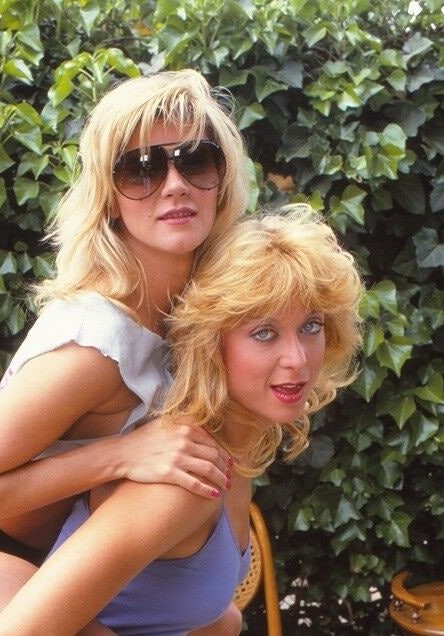
They weren’t just stars of the ‘80s — they were rewriting the rules behind the scenes. But no one knew what was really happening off-camera…

The 1980s are often remembered for excess—the neon lights, the booming music videos, the rise of larger-than-life stars in every arena.
But for the world of adult cinema, it was something more: a golden age, a period when the industry wasn’t yet relegated to the shadows of the internet but was instead brushing shoulders with Hollywood, mainstream pop culture, and the national conversation about sexuality.
Out of this era, two women rose not just as stars but as pioneers—Ginger Lynn and Nina Hartley. They were vastly different in style and approach, yet together, they helped change how audiences, critics, and even the broader culture thought about women in the adult industry.
When Ginger Lynn burst onto the scene in the early 1980s, she didn’t look like a revolutionary. With her blonde hair, wholesome smile, and magnetic warmth, she carried the charm of someone familiar—your high school crush, the friendly neighbor, the girl-next-door.
That very relatability, paired with her natural charisma, set her apart in an industry that often leaned on fantasy archetypes that felt distant and unattainable. But Lynn’s appeal wasn’t simply surface-level.
What she brought to her performances was a certain vulnerability and emotional depth that few expected to find on the adult screen. At a time when women were often reduced to stereotypes,
Lynn infused her work with humor, humanity, and authenticity. Audiences noticed. Very quickly, she became one of the most in-demand performers of the era, a name recognized even outside the insular world of adult cinema.
Her success, however, wasn’t just about popularity. Lynn made bold moves that challenged the boundaries between the adult industry and Hollywood. She transitioned into B-movies and cult thrillers, appearing in films such as
Vice Academy and Young Guns II.
These projects didn’t erase her adult career—they expanded it, allowing her to step into mainstream entertainment at a time when the stigma surrounding adult performers was nearly insurmountable.
For many, she became the first adult star to be taken seriously as a pop culture figure. By the late 1980s, Lynn was more than a performer; she was a brand, a personality, and a cultural touchstone.
Her crossover success hinted at what was possible for adult stars—visibility, agency, and legitimacy beyond the confines of the industry.
If Ginger Lynn was the approachable superstar, Nina Hartley was the intellectual provocateur. Long before she ever set foot in front of a camera, Hartley was a registered nurse.
She brought to the industry not just beauty and presence but a deeply analytical mind and a desire to shift the way people understood sexuality. When Hartley entered the adult scene in 1984, she quickly distinguished herself not just with her performances but with her philosophy.
She viewed her work as both personal expression and public service, pushing back against the shame and stigma that had long surrounded conversations about sex.
She radiated confidence, and her presence on-screen carried an unmistakable clarity: she was in control of her choices, and she wanted others to feel empowered by theirs.
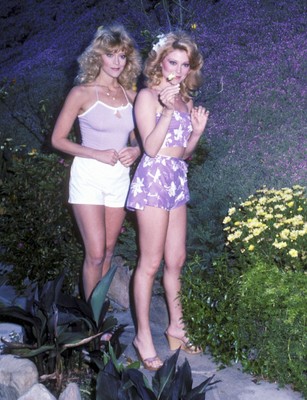
What truly made Hartley a trailblazer, however, was her life off-screen. She became one of the earliest and most outspoken advocates for sexual education within and beyond the industry.
Through books, lectures, and appearances on talk shows, she worked to normalize conversations around consent, communication, and pleasure. She insisted that knowledge was power—and that pleasure was nothing to apologize for.
In doing so, Hartley blurred lines of her own, moving fluidly between adult entertainment, academia, and activism. She proved that an adult performer could also be a public intellectual, an advocate, and an educator. Her voice carried weight not just because of her fame, but because of her conviction.
On the surface, Ginger Lynn and Nina Hartley could not have been more different. Lynn embodied the mainstream glamour and crossover stardom of the golden age, while Hartley represented its intellectual and activist undercurrent.
Yet both women shared something vital: a refusal to be flattened into caricatures. At a time when women in adult cinema were often dismissed, objectified, or forgotten, Lynn and Hartley stood out as multidimensional figures.
Lynn showed that vulnerability and emotional truth had a place in adult performance, while Hartley demonstrated that intelligence, advocacy, and education could grow out of the industry itself.

Perhaps most importantly, their careers overlapped in a way that symbolized a larger cultural shift. The 1980s were a decade of contradictions—public conservatism clashing with private indulgence, censorship battles raging even as adult films gained popularity.
In that climate, Lynn and Hartley became symbols of resistance, not through loud rebellion but through steady authenticity. Their friendship and mutual respect off-screen only reinforced this.
Both women, in their own ways, demanded control of their narratives. They reminded the world—and the industry—that performers were not just commodities, but people with agency, intellect, and the right to shape their own destinies.
Decades later, the adult industry has changed dramatically, shaped by technology, shifting cultural norms, and ongoing debates about representation and ethics. Yet the legacies of Ginger Lynn and Nina Hartley remain.
Lynn is remembered as one of the first true superstars of adult cinema, a woman who crossed over into mainstream visibility and refused to be boxed in. Hartley continues to be a powerful voice in sex education and advocacy, her books, lectures, and interviews still guiding conversations about consent and empowerment.
%E2%98%851997Nina_Hartley__Ginger_Lynn(Porn_Actress_from_Boogie_Nights)_%E3%80%8EPoster%E3%80%8F.JPG?type=w800)
What unites them across time is not simply fame, but influence. They both stood against the reduction of women to one-dimensional roles, whether in film or in culture at large.
They modeled authenticity, resilience, and courage in industries—and eras—that often left little room for such qualities. In the end, the story of Ginger Lynn and Nina Hartley is bigger than adult cinema.
It’s about two women who claimed their space, demanded respect, and turned careers that could have been fleeting into legacies that endure. In a culture that so often flattens or forgets its icons, they remain pioneers—multifaceted, unforgettable, and still shaping the conversation today.
She lit up comedies, haunted horrors, and left two Bonds shaken.
She lit up comedies, haunted horrors, and even left not one but two James Bonds shaken. With a voice like velvet, a statuesque presence, and a gaze that seemed to hold a thousand secrets, Valerie Leon became one of those rare figures in British cinema that everyone recognized—even if they didn’t always know her name. Her career, spanning from the mid-1960s into the 1980s, reflects not just the vibrancy of postwar British entertainment, but also the enduring appeal of performers who move gracefully between genres.
Born in London in 1943, Valerie Leon grew up in an era when the British film and television industry was experiencing enormous change. After leaving school, she trained as a stage performer and worked in the legendary chorus lines of London’s West End. Her tall frame—standing nearly six feet—and natural elegance made her stand out on stage. She radiated charisma, the kind of magnetic quality that often made casting directors take notice.
It didn’t take long for Leon to transition from chorus girl to screen actress. By the mid-1960s, she was appearing in films and on television, at first in smaller parts but always with an undeniable presence. One of her earliest notable breaks came when she was cast in the Carry On comedies, the hugely popular British film series known for its cheeky humor and innuendo.
She appeared in several of them, including Carry On Camping (1969) and Carry On Up the Jungle (1970). Her statuesque figure often made her the subject of the films’ playful jokes, but Leon distinguished herself with her own brand of charm and wit. She wasn’t just there to be looked at—she had timing, a sense of fun, and a light touch that made her roles memorable.

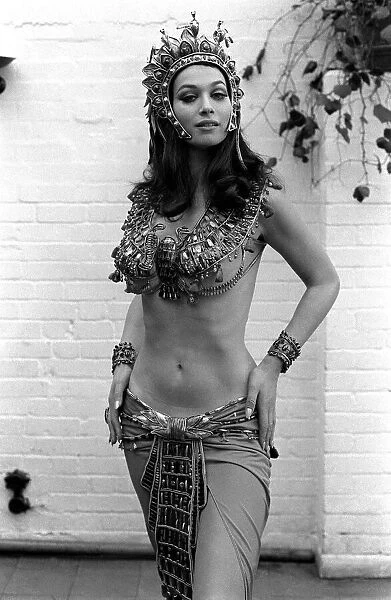
But Valerie Leon was never content to be confined to comedy. The 1970s opened the door to more dramatic opportunities, especially in horror, a genre then dominated by Britain’s Hammer Film Productions. Leon’s most famous horror appearance came in Blood from the Mummy’s Tomb (1971), a Hammer adaptation of Bram Stoker’s novel The Jewel of Seven Stars. In the film, Leon played a double role: the ancient Egyptian queen Tera, and Margaret Fuchs, her modern-day reincarnation.
The role demanded that she project both icy menace and modern vulnerability, and Leon delivered a performance that has since become legendary among Hammer fans. Her haunting beauty and commanding screen presence gave the film an enduring cult reputation, and many consider it one of the studio’s more unusual yet fascinating entries.
While horror and comedy made her a household face in Britain, Valerie Leon also achieved a rare distinction in global cinema: she appeared in two James Bond films, a feat few actresses can claim. She first appeared in You Only Live Twice (1967), and later returned in The Spy Who Loved Me (1977).
Though her roles were relatively brief, they left an impression. In a franchise famous for its glamorous female stars, Leon’s appearances stood out for their poise and sophistication. For fans, she remains one of the actresses who helped define the atmosphere of Bond’s cinematic universe.

Outside of film, Leon also became a cultural icon through television and advertising. Perhaps most memorably, she was the face of the Hai Karate aftershave commercials, a campaign that became wildly popular in the 1970s.
These commercials, humorous and slightly absurd, leaned heavily on Leon’s glamour and ability to play comedy with a straight face. For audiences of the era, she wasn’t just a film actress—she was part of the everyday entertainment landscape, instantly recognizable even to those who might never have seen her on the big screen.
What makes Valerie Leon’s career particularly fascinating is her versatility. While some performers of her generation became typecast, Leon moved freely between comedy, horror, action, and advertising, all without losing her unique identity. She managed to bring dignity and individuality to roles that might have been purely decorative in the hands of others. Her deep voice, regal bearing, and unforced confidence made her unforgettable.
By the 1980s, Leon had slowed down her screen career, but she remained active in theater and made guest appearances on British television. She also became a beloved figure at film conventions and retrospectives, especially those devoted to Hammer Horror and James Bond. Fans who meet her today often remark on her warmth, humor, and willingness to share stories from her extraordinary career.
Her legacy is one of quiet resilience. In a male-dominated industry, she built a body of work that endures because she never underestimated her audience. Whether playing a glamorous comic foil, a resurrected Egyptian queen, or a fleeting yet unforgettable Bond girl, Leon treated each role with professionalism and care. That dedication helped her carve out a space as a cult favorite, celebrated not just for her looks but for her talent and presence.

Valerie Leon represents a golden era of British film, when studios like Hammer were creating atmospheric horrors, the Carry On team was making audiences laugh, and James Bond was redefining global cinema. She managed to be part of all three worlds, leaving behind performances that remain fresh and captivating today.
Looking back, it’s clear that Leon never needed to shout to be remembered. She didn’t chase stardom aggressively, nor did she dominate headlines with scandal. Instead, she built a career on presence, grace, and adaptability.
That, perhaps, is why she has endured as a cult icon. Fans continue to rediscover her films, new generations encounter her through Bond marathons or Hammer box sets, and her face still brings a smile of recognition to those who grew up seeing her everywhere—from the big screen to their televisions at home.
Valerie Leon lit up comedies, haunted horrors, and twice brushed shoulders with James Bond. She became unforgettable not by trying too hard, but simply by being herself: striking, witty, and unshakably memorable. For that, she remains one of British cinema’s most cherished cult stars, a reminder that true presence never fades.
