The moment before the myth: Marilyn Monroe, 20 years old and still unknown

In 1946, a 20-year-old woman named Norma Jeane Dougherty stood at a quiet threshold. She wasn’t yet Marilyn Monroe—the Hollywood icon, the global sex symbol, the enduring cultural myth.
She was still Norma Jeane: shy yet ambitious, shaped by hardship yet lit with the fragile hope of reinvention. And that year, everything began to change.

It was a pivotal chapter in her life. Norma Jeane signed her first film contract with 20th Century Fox, a deal that promised both opportunity and uncertainty. At the urging of the studio, she dyed her naturally auburn-brown hair into the platinum blonde that would become her trademark.
And, crucially, she abandoned her married name, Dougherty, and adopted a new identity: Marilyn Monroe. The first name came from Broadway star Marilyn Miller, the last from her mother’s maiden name. It was an invention—strategic, deliberate, and fated to become one of the most recognizable names in the world.
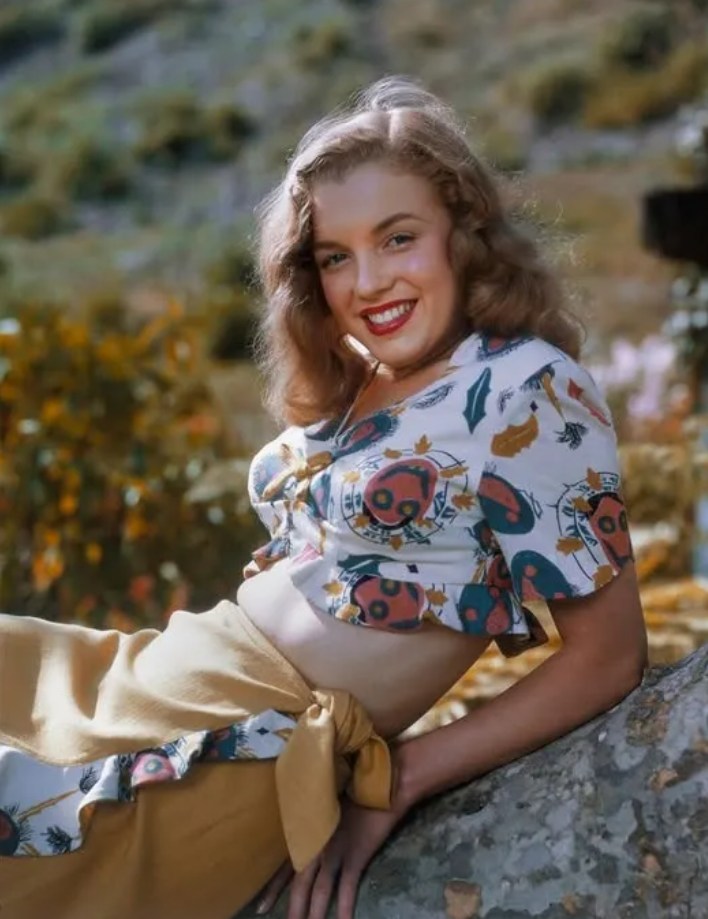
Photographer Richard C. Miller was among the earliest to capture this metamorphosis. His photographs from 1946 don’t yet show the polished goddess of the silver screen. Instead, they reveal a young woman balancing between two worlds: the innocence of Norma Jeane and the allure of Marilyn.
In these images, she wears simple dresses, sometimes even swimsuits, her hair newly lightened but her expressions unguarded. She laughs easily, with a kind of open warmth that would later be concealed by layers of performance and expectation.
What’s striking in Miller’s photographs is not glamour but becoming. Her eyes still hold a touch of the uncertainty of a girl raised in foster homes, shuffled between relatives, longing for a family that never truly held together.

But behind that uncertainty is something else—a flicker of determination, the fragile but insistent belief that she was meant for more.
These photos are rare not because of their scarcity but because of what they preserve: Marilyn Monroe before the myth. Before the studio machine shaped her into a fantasy.
Before magazines printed her every move. Before men projected their desires and women their critiques. In Miller’s lens, she is still Norma Jeane in transition, not yet encased in the diamonds and gowns that would both elevate and imprison her.

The transformation of 1946 was more than cosmetic. It was survival. Norma Jeane had grown up with instability: a mother struggling with mental illness, a childhood spent moving through foster homes, and a teenage marriage that seemed more like escape than romance.
Hollywood wasn’t simply a dream. It was a lifeline—a chance to rewrite a story that had been, until then, defined by loss and displacement.
When she signed her contract with 20th Century Fox, there was no guarantee of success. She started small, with bit parts and fleeting appearances on screen. The studio wasn’t yet sure what to do with her.
But Norma Jeane—now Marilyn—was relentless. She studied acting, practiced her poses, refined her voice. Every audition, every photoshoot, was an opportunity to carve out space for herself in an industry that chewed through starlets as quickly as it created them.

The year 1946 is often remembered as the beginning of her career, but in truth, it was also the last breath of her anonymity. Soon she would no longer belong to herself.
Fame, once it found her, would follow with the devotion of worship and the cruelty of surveillance. Within just a few years, she would become one of the most photographed women in the world, her face plastered across billboards, magazines, and newsreels. Everyone would know her name. Very few would know her.

That’s why Miller’s photographs matter so deeply. They freeze a moment when Marilyn Monroe was still human-sized, not yet inflated into myth.
She wasn’t the tragic figure of later years, nor the untouchable star of the early ’50s. She was simply a young woman daring to believe in the possibility of a different life.
Look closely at those photos and you see more than beauty. You see ambition, flickering confidence, and the trace of vulnerability that would later make her so magnetic on screen.
Marilyn’s gift, even in her earliest roles, wasn’t just her appearance. It was the way she carried both strength and fragility in the same breath. That paradox—innocence wrapped in allure, vulnerability cloaked in radiance—was already present in 1946, even if the world hadn’t yet learned how to name it.

In the decades since, Marilyn Monroe has become less a person than a symbol: of sex, of fame, of tragedy, of Hollywood’s golden age and its merciless cost.
But if we peel back the layers of legend, we return to 1946, to the moment of origin, when a 20-year-old woman stood on the threshold of reinvention.
It’s tempting to look at these photographs as foreshadowing—evidence that Marilyn was destined for greatness, that the spark was always there. And maybe that’s true.
But they also remind us that she wasn’t born a myth. She became one, and that becoming came at a price.

Within a decade, she would star in Gentlemen Prefer Blondes, The Seven Year Itch, and Some Like It Hot, films that cemented her as the quintessential screen goddess.
Yet even then, she remained haunted by the same hunger and fragility visible in Miller’s early portraits. Fame gave her power, but it also trapped her inside a persona that was never fully her own.
The Norma Jeane we glimpse in 1946—playful, uncertain, radiant without armor—is the version of Marilyn Monroe the world rarely saw again. It’s a reminder that behind the diamonds and the legends was a woman who began as a girl with restless dreams.

The year 1946 did more than mark the beginning of a career. It captured the fragile moment before. Before the fame. Before the myth. Before the world turned Norma Jeane into Marilyn Monroe.
Through Richard C. Miller’s lens, we see not just an icon in the making, but a young woman daring to step into her own light. These photographs don’t just show us Marilyn Monroe. They show us the spark before the blaze.