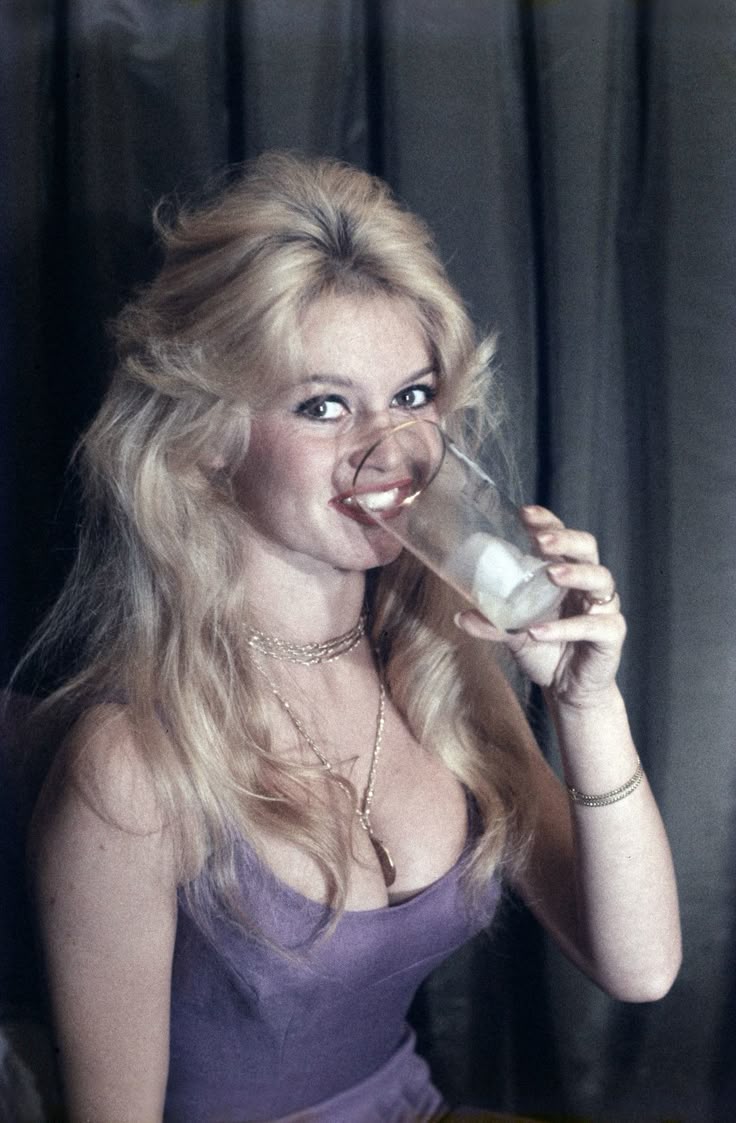
In 1958, one scene, one woman, and one glance changed the image of cinema forever

In 1958, Brigitte Bardot wasn’t simply another actress on the rise—she was a cultural shift in motion. France, still shaking off the dust and shadows of World War II, was redefining itself in the modern era.
The old rules of tradition and restraint were loosening, and in their place, a new spirit of rebellion, individuality, and sensual freedom was taking hold. At the very center of this transformation stood Bardot, a young woman whose very presence on screen felt like both a provocation and a promise.
With her tousled blonde hair, her enigmatic gaze that could turn from playful to defiant in a heartbeat, and a sensuality that felt unstudied and entirely her own, Bardot embodied something the world had not yet seen so vividly on screen. She was natural yet magnetic, raw yet poised. She didn’t just perform—she seemed to live, in front of the camera, with a spontaneity that made audiences lean forward as though they were watching not a character, but a revolution taking shape in human form.
Her breakout role in And God Created Woman (1956) had already ignited sparks. The film was scandalous for its time, telling the story of Juliette, a young woman whose sexuality and independence unsettled the men around her and challenged conventional morality.
For Bardot, the role was perfectly matched. She wasn’t portraying liberation—she was liberation, breathing it into every glance, every line, every gesture. By 1958, the film’s ripple effects had reached far beyond France.
Bardot was no longer just a rising actress; she was an international symbol of change, a face and figure that carried with it a new philosophy about femininity, freedom, and the power of authenticity.
What set Bardot apart from other actresses of the era was her rejection of carefully curated Hollywood glamour.
Stars like Grace Kelly and Audrey Hepburn embodied elegance, refinement, and poise, all tightly packaged by studio systems that controlled their images down to the last detail.
Bardot represented the opposite: she was unpolished, instinctive, unpredictable. Her appeal came not from perfection, but from her refusal to hide imperfection. She was modern womanhood in motion—vulnerable, sensual, and rebellious all at once.

This instinctive quality aligned her with the spirit of the French New Wave, which was beginning to emerge in the late 1950s. The New Wave rejected the stiff, formulaic conventions of mainstream cinema in favor of realism, freedom of movement, and emotional honesty.
Bardot, though not always directly tied to the movement, embodied its essence. Her presence felt unscripted, alive, and deeply personal. In her, audiences found not just a performer, but a reflection of their own desires for authenticity in a world that was rapidly changing.
By 1958, Bardot’s influence had transcended cinema. She had become a global fashion muse, shaping the way women dressed and carried themselves. Her off-screen wardrobe reflected the same instinctive rebellion as her film roles.
Gone were the heavily constructed gowns and polished coiffures of Hollywood’s leading ladies. Instead, Bardot favored breezy silhouettes, capri pants, off-the-shoulder tops, and ballet flats.
She popularized the bikini, transforming it from scandal to mainstream, and made tousled, natural hair the epitome of chic. Women across Europe and America emulated her effortless style, while men idolized her as the embodiment of modern allure.

But it wasn’t just about clothes. Bardot’s fashion was an extension of her philosophy: comfort over constraint, individuality over conformity.
She gave women permission to embrace ease, sensuality, and natural beauty without apology. In doing so, she redefined not just the aesthetics of femininity, but the very idea of how women could inhabit their identities.
Of course, such a meteoric rise was not without controversy. In conservative circles, Bardot was accused of undermining morality, of embodying decadence, of representing everything that was “wrong” with modern society.
Critics saw her as a threat, a destabilizing force who blurred the lines between art and provocation.
But for every critic, there were thousands of admirers—women who felt inspired, men who felt captivated, and a younger generation who saw in Bardot the embodiment of their own unspoken restlessness.
In truth, the Bardot phenomenon was never just about one woman. It was about the broader cultural conversation she sparked.
She became a canvas onto which society projected its anxieties and its aspirations: freedom versus control, authenticity versus artifice, rebellion versus tradition.
In Bardot, people saw the possibility of a new kind of woman—one who could be both sensual and self-possessed, both an object of desire and a subject of her own destiny.

What makes 1958 particularly significant in Bardot’s journey is that it crystallized her transformation from star to symbol. The initial shock of And God Created Woman had subsided, but the aftershocks were still being felt.
By then, Bardot had moved beyond being a promising actress into becoming a living emblem of an era. France embraced her as both a source of national pride and controversy, while the international press couldn’t resist her story.
Photographers pursued her relentlessly, eager to capture every glimpse of this woman who seemed to embody not just glamour, but a new way of being.
And Bardot, for her part, never seemed interested in carefully managing her image. She resisted being molded, resisted being told what to say or how to behave. Her authenticity, sometimes messy, sometimes confrontational, only deepened the fascination.
She wasn’t an actress who played by the rules; she was a woman who rewrote them.

Her influence spread into music, fashion, art, and even politics. Bardot became shorthand for a kind of youthful, liberated Europe, a counterpoint to the conservative order that had dominated much of the continent before and after the war.
She was, in many ways, the face of a new generation—one that valued freedom, individuality, and authenticity over tradition and restraint.
Looking back, it’s clear that Bardot’s image in 1958 represented more than stardom. It represented possibility. She showed that femininity could be bold, natural, imperfect, and still utterly magnetic.
She showed that a woman could command attention without conforming, could inspire desire without surrendering agency, could become an icon not by playing a part, but by being unapologetically herself.
Even today, the photographs and films from that era carry an electric charge. Bardot walking barefoot on the beach, her hair tousled by the wind, her expression both carefree and defiant.
Bardot in a simple striped top, transforming everyday fashion into a global statement. Bardot looking directly into the camera, daring it to look back without blinking.
These images endure not because they are nostalgic relics, but because they continue to resonate with truths that feel timeless.
The cultural revolution that Bardot helped to spark went far beyond her own career. It paved the way for later icons of independence and sensuality, from Jane Birkin to Madonna to countless contemporary figures who continue to grapple with the balance between authenticity and image.
In many ways, Bardot was one of the first true modern celebrities—both adored and criticized, both celebrated and scrutinized, yet always undeniably central to the conversation.

1958 was the year that all of this crystallized. Not just a peak in Bardot’s fame, but a turning point in how cinema, fashion, and society began to understand femininity itself.
She wasn’t merely an actress or a fashion muse; she was a cultural movement embodied in one woman. And though decades have passed, her impact remains.
Brigitte Bardot’s image from that year is more than iconic. It is a reminder of the moment when cinema and culture collided, when a single woman’s instinctive authenticity redefined what it meant to be free, feminine, and unforgettable.
She didn’t just act, or pose, or dress a certain way—she lived the very revolution that others only dared to imagine.
And in that sense, 1958 was not just the year Bardot became a star. It was the year she became timeless.