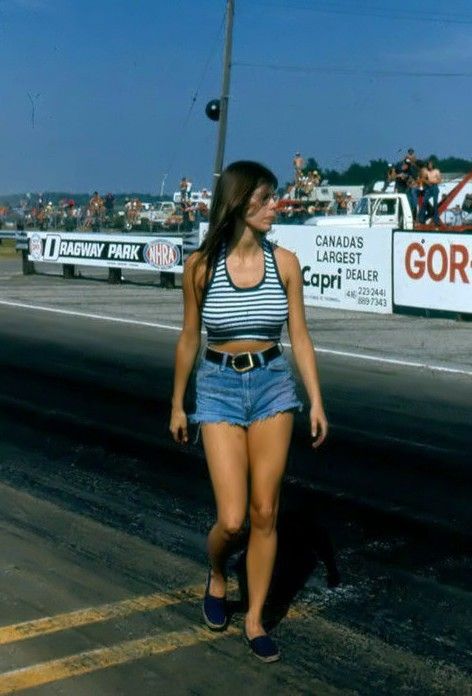
The Woman Who Brought Beauty, Grit, and Star Power to the Drag Strip

In a world dominated by roaring engines, nitro-fueled adrenaline, and testosterone-heavy competition, Jungle Pam Hardy stood out—not just for her looks, but for the unforgettable energy she brought to the track.
For drag racing fans of the 1970s, her name still ignites nostalgia, admiration, and a reminder of a time when racing was as much about spectacle as it was about speed.
Though she never drove a Funny Car herself, Pam Hardy, better known by her legendary nickname “Jungle Pam,” made just as much noise outside the cockpit.
A Legend Born on the Side of the Road
Pam’s path to drag racing stardom began in the most unexpected way. It was May 1972—just two weeks before high school graduation—when she was spotted hitchhiking by flamboyant drag racing star
Jim “Jungle Jim” Liberman.
He was already a beloved figure on the circuit, known as much for his showmanship as his skill behind the wheel.
Pam, then just 18, was planning to attend West Chester University to study business. But fate had other plans.
After one ride in Jim’s yellow Corvette, she traded college textbooks for the fast-paced life of the drag strip. “I ditched the college that had accepted me, and it drove my mother nuts,” she later said.
More Than a Pretty Face
Pam quickly became Jungle Jim’s on-track partner—and not just in name. Her presence became part of the act, thrilling crowds as she backed up Jim’s Funny Car in braless tank tops and tiny denim shorts.
Her natural beauty and magnetic charm made her a media darling, landing her on the cover of Hot Rod Magazine—a first for any woman in the sport.
But those who thought Pam was only there for eye candy were sorely mistaken.
She staged the car, checked for fluid leaks, packed parachutes, and poured oil and water before every run. She was hands-on, professional, and passionate. “It wasn’t about me,” Pam explained years later.
“When you were out there doing what we were doing, it was about us. We put on a good show.”
The Ultimate Drag Racing Duo
Together, Jungle Jim and Jungle Pam became drag racing’s hottest attraction. While Jim won races and captured the crowd with his flamboyant style, Pam brought a flair that helped drag racing reach a wider audience.
Their chemistry—both on and off the track—made them one of the sport’s most iconic duos.
But their story wasn’t just a flash of fun; it was also a story of passion and trust. “He had more pictures taken of his car as long as I was standing next to it than anybody else,” Pam once said. “And that’s just marketing. Sex sells.”
Tragedy Strikes
The fairy tale ended abruptly on September 9, 1977. Just days before his 32nd birthday, Jungle Jim was killed in a car crash while driving his Corvette at over 250 mph. The accident left the racing world stunned.
“It was my mother who called me and told me because she didn’t want me to hear it on the news,” Pam recalled tearfully.
Devastated, she stepped away from the sport, vowing never to partner with another driver. But she continued to honor Jim’s memory, attending memorial events and quietly preserving the legacy they built together.

A Life After the Track
Pam eventually moved on romantically, marrying drag racing figure Fred Frey and later engine tuner Bill Hodgson, who still works on nostalgia Funny Cars today. But her first love—racing—never truly left her.
She remained active at the grassroots level, attending shows, meeting fans, and sharing stories from what many consider drag racing’s golden era.
Despite the passing decades, Pam Hardy’s influence hasn’t faded. She is still widely regarded as one of the sport’s most recognizable icons—a woman who challenged gender roles in motorsports and won over a male-dominated crowd through both beauty and grit.
The Truth Behind the Image
While she became a sex symbol of the strip, Jungle Pam has always kept her feet on the ground. “Hell no, and hell no,” she famously said when asked if she ever wanted to race a car herself. “Those things could blow up and catch fire.”
Her refusal wasn’t fear—it was practicality. Her role was behind the scenes and beside the car, where she brought value in ways few others could.
Today, at 67 years old
, Pam still lives with that same fierce spirit. Her vibrant charm remains intact, and fans who meet her today often comment on how down-to-earth and genuine she is—proof that legends don’t need to fade.

A Legacy in Denim and Nitro
In revisiting the photos and stories of the 1970s drag racing scene, Pam Hardy’s impact becomes even clearer. She wasn’t just a sidekick. She was a trailblazer who redefined what it meant to be a woman in racing, helping bring color, energy, and a human touch to one of the loudest sports on Earth.
Pam didn’t just stand by the car. She stood for something bigger: a time when racing was real, personalities were larger than life, and one woman’s presence could electrify an entire crowd.
Here’s to Jungle Pam—an icon who gave drag racing its swagger, and whose memory still burns rubber in the hearts of fans everywhere.
“With Stunning Features, a Gorgeous Figure, And a Career That Began In Childhood”: Can You Guess The Famous Actress?
Alyssa Milano’s journey through Hollywood is one of rare endurance, transformation, and unwavering authenticity. Born in Brooklyn in 1972 and raised in a creative, working-class family, Milano first stepped into the spotlight at a time when most children were still learning their times tables. Her early career began on the stage, touring with the Broadway production of Annie when she was just eight years old. Even then, audiences sensed a spark in her—a blend of confidence, warmth, and natural talent that set her apart from the sea of aspiring young performers.
Her life changed dramatically when she landed the role of Samantha Micelli on the hit sitcom Who’s the Boss? The series became a cultural staple of 1980s television, and Milano quickly grew into one of its most beloved young stars. Her character, expressive and bright-spirited, mirrored much of Alyssa herself: determined, curious, and unafraid to speak her mind. It was during this time that she became a familiar name across American households, and the entertainment world began to recognize that she wasn’t just another child actor—she had longevity in her bones.
As with many actors who mature on camera, the transition from teen roles to adult characters can be precarious. But Milano navigated it with both grace and strategy. Rather than distancing herself from her early fame, she built upon it, choosing roles that allowed her to evolve while still honoring the fans who had grown up alongside her. In the 1990s, she expanded her résumé with appearances in popular series like Melrose Place, gradually shaping an identity as a versatile performer capable of balancing drama, humor, and emotional authenticity.
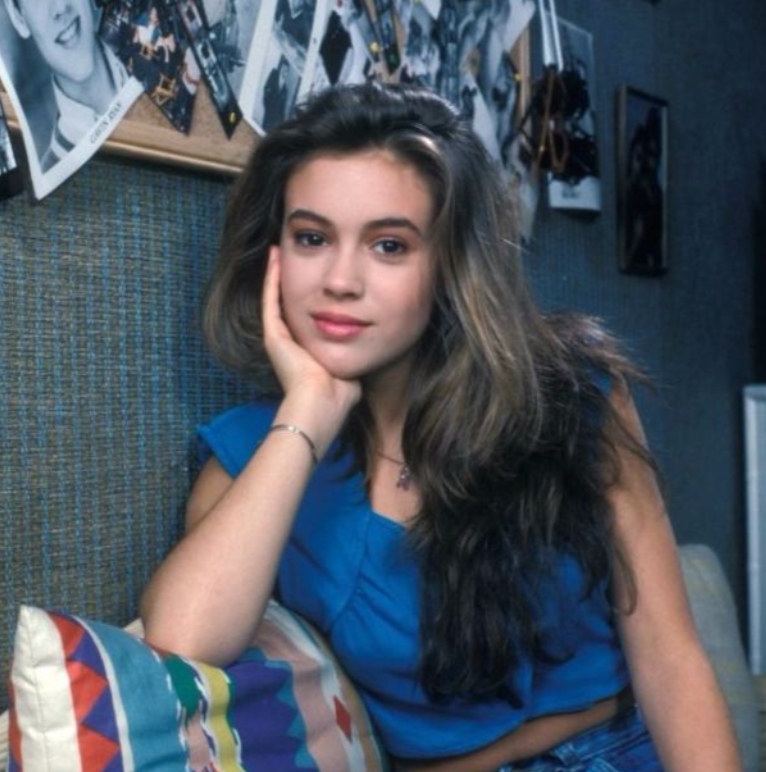
Then came the role that would define an entire chapter of her career: Phoebe Halliwell on Charmed.
Premiering in 1998, Charmed introduced audiences to the magical world of the Halliwell sisters—three young women discovering both their supernatural powers and their own inner strength. Though the show offered enchantment, spells, and mystical battles, it also grounded itself in the emotional journeys of its characters. Milano’s portrayal of Phoebe grounded the series with emotion, charm, and a sense of vulnerability that resonated deeply with viewers. She captured the imagination of millions, not by portraying a perfect heroine, but a relatable one—someone who made mistakes, grew through them, and faced life’s challenges with resilience and heart.
Phoebe Halliwell wasn’t just a character; she became a symbol of empowerment during an era when female-led television was still fighting for mainstream space. Fans connected with Phoebe’s boldness, humor, and compassion, often crediting Milano’s performance for giving the show its emotional anchor. Even decades after Charmed ended, its fanbase continues to thrive, with new generations discovering the series through streaming platforms. To this day, Milano is stopped by fans who tell her how Phoebe helped them through adolescence, inspired their confidence, or gave them comfort during difficult times. Few roles have the power to leave such a lasting imprint, and Milano embraced the responsibility with gratitude and warmth.
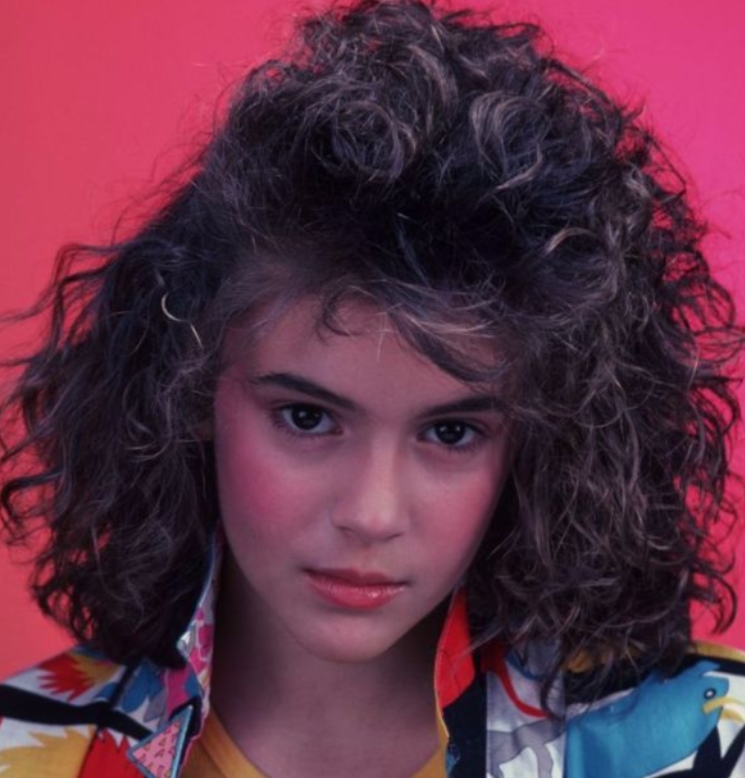
Now in her fifties, Alyssa Milano continues to captivate the public—not because she tries to relive her past fame, but because she evolves with each new chapter of her life. At 53, she carries a presence that is confident, grounded, and reflective. Whether she’s walking a red carpet or sharing glimpses of her everyday life, she radiates authentic elegance. Instead of resisting time, she embraces it, showing her audience that growth is not something to fear but something to celebrate.
Beyond the entertainment world, Milano has shaped a second career—one defined not by scripts or cameras but by advocacy and civic engagement. Over the last decade, she has become a prominent voice in social justice, equality, and women’s rights. Her involvement in the #MeToo movement was particularly impactful; she amplified the conversation at a critical moment, helping survivors share their stories and encouraging global dialogue about accountability, boundaries, and respect.

Her activism extends far beyond a single cause. She has spoken passionately about climate issues, healthcare accessibility, political fairness, children’s welfare, and the importance of mental health awareness. Milano approaches advocacy with the same emotional depth she brings to her acting, using her platform to highlight voices that often go unheard. Through interviews, public speaking engagements, books, and social media, she demonstrates a commitment to civic responsibility that has earned both respect and criticism—something she faces with unwavering conviction.
Yet perhaps the most compelling part of Alyssa Milano’s story is that she has never tried to reinvent herself into something unrecognizable. Instead, she has expanded her identity layer by layer: child star, teen idol, dramatic actress, pop-culture icon, producer, writer, activist, and—above all—an individual constantly learning and evolving. Her journey is not defined by a single transformation or comeback but by a steady, lifelong pattern of growth.

Milano’s legacy continues to inspire because it mirrors real human experience. She has faced challenges, navigated public scrutiny, and redefined herself multiple times while remaining true to her values. Her career serves as a reminder that authenticity can be a source of strength, and that reinvention doesn’t require erasing one’s past.
Alyssa Milano’s impact—on television, on pop culture, and on contemporary activism—remains as powerful today as it was decades ago. She grew up before the world’s eyes, yet still holds the ability to surprise, inspire, and lead with intention. As she continues exploring new projects and advocating for meaningful change, one thing is clear: her influence is far from fading. Alyssa Milano is a testament to resilience, evolution, and the enduring power of a voice that refuses to go silent.
