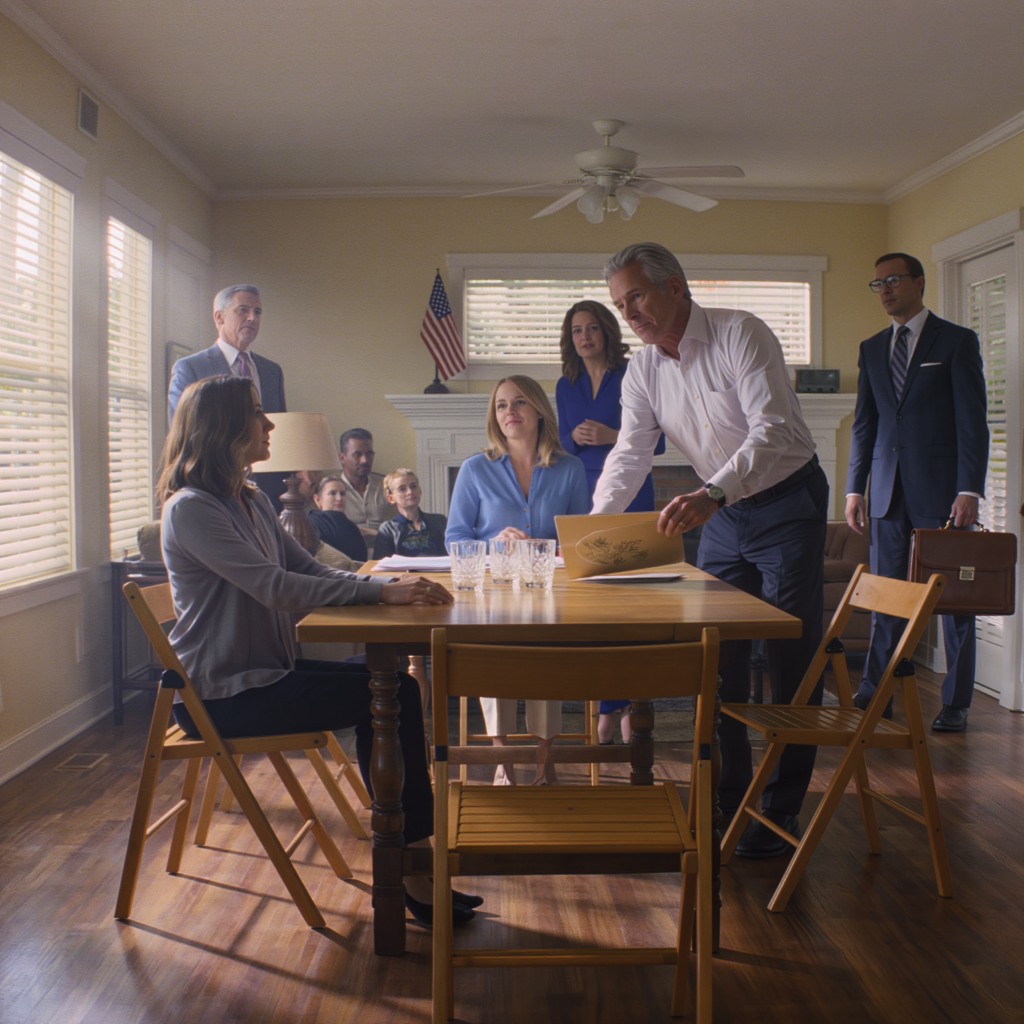

My father didn’t raise his voice when he said it. He didn’t need to.
The living room was quiet enough to hear the grandfather clock over the fireplace ticking like a countdown, and the only other sound was an old Sinatra station my mother kept low in the kitchen—soft brass, soft lies. A small American flag magnet sat crooked on the side of the refrigerator, holding up a faded grocery list and a church flyer like it could pin normal life in place.
“Sign the transfer,” my father said, calm as a judge. He slid a folder across the oak table toward me. “All nine point eight million to your sister.”
I stared at the paper—the names, the numbers, the certainty in his face.
“I’m not signing,” I said.
My mother moved so fast her chair scraped the hardwood. Her hand came out of nowhere.
Smack.
“You don’t have a choice!” she screamed, breath sharp with lemon cleaner and outrage.
The lawyer looked straight at her, then at my cheek, and started carefully, “Ma’am, do you know who actually—”
My father exploded. His palm hit the table hard enough to rattle the good dishes. “KNOW… WHAT?!”
And in that moment, with twenty-three people watching like I was the entertainment between roast chicken and dessert, I realized this wasn’t a family meeting.
It was an execution.
Three days earlier, my mother had called with that voice she used when she wanted something but didn’t want to be accused of asking.
“Just family,” she said, too sweet, stretched tight like plastic wrap. “Nothing formal. We just need to be on the same page.”
Those words should’ve warned me. My mother never cared about everyone being on the same page unless the page was already written and my job was to sign at the bottom.
Sunday afternoon, I drove into my parents’ subdivision with my windows up and my shoulders loose, the way I’d been trained. Don’t telegraph. Don’t flinch. Don’t let your nerves announce you before you open the door.
Their street was crowded with cars.
My aunt’s pearl-white Lexus. My uncle’s sun-faded pickup with the dented tailgate. Two sedans I recognized from church, the kind of people who called everything “a blessing” as long as they weren’t the ones paying for it.
I parked on the curb and sat for a second with my hands on the steering wheel, watching my parents’ porch flag lift and fall in the late fall breeze. It wasn’t even the holiday season yet, but my mother already had a wreath on the door. She liked signals. She liked the appearance of warmth.
Inside, the house smelled like lemon polish and roast chicken—the scent of effort. The good dishes were out, the ones that only came out when company was present or when my mother wanted to prove she could still host the world.
Folding chairs lined the walls of the living room facing the long oak table like an audience waiting for a verdict.
I counted without meaning to.
Twenty-three.
Not eight. Not ten. Not “just family.” Twenty-three people meant witnesses. Twenty-three meant no one could later claim they’d misunderstood, no one could pretend they hadn’t heard the terms.
That was the first hinge in the door I’d been holding shut my entire life: they weren’t inviting me to talk.
They were inviting me to comply.
My sister, Karen, sat near the center of the room with her legs crossed and her hands folded neatly in her lap. She wore cream-colored slacks and a soft blue blouse, the kind of outfit that said, Reasonable. Responsible. Please don’t look too closely.
Her husband sat beside her with one hand resting possessively on the back of her chair like she was the prize and the chair was the proof.
Karen smiled when she saw me—the same tight smile she’d worn our entire lives. Polite. Careful.
Victorious.
I took a seat near the end of the table, close to the wall. Old habit. I’d learned early how to stay out of the center of things so I didn’t get blamed for being in the way.
My father stood at the head of the table with his back straight, wearing that expression he always wore when he believed he was doing the right thing. In his mind, righteousness was a uniform.
Beside him was a man I recognized immediately.
Mr. Caldwell.
Gray hair. Clean suit. Leather briefcase on the floor at his feet like punctuation.
That was when I knew my mother’s “just family” had been a lie with a bow on it.
My mother hovered near the kitchen doorway with her arms crossed. She didn’t sit. She paced.
She always paced when she thought control might slip.
“Thank you all for coming,” my father began. His voice filled the room without effort. “This won’t take long.”
Karen glanced around and nodded as if she were the one hosting. A few relatives murmured approvingly. Someone chuckled.
I noticed how easily they leaned toward her, how natural it looked.
My father slid a thick folder across the table toward me. It stopped just short of my hands.
“We’ve been reviewing the family assets,” he said. “After a lot of thought, your mother and I have decided it’s best to simplify things.”
I opened the folder slowly—not because I was confused, but because I already knew what I’d find.
Property valuations. Investment summaries. Trust language.
And the number sat bold and unapologetic on the first page.
$9,800,000.
My name was already printed on the signature line, blank, waiting.
“Sign the transfer,” my father said, finally looking directly at me. “All of it to your sister.”
A ripple moved through the room. Not surprise.
Relief.
This was the ending they’d rehearsed.
My pulse didn’t spike. Years in uniform will do that to you. When things get loud, you get quiet.
“I’m not signing,” I said.
The words weren’t dramatic. They didn’t need to be.
Karen’s smile flickered—just for a second.
My mother reacted first. She surged forward so fast her chair tipped behind her. Her face went red with something deeper than anger.
Her hand connected with my cheek before I had time to move.
The sound was sharp. Final.
“You don’t have a choice!” she screamed. “Do you hear me? You don’t!”
Someone gasped. Someone whispered my name.
I tasted metal—not blood, just the shock of it. My cheek burned, but my hand stayed flat on the table.
Mr. Caldwell stood slowly and adjusted his glasses. His eyes moved from my mother’s raised hand to my face, then down to the folder.
“Ma’am,” he began carefully, “do you know who really—”
My father slammed his palm on the table so hard the dishes rattled. “Know what?” he roared. “What are you even implying?”
Every head turned. Every breath held.
I looked at my father—really looked—at the certainty etched into his expression, at the confidence of a man who believed the ground beneath him was solid because it always had been.
“You really don’t know,” I said quietly.
Confusion spread across the room like a slow leak.
My father laughed once—sharp, dismissive. “Don’t start this,” he said. “You’ve always had trouble accepting reality.”
Reality.
That word had followed me my whole life, usually as a warning. Be realistic. Don’t make this harder than it needs to be. Karen needs this more than you.
My mother cut in, voice tight with contempt. “She’s being selfish. She always does this. Makes things difficult after everything we’ve done for her.”
I lifted my hand slightly—not to defend myself, not to touch my cheek—but to signal patience.
“I’m not signing,” I repeated. “And before anyone says another word, I think you should hear why.”
Karen leaned forward, eyes glossy, voice soft. “We’re just trying to keep the family together,” she said. “You’re barely even here anymore. You have your career, your life.”
There it was. The familiar framing.
I had enough. Therefore I should give.
I closed the folder gently and pushed it back across the table.
“You didn’t invite me here to talk,” I said. “You invited me to comply.”
Mr. Caldwell finally spoke, steady but edged with concern. “Before any documents are signed,” he said, “there are some clarifications we need to make.”
My father rounded on him. “This is straightforward.”
“It may not be,” Mr. Caldwell replied.
My mother’s eyes darted between us. “What does that mean?”
I leaned back in my chair. The sting on my cheek faded into a dull ache. The room felt smaller, tighter, like the air before a storm.
“It means,” I said, “you’re asking me to sign away something you don’t actually control.”
The silence that followed pressed against my ears.
My father stared at me, jaw tightening. “You’re confused.”
“No,” I said. “I’m prepared.”
Karen shook her head and laughed nervously. “This is ridiculous.”
“Is it?” I asked.
I stood slowly, every movement deliberate.
“Before we go any further,” I said, “you should all understand how we got here. Because this story didn’t start today.”
And it didn’t start with money.
It started years ago, when I learned what happens to the child everyone assumes will be fine.
Growing up, my family never called it favoritism. They didn’t need to. Favoritism was just the shape of our lives—the way furniture sits in the same place long enough that you stop noticing it’s there.
Karen was three years older than me, which in our house translated into something far more permanent than age.
She was first.
First grandchild. First steps. First smile everyone remembered.
By the time I arrived, the family narrative had already been written and Karen’s name was printed in bold at the top.
She was the organized one, the dependable one, the child my parents said had “leadership qualities” before she’d even learned to tie her shoes.
I was the other one.
Not unwanted. Not unloved.
Just expected to manage.
When Karen cried, my mother rushed.
When I cried, I was told I was strong.
When Karen struggled, my father intervened.
When I struggled, I was reminded I’d always been independent.
“You’ll be fine,” they’d say over and over again.
In my family, “You’ll be fine” wasn’t comfort.
It was a command.
At family dinners, Karen sat beside my father, updating him on her plans, her classes, her goals. He listened, nodding, offering advice.
When I spoke, conversations paused politely and drifted back to where they’d been.
I learned early that attention was currency I didn’t have.
In elementary school, Karen’s report cards went on the refrigerator.
Mine went into a drawer.
In middle school, when she joined student council, my parents rearranged their schedules to attend meetings.
When I qualified for an academic competition, my mother smiled and said, “That’s nice, honey,” before reminding me Karen had practice.
It wasn’t cruelty. That’s what makes it hard to explain to people who didn’t grow up like that.
There were no slammed doors, no screaming matches.
Just a thousand small recalibrations where my needs were adjusted downward to make room for hers.
Karen needed a new car for college.
I took the bus.
Karen changed majors twice.
My tuition came with a reminder to be grateful.
Karen moved back home after graduation to “figure things out.”
When I stayed home too long after high school, my father asked when I planned to do something real.
So I joined the military at twenty-two.
People assume it was a calling—a dream—some patriotic awakening.
It wasn’t.
It was a way out.
The day I signed my enlistment papers, my father shook my hand like I’d accepted a job at a factory across town.
“Good benefits,” he said. “Structure.”
Karen hugged me and whispered, “I could never do that,” like it made her better.
Basic training stripped me down to nothing and rebuilt me piece by piece. The yelling didn’t bother me. I’d grown up translating tone into survival.
What surprised me was how clear everything was.
In uniform, effort mattered. Precision mattered. Documentation mattered.
Nobody asked whose daughter I was.
Nobody expected me to shrink so someone else could shine.
For the first time in my life, being quiet didn’t make me invisible.
It made me observant.
I learned how systems actually worked. How one missing signature could stall an entire operation. How numbers told stories if you paid attention long enough. How rules existed not to control people, but to keep chaos from pretending it was order.
When I came home on leave, the contrast was jarring.
Karen was “helping” my parents manage things—their investments, their accounts, their paperwork. My father bragged about her to anyone who’d listen.
“She’s got a head for business,” he’d say. “Just like me.”
No one asked what I did in the military.
When they did, they stopped listening halfway through the answer.
“You don’t need to worry about money,” my mother once told me over coffee, sliding a glass of sweet tea across the table like it was comfort. “Karen’s taking care of that side of things.”
That was the first time I noticed the phrase: that side of things.
As if finances were a personality trait.
As if responsibility could be assigned by birth order.
The one person who never spoke that way was my grandmother, Eleanor—my father’s mother.
She lived alone in a modest house with creaky floors and a view of the back alley, not the bay. Her mailbox leaned like it was tired. She kept her curtains open during the day and her opinions mostly to herself.
She watched everything.
She commented on very little.
When I visited her, she asked real questions, not polite ones.
“What are you learning?” she’d ask. “What do you notice? What doesn’t make sense to you?”
Once, while sorting through old family files at her kitchen table, she slid a stack of documents toward me.
“Tell me what you see,” she said.
Not your opinion.
Your eyes.
I did what I’d been trained to do.
Dates. Headings. Totals.
Rental income summaries. Investment distributions. Maintenance expenses.
At a glance, everything looked tidy.
Too tidy.
I flipped a page, then another.
The same vendor name appeared three times in one quarter.
Emergency repairs—all under the same dollar threshold.
Each one approved by Karen.
Each one paid promptly.
“That roof can’t be replaced three times in four months,” I said without looking up.
Eleanor nodded once, but didn’t smile.
I kept going.
A line item labeled miscellaneous administrative costs ballooned year over year.
Travel reimbursements tied to “site visits” that didn’t match lease renewal dates.
Checks written instead of electronic transfers—just often enough to avoid patterns a casual reviewer might notice.
It wasn’t theft in the movie sense.
It was something far more familiar.
Assumption.
The assumption that no one would look closely, that even if someone did, they wouldn’t understand what they were seeing, and if they understood, they wouldn’t push back.
I exhaled slowly.
“These accounts aren’t structured the way Dad says they are,” I said.
Eleanor folded her hands.
“No,” she said. “They aren’t.”
She reached for a folder I hadn’t opened yet. Heavier paper. Crisp edges.
Trust documents.
Not drafts.
Executed copies.
A revocable trust established years earlier. Assets listed meticulously—properties, accounts, contingencies.
And then a clause that made my breath catch.
Successor authority.
My name.
Not beneficiary.
Not recipient.
Authority.
I looked up at her. “When did you do this?”
“When I realized,” she said calmly, “that love doesn’t stop people from making selfish decisions. It just makes them better at justifying them.”
I wanted to argue. To soften it. To suggest there had been misunderstandings.
But the numbers didn’t lie.
And neither did the documents.
“I didn’t want conflict,” she continued. “I wanted continuity. Someone who would protect what exists, not drain it for validation.”
She paused, studying my face like she’d already decided and was simply confirming she was right.
“You know how to do that,” she said.
I swallowed.
“Karen won’t take this well.”
Eleanor’s mouth twitched. “Karen has always taken well to applause. This isn’t that.”
She didn’t ask me to promise anything.
She didn’t need to.
Instead, she closed the folder and slid it toward me.
“Keep copies,” she said. “And keep quiet.”
I did both.
And in the quiet of that kitchen—coffee cooling, papers spread like a map—I made a bet with myself that I didn’t say out loud.
If the day ever came when my family tried to corner me, I wouldn’t fight with feelings.
I’d let the paper speak.
That was the second hinge in the door: the moment I understood silence could be strategy.
Over the next year, I paid attention in a way I never had before.
Not because I was looking for betrayal.
Because I finally understood the language being spoken around me.
When my father boasted about the “family portfolio,” he always spoke in estimates—rounded numbers, convenient totals.
When Karen talked about managing assets, she focused on outcomes, not processes.
Growth.
Expansion.
Lifestyle.
No one mentioned governance, oversight, safeguards.
No one except Eleanor.
And me.
Eleanor passed eighteen months later.
The grief hit me sideways. She had been the one place in my family where I didn’t have to translate myself. Losing her felt like losing gravity.
Her funeral was dignified, controlled. People praised her foresight, her generosity, her devotion to family.
The morning after, my mother called.
“We should talk about the assets,” she said gently.
Not about Eleanor.
About the assets.
I declined politely. Firmly.
Three weeks later, the first message came from Karen.
We need to simplify things.
This doesn’t have to be hard.
Dad’s getting older.
Each text carried the same subtext I’d grown up with.
Step aside.
I didn’t respond.
Instead, I met with an independent attorney—not Caldwell—to confirm what I already knew.
He reviewed the trust, the filings, the recorded instruments. He didn’t even need long.
“It’s solid,” he said. “Very intentionally structured.”
“Who can change it?” I asked.
“No one,” he replied. “Not without your cooperation.”
That was the moment the weight of it settled in my chest.
Not triumph.
Not fear.
Responsibility.
I wasn’t holding money.
I was holding a boundary someone else had built and trusted me to enforce.
The family meeting invitation arrived two weeks later, wrapped in politeness and pressure.
We just need clarity.
For peace.
For family.
By then, I understood something they didn’t.
They believed they were negotiating.
They didn’t realize the negotiation had already ended years ago, with signatures they’d never bothered to read.
Back in my parents’ living room, after my mother’s slap and my father’s shout, I looked around at the faces that had watched me grow up and decided long ago what role I was allowed to play.
My aunt’s disapproving pursed lips.
My uncle’s nervous stare at his hands.
A cousin who suddenly found the ceiling fascinating.
Twenty-three people who’d come to witness my surrender.
I took a breath.
“I didn’t come here to fight,” I said, voice even. “I came because you invited me. But I won’t be cornered.”
My father’s voice dropped, dangerous and controlled. “If you’re not signing, then tell us what you think you know.”
I didn’t answer right away.
Instead, I reached down and pulled my bag onto the table.
It wasn’t dramatic. No slam.
Just the soft thud of canvas against oak.
I unzipped it and removed a slim fireproof folder—charcoal gray, the kind you buy when you’ve learned that paper is only powerful if it survives.
A metal clasp sat at the edge.
Click.
The sound cut through the room sharper than my mother’s slap had.
Karen leaned back, trying to sound amused. “What is this? Are you serious right now?”
Mr. Caldwell’s eyes fixed on the folder.
He didn’t speak, but something in his posture changed.
Lawyers know that sound.
The sound of preparation.
“I didn’t bring opinions,” I said. “I brought records.”
I opened the folder and slid the first document onto the table.
I didn’t announce it.
I let the paper speak for itself.
Mr. Caldwell leaned forward, adjusting his glasses. He read silently at first, lips moving slightly, then his brow furrowed.
“This is a recorded trust,” he said slowly.
My father scoffed. “We already have a trust.”
Mr. Caldwell didn’t look up. “Not like this.”
I placed the second document down, then the third.
Each one aligned carefully, edges squared, the way I’d been trained.
Karen’s smile vanished.
“You’re embarrassing yourself,” she said. “You don’t even understand.”
“Karen,” Mr. Caldwell interrupted quietly, “please stop talking.”
That alone stunned the room.
He picked up the top document, checking the county seal, the recording number, the date. Then he flipped to the signature page.
My name wasn’t on the line they’d asked me to sign today.
It was already there.
My mother’s voice shook. “That… that doesn’t mean anything. Eleanor was old. She didn’t know—”
“She knew exactly what she was doing,” Mr. Caldwell said, sharper now. “This was executed years ago properly. Witnesses. Independent counsel.”
My father stood so fast his chair toppled backward.
“No,” he said. “That’s not possible.”
I slid one more page forward.
This one explained it.
Designation of authority.
Clear.
Unambiguous.
Karen lunged forward, fingers stretching toward the papers like she could snatch reality back into place.
“This is fake,” she hissed.
Mr. Caldwell caught her wrist midair.
“Do not touch that,” he said.
Karen froze.
The room seemed to inhale all at once.
Mr. Caldwell turned to my parents.
“Do you know who really holds decision-making authority over these assets?” he asked again—calm, final.
My mother opened her mouth.
No sound came out.
My father’s face drained of color.
“We’re the parents,” he said, suddenly smaller. “They’re family assets.”
Mr. Caldwell shook his head.
“They are not.”
He looked at me then—not as their daughter, but as his client.
“You are the acting authority,” he said. “You always have been.”
The room erupted.
My aunt whispered, “Oh my God.”
Someone else muttered, “That changes everything.”
Karen’s husband stood, backing away as if the floor had cracked.
“Karen,” he said quietly, “you said this was settled.”
My mother pressed her hands to her mouth, eyes wide.
“You planned this,” she whispered at me. “Behind our backs.”
“No,” I said. “You ignored it.”
My father rounded on me, rage flickering behind his eyes.
“You let us plan this meeting,” he accused. “You let us invite people.”
“Yes,” I said evenly. “Because I was told I didn’t have a choice.”
Karen’s voice broke. “You did this to hurt me.”
I finally looked at her fully.
“No,” I said. “I did this to stop you.”
The truth settled slowly, unevenly—not like a bomb.
Like a fog lifting.
Mr. Caldwell gathered the documents into a neat stack.
“There is nothing to transfer,” he announced to the room. “The assets are already placed. There is no legal mechanism for what you’re asking.”
My father sank back into his chair. His hands were shaking.
“All this time,” he whispered.
“All this time you thought,” I said softly.
You assumed.
Karen shook her head, tears streaking down her face now. “This isn’t fair.”
I held her gaze.
“Neither was being told my whole life that I didn’t matter.”
My mother’s eyes snapped to mine, the kind of stare that used to make me shrink.
“We raised you,” she said. “You owe us.”
I closed the fireproof folder and clasped it shut.
Click.
“I don’t owe you my silence,” I replied.
No one argued after that.
There was nothing left to argue about.
The paper had taken the floor.
And for once, it wasn’t yielding.
I picked up my bag and turned toward the door.
“This meeting is over,” I said. “And so is the assumption that I will always step aside.”
As I walked out, I didn’t feel victorious.
I felt clear.
Consequences rarely arrive with drama. They don’t slam doors or shout accusations.
They move quietly.
Methodically.
Like paperwork processed in the background while people are still arguing about feelings.
Outside, the sun was lowering, casting long shadows across my parents’ driveway. Their porch flag lifted and fell like nothing had happened.
I paused by my car and listened to the muffled sound of voices inside—confused, overlapping, stripped of the certainty they’d walked in with.
Then I got in, shut the door, and drove away.
That night, I slept deeper than I had in weeks. No replaying conversations. No rehearsing defenses. Just the steady quiet that comes when a decision is no longer theoretical.
The fallout began the next morning.
Mr. Caldwell called first. His tone was professional but different now—careful, respectful.
“There will be adjustments,” he said. “Some things your parents believed were in motion simply aren’t.”
I thanked him and ended the call.
By noon, Karen had called six times.
By evening, twelve.
By the end of the week, twenty-nine.
Twenty-nine missed calls that felt like a countdown of their own.
And every time my phone lit up, the same thought sat steady in my chest:
Pressure doesn’t become permission just because it’s loud.
The family group chat exploded.
How could you do this to us?
Mom hasn’t stopped crying.
You embarrassed Dad in front of everyone.
This isn’t what Grandma would have wanted.
I read every message once, then muted the thread.
Instead, I opened my laptop and did what I’d been trained to do.
Review.
Verify.
Document.
Within forty-eight hours, I engaged an independent management firm to oversee the assets.
Not friends.
Not family.
Professionals with no emotional investment and a paper trail for everything they touched.
Tenants were notified.
Maintenance schedules standardized.
Financial accounts locked down with two-factor authentication and oversight protocols that made quiet skimming impossible.
No speeches.
No victory lap.
Just structure.
Karen’s lifestyle began unraveling almost immediately.
Credit cards flagged.
Accounts frozen pending review.
A temporary hold placed on discretionary spending she’d come to rely on.
Her husband moved out within a week, citing “misrepresentation” with the flat tone of someone who’d discovered the foundation of his life was built on borrowed confidence.
My mother called my job.
Not my phone.
My job.
She left a message with a supervisor, voice trembling with practiced hurt.
“She’s taking everything,” she said. “She’s destroying the family.”
My commander didn’t ask for details. He simply told me, quietly, “Handle your business. Keep it clean.”
So I did.
The management firm’s first internal audit didn’t read like a scandal.
It read like a pattern.
Small expenses repeated.
Vendors who didn’t exist.
Reimbursements for “travel” that never happened.
Payments kept just under thresholds that would trigger automatic reviews.
Not a single smoking gun.
A whole drawer full of matches.
When the firm asked for supporting documentation, Karen sent a flood of PDFs—blurred screenshots, missing pages, invoices with inconsistent formatting.
The kind of “proof” that only works if no one asks a second question.
They asked a second question.
Then a third.
Karen responded the way she always had when she sensed control slipping.
She went for the crowd.
At church the following Sunday, my aunt cornered a woman my mother considered a friend and whispered about how I’d “turned on my own blood.”
By Monday, my inbox had messages from cousins I hadn’t spoken to in years.
“We’re praying for you.”
“You need to do the right thing.”
“Family is everything.”
Family is everything was always said like a threat.
I didn’t answer.
Instead, I sent the management firm’s audit summary to my independent attorney.
He read it, then said something that lodged in my bones.
“They weren’t just entitled,” he told me. “They were comfortable.”
Comfort makes people careless.
Comfort makes them think the rules are for everyone else.
Karen’s attorney sent a letter two weeks after the meeting.
It was written in the language of indignation disguised as legal concern.
Undue influence.
Questionable capacity.
Emotional manipulation.
They claimed Eleanor had been “confused” and “pressured.”
The letter demanded I “reconsider for the sake of harmony.”
Harmony.
That word—sweet on the surface, sharp underneath.
My attorney replied with facts.
Recording numbers.
Witness names.
The independent counsel Eleanor had used.
And one line that made Karen’s letter feel like smoke against stone:
Any further interference will be documented.
When people can’t win on paper, they try to win with noise.
Karen started posting online without naming me.
Vague quotes.
“Betrayal comes from the people you feed.”
“Some siblings are wolves in disguise.”
Relatives commented with little heart emojis and scripture.
I didn’t engage.
I’d spent too long in rooms full of witnesses to misunderstand how public performance works.
If you shout enough, people assume you must be right.
But paper doesn’t care about volume.
Two weeks after the meeting, an envelope arrived at my apartment.
My mother’s handwriting, careful and controlled.
Inside was a single page.
We need to talk.
No apology.
No accusation.
Just the first honest sentence she’d offered in years.
I didn’t respond.
Not yet.
Instead, I kept building the life I’d paused to survive the confrontation.
Morning runs.
Work deadlines.
Grocery lists.
Normal things.
The kind of normal no one in my family had ever expected me to prioritize.
A month passed.
Then another.
The assets stabilized.
Tenants felt secure.
Systems worked the way they were supposed to.
And that was when Karen showed up.
I saw her car first—a shiny SUV she shouldn’t have been able to afford in the first place, parked crookedly outside my building like it owned the space.
I’d just come back from the gym, hoodie up, earbuds in.
She stepped out with sunglasses on even though it was overcast.
“Wow,” she said, loud enough for a couple walking their dog to hear. “You really do live like you’re untouchable.”
I pulled out one earbud. “Karen.”
She laughed without humor. “Don’t say my name like you’re being polite. You don’t get to be polite anymore.”
“I didn’t come here to fight you,” I said.
“You didn’t have to,” she snapped. “You just… took everything.”
“I didn’t take anything,” I replied. “I stopped you from draining it.”
Her face tightened. “You always think you’re smarter than us.”
I shook my head. “I think I’m done being quieter so you can be louder.”
She stared at me like I’d spoken in a language she couldn’t translate.
Then she leaned closer, voice lower. “Do you know what people are saying about you?”
“I don’t care,” I said.
That shocked her more than any document ever could.
For a second, I saw it—the panic behind her fury.
Because if I didn’t need the crowd, she had no weapon.
She backed away, chin lifting, trying to recover her script.
“This isn’t over,” she said.
“It is,” I replied.
I walked past her into my building without looking back.
The silence that followed wasn’t empty.
It was full of boundaries.
One evening, my phone rang with an unfamiliar number.
I almost didn’t answer.
But something in me—curiosity, maybe—made my thumb slide across the screen.
“Hello?”
My father’s voice came through, lower than I remembered.
“I’d like to meet,” he said.
Not my mother.
Not a group text.
Just him.
“If you’re willing.”
I stared at the charcoal-gray fireproof folder on my desk, the metal clasp catching the lamplight.
Click.
The sound from weeks ago echoed in my head like a reminder.
I considered the request longer than I expected.
Then I said, “Yes.”
Not because I owed him closure.
Because I wanted to hear what a man sounds like when his authority finally stops working.
We met at a diner my father used to take us to when we were kids.
Vinyl booths.
A counter worn smooth by decades of elbows.
Coffee that tasted burnt no matter how much cream you poured in.
A faded American flag in the corner by the register, the kind that had seen so many mornings it looked tired.
He was already there when I arrived, sitting with his hands folded around a mug he hadn’t touched.
For a moment, I almost didn’t recognize him.
Not because he looked older—though he did.
Because something essential was missing.
The certainty.
The assumption that the world would arrange itself around his decisions.
He stood when he saw me, hesitated, then sat back down.
“Thank you for coming,” he said.
I slid into the booth across from him and nodded.
“You said you wanted to talk.”
The waitress appeared, poured coffee without asking, and disappeared again.
We sat in the silence she left behind.
“I was wrong,” my father said.
No preamble.
No qualifiers.
Just three words spoken like they’d been sitting on his tongue for weeks.
I didn’t respond right away.
In my experience, people rush to fill quiet when they’re uncomfortable.
I wanted to hear what he’d say when no one rescued him from it.
“I thought,” he continued slowly, “that keeping the family together meant deciding what was best for everyone. I thought authority was the same thing as responsibility.”
He looked down at his hands.
“I see now that it isn’t.”
Something loosened in my chest.
Not forgiveness.
Relief.
The kind that comes when a truth finally gets spoken aloud.
“You didn’t ask,” I said. “You decided.”
He nodded. “I did.”
Another pause.
This one heavier.
“I should have protected you,” he said quietly. “Instead, I treated your silence like consent.”
That landed harder than I expected.
Not because it was dramatic.
Because it was accurate.
“I learned to be quiet because it kept the peace,” I said. “Not because I agreed.”
“I know,” he replied. “I see that now.”
We talked for nearly an hour.
Not about money.
Not about documents.
About childhood.
About expectations that calcify into roles.
About how easy it is to reward the child who reflects your own image and overlook the one who challenges it simply by being different.
He didn’t ask for the assets back.
He didn’t ask me to soften anything.
He didn’t ask me to fix what had broken.
That mattered.
When we stood to leave, he placed a tentative hand on my shoulder.
“I’m proud of you,” he said.
“I should have said that a long time ago.”
I nodded once. “Thank you.”
Outside, the air was cool and clean.
Traffic moved steadily down the road, indifferent to family reckonings and long-overdue admissions.
Life didn’t magically resolve after that.
My mother took longer.
Karen longer.
Some relationships remained distant, polite, redefined.
But something fundamental had changed.
I no longer explained myself.
I no longer preemptively shrank.
The assets stopped being symbols.
They became what Eleanor intended them to be.
Responsibilities.
A structure.
A safeguard.
A quiet, durable boundary.
Weeks later, when the management firm sent me the final audit report, I read it at my kitchen table with the fireproof folder beside my coffee mug.
Twenty-three flagged transactions.
Not millions.
Not a cinematic heist.
Twenty-three small acts of entitlement that only mattered because they revealed the mindset behind them.
I thought about the twenty-three people in my parents’ living room.
Twenty-three witnesses.
Twenty-three pairs of eyes waiting to see me fold.
And I understood, with an almost unsettling calm, how patterns repeat until someone stops them.
Sometimes late at night, I think about the version of me who sat at that oak table, cheek burning, being told she had no choice.
I think about how many people are asked to sign away pieces of themselves in the name of harmony.
How often love gets used as leverage.
If I could speak to her now, I’d tell her this:
You always had a choice.
You just didn’t have proof yet.
To anyone who has ever been pressured to comply—to stay quiet, to give up what matters because it makes someone else more comfortable—hear me.
Your boundaries are not betrayal.
Your clarity is not cruelty.
And sometimes the most powerful thing you can do is let the truth speak for itself.
Because when the paper finally speaks louder than the room, even the loudest people have to listen.
I thought that would be the end of it.
I was wrong.
The first week after the meeting didn’t feel like a victory. It felt like I’d walked out of a burning building and realized I still smelled like smoke. I went to work. I ran my miles. I answered emails. I made dinner. And every time my phone vibrated, my body braced like the slap was happening again.
The management firm I hired moved fast. They didn’t gasp. They didn’t moralize. They opened spreadsheets the way surgeons open a chart.
On Tuesday, the lead manager, a woman named Denise with a voice like clean edges, called me while I was standing in the commissary line.
“We’ve locked down the accounts,” she said. “Two-factor on everything. New user permissions. Alerts for any attempted access.”
“Thank you,” I said.
There was a short pause.
“And,” Denise added, “we found twenty-three irregular entries in the last eighteen months that need explanation.”
Twenty-three.
Not a headline number.
Not a Hollywood heist.
A pattern.
“Can you send them?” I asked.
“I already did,” she said. “Also—there are three vendors that appear to be… duplicates. Same services. Different names. Similar invoice layouts.”
“Karen’s vendors,” I said.
“I won’t speculate,” Denise replied, which told me she absolutely was.
I hung up and stared at my phone screen while the cashier asked if I wanted a receipt.
“Yes,” I said, and the word felt like a new habit.
That was the hinge: I’d spent most of my life trained to decline proof.
Now I was collecting it.
By Wednesday, Karen’s calls turned into voicemails. Her voice climbed from wounded to furious like she thought emotion was a key that could unlock anything.
“You’re punishing me!”
“You’re humiliating Mom!”
“Dad can’t sleep!”
Then my mother.
She didn’t leave voicemails at first. She left silence—calls that rang twice and stopped, like a hand hovering over a bruise.
When she finally spoke, it wasn’t to apologize.
It was to threaten without using the word.
“I hope you understand what you’re doing,” she said softly, as if caution made her righteous. “People are watching.”
They always were.
That was the point.
On Friday morning, Denise emailed me a short subject line that made my stomach go cold.
ATTEMPTED ACCESS.
The bank had flagged a login from a device that wasn’t mine.
Location: back in my hometown.
Time: 2:07 a.m.
Denise’s message was simple. We blocked it. Do you recognize the device?
I didn’t have to.
I called my attorney. He answered on the second ring.
“Keep it,” he said, meaning the record. “Screenshots. Time stamps. Everything.”
Then he added, “And don’t talk to them without me in the loop.”
I stared at my kitchen counter where the fireproof folder sat beside my coffee mug.
Click.
Even in my head, the sound steadied me.
My family had always treated boundaries like insults.
But boundaries weren’t insults.
They were insurance.
The next escalation came dressed as civility.
A courier showed up at my building on a rainy Monday and handed me a thick envelope that smelled like toner and entitlement.
Karen had filed a petition.
She and my mother were claiming “undue influence,” “questionable capacity,” and “family necessity.”
They wanted an emergency hearing to remove me as trustee and install Karen.
Under the legal language, the message was the same one I’d heard at that oak table.
Step aside.
Sign.
Obey.
My attorney called two minutes after I texted him a photo.
“They’re trying to force this into probate court,” he said. “It’s not really probate, but they’re hoping a judge will get tired of the noise.”
“Will it work?” I asked.
“No,” he said. “But it will cost them. And it will cost you time.”
Time was a resource my family had always assumed they could spend for me.
They were about to learn I audited that too.
Two days later, I sat in my attorney’s office under fluorescent lights while he laid out the plan like a mission brief.
“We respond with documentation,” he said. “We request the trust’s execution records. We subpoena the independent counsel who drafted it. We bring in the management firm’s preliminary findings.”
“And Caldwell?” I asked.
He raised an eyebrow. “If he has a conscience, he’ll tell the truth. If he doesn’t, he’ll protect himself.”
I pictured Mr. Caldwell’s face in my parents’ living room—the way his posture changed when the fireproof folder opened.
“He knows,” I said.
My attorney nodded. “Then we let him.”
That was the hinge: I didn’t need to win with charisma.
I needed to win with clarity.
Karen, of course, didn’t understand that.
She treated the court date like a stage.
She posted another vague quote online the night before.
When the people you feed bite you, don’t be surprised.
My aunt commented with prayer hands.
My mother’s friend from church typed, Stay strong, sweet girl.
Sweet girl.
Karen was thirty-five.
But my mother had always loved framing her as delicate.
It made Karen’s demands look like needs.
The morning of the hearing, I didn’t wear a suit. I wore clean, simple clothes and a jacket that fit. My attorney told me not to look like I was trying too hard.
“Let them perform,” he said. “You don’t have to.”
We walked into the courthouse past a row of metal detectors and a bored deputy with a badge that caught the light. The hall smelled like old paper and floor wax. People whispered as they passed, like they could feel the gravity of other people’s secrets.
Karen was already there with her husband—no, her almost-ex-husband now, though the paperwork hadn’t caught up. He stood a step behind her, eyes tired, like he’d been drafted into a war he didn’t understand.
My mother clutched a tissue in one hand even though she wasn’t crying yet. She wanted the option.
My father wasn’t with them.
That detail hit me harder than I expected.
Absence is a sentence.
Karen saw me and smiled too brightly.
“Wow,” she said, loud enough for the hallway. “You really brought your lawyer.”
I looked at her. “You filed the petition.”
She tilted her head like I’d missed the joke. “It didn’t have to be like this.”
It had always been like this.
Only now, it had a docket number.
Inside the courtroom, the judge was an older woman with reading glasses and a patience that looked earned. She listened while Karen’s attorney spoke in smooth phrases about family unity and a sister who’d been “absent” and “uncooperative.”
Karen dabbed at her eyes on cue.
My mother clasped her hands as if she were praying.
I sat still.
When it was my attorney’s turn, he didn’t raise his voice.
He didn’t need to.
He handed the clerk a stack of exhibits.
Recording numbers.
Witness affidavits.
A statement from the independent counsel who had drafted Eleanor’s trust.
And Denise’s preliminary audit summary, printed cleanly like reality.
The judge skimmed. Her expression didn’t change, but her attention sharpened.
Then she asked the first question that cracked Karen’s performance.
“Ms. Karen,” the judge said, “if your grandmother lacked capacity, why did you wait years to challenge the trust?”
Karen blinked.
Her attorney started, “Your Honor, she only recently—”
“Recently what?” the judge cut in. “Recently discovered a document recorded with the county years ago?”
Silence.
The judge turned a page.
“And why,” she continued, “does this trust designate your sister as successor authority?”
Karen’s face flushed.
My mother shifted in her seat.
Karen’s attorney tried to pivot. “There were promises made—”
The judge held up a hand. “Promises are not instruments.”
Then she looked directly at me.
“Ma’am,” she said, “do you understand what authority you hold?”
“Yes,” I answered.
“Do you wish to continue as trustee?”
“I do,” I said.
My mother made a small sound in her throat, like she wanted the room to notice her pain.
The judge didn’t.
“Then here is what will happen,” she said, voice steady. “This petition is denied. If the petitioners wish to proceed with further claims, they may do so through proper channels, with proper evidence. Not theatrics.”
Karen’s attorney opened his mouth.
The judge lifted her gaze.
“And,” she added, “given what I see here, I am ordering reimbursement of reasonable legal fees. This court will not be used as leverage in a family power struggle.”
Karen’s face went blank.
It was the first time I’d ever seen her without a script.
That was the hinge: the room had changed.
Not because I won.
Because the rules finally applied.
Outside the courtroom, Karen rushed me in the hallway like she could shove the ruling back into my body.
“You think this makes you some kind of hero?” she hissed.
My attorney stepped between us.
“Do not approach my client,” he said.
Karen’s eyes flashed. “She’s not your client. She’s my sister.”
I spoke quietly, so only she could hear.
“You don’t get to use that word like a weapon anymore.”
Her jaw trembled.
Then, like she always did when she couldn’t win privately, she went public.
She turned to the people in the hallway—strangers waiting for traffic tickets, custody hearings, paperwork—and raised her voice.
“She stole our family!”
The deputy at the end of the hall looked up.
My attorney didn’t react.
I didn’t react.
I simply said, “If you want to keep shouting, Karen, do it where the microphones are. Otherwise, move.”
That shut her up.
Because she knew.
Paper cares about what can be proven.
Noise doesn’t.
By the time I got back to my car, my hands were shaking—not from fear, but from the strange release of seeing the world agree with something I’d known my whole life.
A week later, Denise called again.
“We have more,” she said.
“What kind of more?” I asked.
“The kind that explains the pattern,” she replied. “We traced the duplicate vendor payments. One of the vendor accounts routes to a personal account with matching identifiers.”
My throat tightened.
“How much?” I asked.
“Not the whole estate,” Denise said, almost gently. “But enough. Nineteen thousand five hundred in duplicate invoices alone. And that’s just what we can confirm without digging into the older files.”
$19,500.
In my parents’ world, that was a vacation.
In my world, it was intent.
Denise continued, “We can recommend next steps. Forensic accounting. A formal demand letter. Potential referral if you choose.”
“If I choose,” I repeated.
Choice.
My mother had screamed that I didn’t have one.
Now the whole system was handing it back.
I sat at my kitchen table, the fireproof folder beside my coffee, and watched the rain crawl down my window.
Click.
I didn’t need revenge.
I needed resolution.
So I chose the cleanest option.
We sent a formal demand letter to Karen requesting documentation, repayment of confirmed duplicate invoices, and an agreement to cease contact with vendors, tenants, and management.
We offered a repayment plan.
Not because she deserved generosity.
Because I wanted a paper trail so clear it could be read from space.
Karen responded with a voicemail that would have been funny if it hadn’t been my life.
“You think you can intimidate me?” she shouted. “I’m not scared of your little paperwork.”
Little paperwork.
That was the hinge: Karen still believed paper was decoration.
I treated it like gravity.
Three days later, a tenant from one of the properties called the management firm in a panic.
Karen had shown up.
She’d told them she was “in charge again.”
She’d asked for rent checks made out to a different name.
Denise called me immediately.
“We told them not to comply,” she said. “But she’s escalating.”
I drove to the property myself.
Not because I wanted to confront Karen.
Because I needed to reassure the people who’d been caught in the splash zone of my family’s mess.
It was a small duplex on the edge of town, the kind of place that smelled like laundry detergent and dinner. An American flag hung on the porch railing, faded from sun, still stubbornly upright.
The tenant, a young mom with tired eyes, held her toddler on her hip while she spoke.
“She came here saying she was family,” she said. “She said if we didn’t pay her, we’d get evicted.”
I felt my jaw clench.
“No,” I told her. “You’re not getting evicted. You pay the management company. You don’t owe her anything.”
The woman’s shoulders dropped like she’d been carrying the fear in her collarbones.
“Thank you,” she whispered.
A car door slammed behind me.
Karen’s voice cut across the parking lot.
“There you are,” she called, like I was late to something she owned.
I turned.
She was smiling too hard again.
“I knew you’d come,” she said.
I didn’t match her energy.
“Leave,” I said.
Karen laughed. “You can’t tell me what to do.”
“Yes,” I replied, “I can.”
She took a step closer.
“You’re making me look like a criminal,” she hissed.
I glanced at the toddler, at the mom’s trembling hand.
“You’re doing that yourself,” I said quietly.
Karen’s eyes darted toward the tenant, then back to me.
“This is my family,” she snapped. “You’re ruining my life.”
I took out my phone and called Denise on speaker.
“Denise,” I said, calm, “confirm for the record: Karen has no authority to collect rent, contact tenants, or represent herself as management. Correct?”
Denise’s voice came through clear as a stamp.
“Correct.”
Karen’s face shifted.
“You’re recording me?” she said.
“I’m documenting,” I replied.
That word made her flinch.
She backed up, then switched tactics, voice rising.
“Fine!” she shouted. “Call the cops. Tell them you’re stealing from your own mother.”
I didn’t call the cops.
I called the non-emergency line and asked for an officer to advise on a trespass notice.
Because I wasn’t trying to punish.
I was trying to stop.
When the officer arrived, he didn’t care about our family story. He cared about the lease documents, the management agreement, and whether Karen was authorized to be there.
She wasn’t.
The officer spoke in the patient tone used for people who think feelings override facts.
“Ma’am,” he said to Karen, “you need to leave the premises. If you return, you can be cited for trespassing.”
Karen’s cheeks flushed bright.
She stared at me like she wanted to set me on fire with her eyes.
“This isn’t over,” she whispered.
I looked back without blinking.
“It is,” I said. “The moment you brought tenants into it.”
That was the hinge: when someone drags innocent people into their entitlement, it stops being family drama.
It becomes harm.
After that, Karen quieted—but not because she understood.
Because she ran out of rooms where her voice had power.
My mother tried next.
She didn’t file petitions.
She showed up at my building without warning on a Saturday morning, holding a casserole dish like it was a peace offering.
I opened the lobby door and found her standing there in a beige coat, hair set, lipstick perfect.
“Hi,” she said, too bright.
“Mama,” I replied, and the word felt strange on my tongue now.
She held up the dish. “I made your favorite.”
I looked at it, then at her face.
“You didn’t know my favorite,” I said softly.
Her smile faltered.
She shifted the casserole like a shield.
“Can we talk?” she asked.
I hesitated, then nodded. Not because I was weak.
Because I wanted to know what she’d do without an audience.
We sat in a small coffee shop two blocks from my building. A college kid behind the counter played an old pop station. Outside, cars rolled past with bumper stickers that said things like PROUD VETERAN DAD and KEEP AMERICA KIND.
My mother wrapped her hands around her coffee cup like she needed the warmth to justify being there.
“You embarrassed us,” she began.
There it was.
Not I’m sorry.
Not Are you okay.
Embarrassed.
“I didn’t embarrass you,” I said. “You embarrassed yourselves.”
Her eyes flashed. “We’re your parents.”
“And I’m your daughter,” I replied. “That isn’t a blank check.”
She opened her mouth, shut it, tried again.
“You don’t understand what it’s like,” she said, voice trembling now. “People talk. Church. Family friends. They look at me like I failed.”
I studied her.
Not the woman who slapped me.
The woman who had built a life out of being seen as good.
“You did fail,” I said quietly. “But not because I wouldn’t sign. Because you believed hitting me would work.”
Her face drained.
For a second, her eyes looked wet—not staged.
“I didn’t mean—” she started.
“You did,” I said. “In that moment, you meant it.”
She inhaled sharply and looked down.
Then she said something that finally sounded like the truth.
“I was afraid,” she whispered.
“Of what?” I asked.
Her fingers tightened around the cup.
“Of Karen,” she admitted.
That stopped me.
My mother had never said she was afraid of anything.
“She said you would leave us,” my mother continued, words spilling now like she’d been holding them too long. “She said if we didn’t secure everything, you’d disappear and we’d have nothing. She said you didn’t love us.”
I stared at her.
Karen had been manipulating them.
But my parents had also wanted the outcome.
Both things could be true.
“You chose her fear over my reality,” I said.
My mother’s shoulders shook once.
“We thought you’d be fine,” she whispered.
That phrase again.
The family mantra.
“You’ll be fine.”
In my chest, something tightened and unclenched.
“You said that my whole life,” I told her. “And you never asked what it cost.”
She looked up then, eyes glossy, and for the first time she looked at me like she was seeing the person behind the role.
“What do you want?” she asked.
I didn’t answer quickly.
Because if I was honest, part of me wanted what I’d always wanted.
To be chosen.
To be protected.
To be considered.
But wants aren’t contracts.
And I wasn’t a child anymore.
“I want accountability,” I said. “I want you to stop asking me to sacrifice myself so you can call it peace. And I want boundaries you respect even when no one’s watching.”
My mother nodded slowly like she was learning a new language.
“What does that mean?” she asked.
“It means you don’t show up unannounced,” I said. “You don’t contact my job. You don’t send people to guilt me. And you don’t ask me for access. If you want to rebuild anything, it starts with respect.”
She swallowed.
“And Karen?” she asked.
I held her gaze.
“Karen is responsible for Karen,” I said. “Not me. Not you. If she wants to repair what she broke, she can start by telling the truth.”
My mother stared into her coffee.
Then she whispered, “She won’t.”
I believed her.
But I also believed something else.
Karen didn’t have to.
The paper would.
That was the hinge: I stopped waiting for the people who harmed me to become the people who healed me.
I built healing out of reality.
Two months after the hearing, Karen signed the repayment agreement.
Not because she suddenly felt remorse.
Because her attorney finally told her the same thing the judge had.
The rules apply.
She refused to meet me.
She refused to apologize.
But she signed.
And she agreed to stay away from tenants, vendors, and accounts.
It wasn’t the emotional ending a movie would want.
It was better.
It was enforceable.
My father called again the week after Karen signed.
His voice sounded thinner, like someone who’d spent months swallowing pride.
“I heard she agreed to pay back,” he said.
“Yes,” I replied.
A pause.
“You didn’t have to do it the way you did,” he said, and I could hear him trying to say it carefully.
I waited.
Then he added, “But I think… I think you did.”
I exhaled.
“Dad,” I said, “the way you wanted was me folding. The way I needed was me standing.”
Silence.
Then he said, quietly, “I know.”
He asked if we could meet again.
We did.
Not in the diner this time.
In a small park near my apartment, benches wet from morning dew.
He looked around like he didn’t know where to put his hands without a table to claim.
“I’ve been thinking about Mom,” he said.
I didn’t respond.
He kept going.
“She’s… she’s not doing well,” he admitted. “Not because of money. Because people are talking.”
Always people.
Always the crowd.
“What do you want me to do?” I asked.
He shook his head. “I’m not asking you to fix it. I’m asking you… to understand why she’s stuck.”
I studied him.
Understanding wasn’t the same thing as forgiving.
“I understand,” I said. “But I’m not going back to being the one who makes it easy.”
He nodded, eyes damp.
“I wouldn’t ask you to,” he whispered.
That was the hinge: my father was learning that love without respect is just appetite.
And I wasn’t food.
Over the next year, the estate stopped feeling like a battlefield.
With professional management in place, the properties ran like they were supposed to. Repairs got done on schedule. Tenants stopped fearing surprise visits. Rent payments flowed into the right accounts.
For the first time, the money wasn’t a weapon.
It was a responsibility.
And because the trust was structured to support family needs within limits, I did what Eleanor had done.
I set rules.
My parents received a modest monthly distribution—enough to live with dignity, not enough to live with entitlement.
It went through the management firm.
Not through Karen.
Not through emotional negotiations.
Through a system.
My mother hated it.
My father accepted it.
Karen called it punishment.
I called it safety.
One evening, as I sat at my kitchen table paying bills, my eye caught the fireproof folder again. The clasp reflected the lamp light like a small, steady star.
Click.
Eleanor’s voice echoed in my memory.
Keep copies.
Keep quiet.
She’d meant: keep your power alive long enough to use it.
But I realized something else.
Quiet isn’t the final goal.
Peace is.
And peace doesn’t come from surrender.
It comes from structure.
That was the hinge: I stopped treating peace like something my family could grant me.
I built it.
On the anniversary of Eleanor’s funeral, I drove back to my hometown alone.
I didn’t go to my parents’ house.
I went to the cemetery.
The grass was trimmed and bright, the kind of manicured green that looks almost staged. Tiny flags marked the graves of veterans nearby, fluttering in a light breeze.
I stood by Eleanor’s headstone and set down a simple bouquet.
“I did what you asked,” I said quietly.
No one answered.
But for the first time, that silence didn’t feel like absence.
It felt like approval.
On the way out, I stopped by a diner—not the same one with my father, a different one off the highway. I sat at the counter and drank coffee that tasted burnt, just like always.
A man two seats down chatted with the waitress about his kid’s college application.
A woman on the other side scrolled her phone and laughed at something only she could see.
Ordinary life.
The kind of life I’d never been allowed to have in my parents’ house because everything was always about roles and expectations.
I pulled out my phone and opened my notes.
Not a legal note.
A personal one.
I wrote down the name of a small scholarship fund.
The Eleanor Ledger.
Not because I needed to prove anything.
Because I wanted something good to grow from the place something hard had ended.
A few months later, when the fund launched quietly through a local community foundation, I didn’t make a big announcement. I didn’t post a press release.
I just made sure one thing was true.
The first recipient was a kid who’d grown up being told they’d be fine.
And who needed someone to say, for once, you deserve more than survival.
That was the hinge: I stopped measuring my life by what my family took.
I started measuring it by what I chose to give.
Karen never came back to apologize.
She sent one last message six months after the court hearing.
I hope you’re happy.
It was meant to be a curse.
I read it and felt… nothing.
Not anger.
Not triumph.
Just distance.
Because happiness isn’t something you owe your enemies.
It’s something you build for yourself.
My mother did eventually say the words.
Not in a speech.
Not in front of witnesses.
In a letter.
It arrived in a plain envelope, no perfume, no theatrics.
Inside, her handwriting was smaller than usual.
I’m sorry I hit you.
I’m sorry I told you that you had no choice.
I’m sorry I believed your silence meant you agreed.
The last line made my throat tighten.
I’ve been afraid for so long that I forgot how to be fair.
I sat with that letter for a long time.
Then I folded it and placed it in the fireproof folder.
Click.
Not because I needed to hold it over her.
Because it was proof of something I once thought I’d never get.
An acknowledgement.
A crack in the old story.
I didn’t rush to forgive.
But I did write back.
One page.
No yelling.
No punishment.
Just the truth.
We can speak again, I wrote, but the old rules are gone. If you want a relationship, it will be a new one.
Then I mailed it.
Certified.
Because I wasn’t playing pretend anymore.
That was the hinge: even my healing came with a paper trail.
A year after the day my mother slapped me, I sat at my own kitchen table with the windows open. The city outside sounded like normal life—cars, voices, someone’s dog barking like it owned the world.
I made iced tea the way Eleanor used to, too much lemon, too much sweetness, unapologetic.
And I thought about that living room.
The oak table.
The twenty-three witnesses.
The folder they slid toward me like a sentence.
I thought about the moment my father shouted, KNOW… WHAT?!
And I thought about what the answer really was.
He didn’t know that the child he overlooked had been quietly training for the day she would need to protect herself.
He didn’t know that my silence had never been consent.
He didn’t know that love doesn’t excuse control.
And now he did.
If you’re reading this and you’ve ever been told you don’t have a choice—by family, by a partner, by anyone who benefits from your quiet—please hear me.
You do.
Sometimes your choice is to gather proof.
Sometimes your choice is to say no once and let the silence do the rest.
Sometimes your choice is to walk away from the table they built to trap you.
And if you’re reading this on Facebook, I’d really love to hear your story.
Have you ever been pressured to “keep the peace” by giving up something that mattered to you? Did you set a boundary—and what happened next?
Drop a comment, even if it’s just a single sentence. Tell me where you’re reading from, too. I read every response, and I promise you’re not the only one who’s been sitting at a table like that.
Because the truth is, the moment you stop signing away your voice, you don’t just change your own story.
You change what your family learns they can get away with.
And that change lasts.
