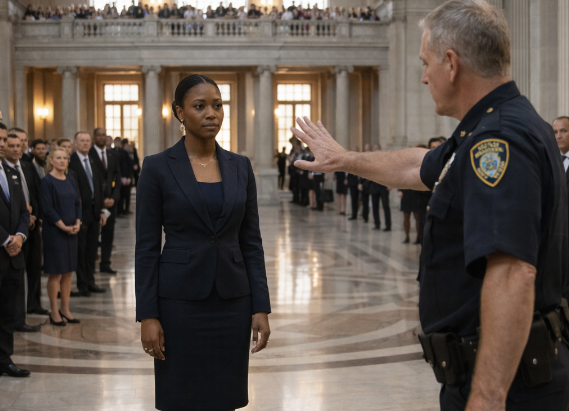
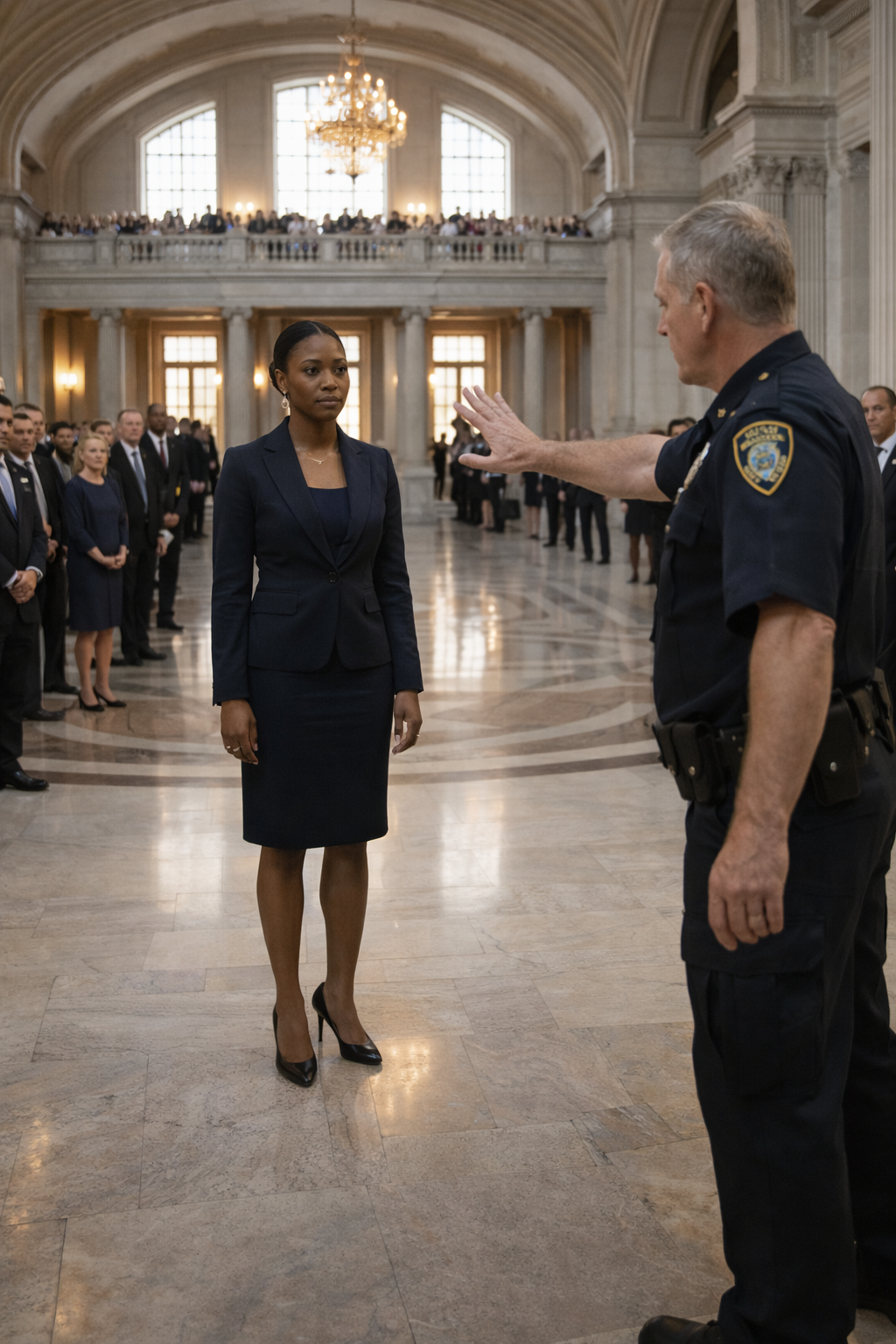
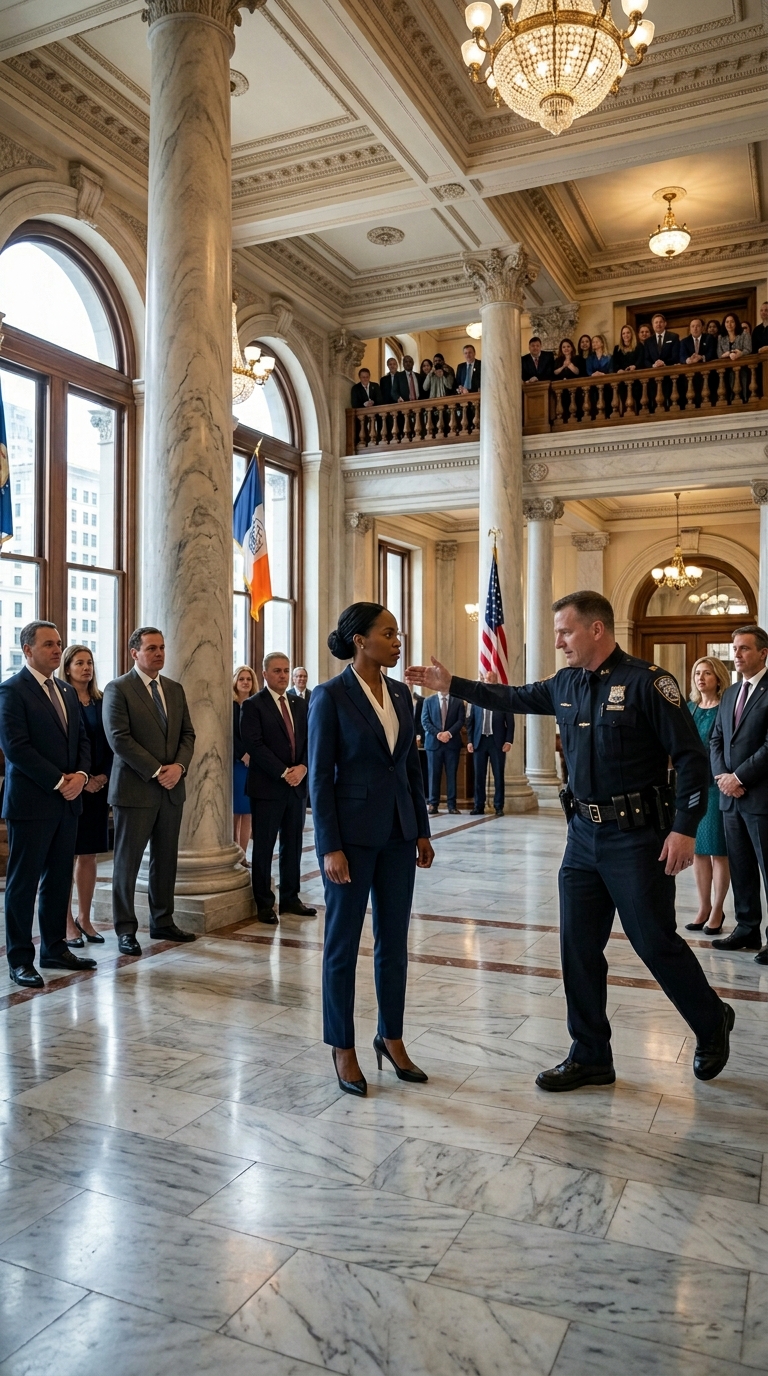
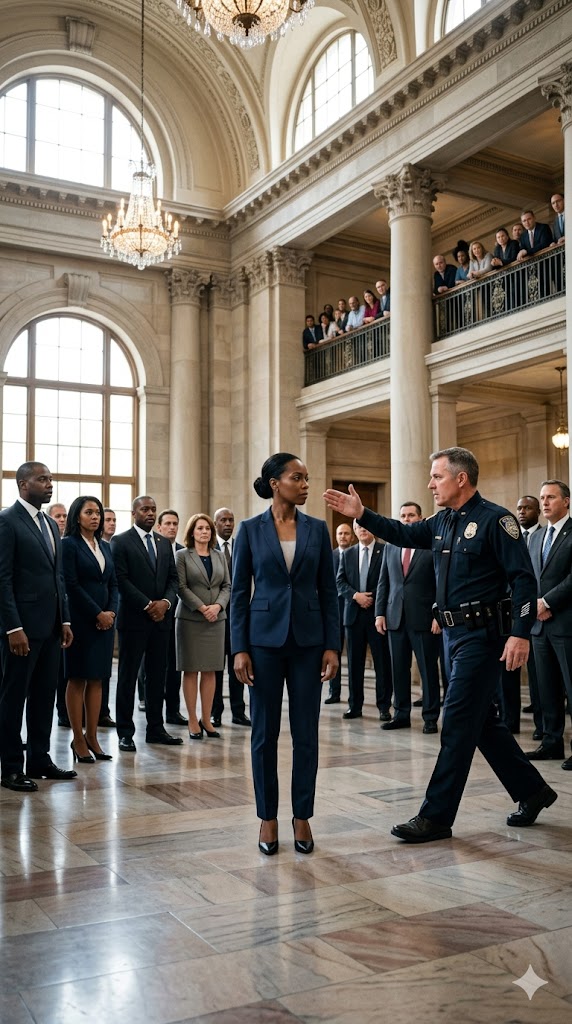
The young mother let out a soft gasp. Naomi’s expression remained unchanged. “I assure you, officer, I’m neither confused nor lost.” “Then prove it. Show me some ID.” “Am I being detained?” Walsh straightened. “Don’t get smart with me, lady. I’m trying to be nice here, but if you want to make this difficult—” “I’m not making anything difficult.”
“I asked a simple question. Am I being detained, or am I free to continue waiting for my appointment?” Walsh’s face tightened. “You know what? Yeah, you’re being detained for suspicious behavior.” Morrison’s eyes widened. “Walsh, come on. She’s just sitting.” “I said I’ve got this.” Walsh pointed at Naomi’s briefcase. “That’s yours?” “Yes.”
“Mind if I take a look?” “Actually, I do mind. You have no probable cause to search my belongings.” Walsh smiled—a cold, unpleasant smile. “Probable cause? Listen to you, talking like a lawyer. Where’d you learn that, TV?” Someone in the crowd muttered, “This isn’t right.” Walsh spun around. “Does anyone else want to interfere with police business? No? Then mind your own.”
He turned back to Naomi. “Last chance. Show me ID and open that briefcase, or we do this the hard way.” Naomi reached slowly for her purse. “Hands where I can see them!” Walsh’s hand flew to his weapon. Morrison mirrored him. The lobby erupted in shocked gasps. Three people dove behind a pillar.
Naomi froze, her hands visible. “Officer, I’m simply reaching for my identification, which you requested.” “Don’t move until I tell you to move.” Her hands remained perfectly still. “I need to reach into my purse to get my ID. I’m going to do that now. Slowly.” Walsh kept his hand on his holster. “Fine. Slow.” She retrieved her wallet, took out a card, and extended it toward him. He snatched it from her hand.
State of Oregon identification card. Official seal. Naomi’s photo—and in bold letters across the top: Governor. Walsh glanced at it for maybe two seconds. “This doesn’t give you clearance to loiter in government buildings.” He didn’t really read it. He saw a state ID and dismissed it. Morrison leaned over.
“Walsh, does that say—” “It says she’s got a state ID. So what? Everybody’s got an ID.” He tossed the card back at Naomi. It landed on the bench beside her. Martinez, the security guard, stepped forward. “Officers, perhaps I should check the—” “Martinez, back off. This doesn’t concern you.” “But sir, the visitor log—” “I said, back off.” Martinez retreated, though his hand drifted toward the phone on his desk.
Walsh grabbed Naomi’s briefcase. “Since you won’t open it voluntarily, I’m conducting a search for weapons and contraband.” “That’s an illegal search. I don’t consent.” “Your consent isn’t required.” He unzipped it roughly, dumping the contents onto the bench. Architectural plans spilled out. Budget spreadsheets. Official documents stamped with state letterhead.
A leather-bound planner embossed in gold: Office of the Governor. Walsh barely looked. “State documents? Where’d you steal these from?” “I didn’t steal anything. Those are my work materials.” “Your work materials?” Walsh laughed. “Right. What do you do—clean the state office buildings?” Morrison picked up the planner. His face drained of color. “Walsh.” “This says—” “Put it down.” “But Walsh—” “Put it down.” Morrison dropped it as if it burned him.
Naomi’s phone rang. Walsh grabbed it from the bench. “Who’s this? Your accomplice?” The screen read: Chief of Staff, Office of the Governor. Walsh declined the call. “Stop wasting government resources with fake contact names.” He tossed the phone back into her briefcase, cracking the screen.
“That’s destruction of property,” Naomi said quietly. “Sue me.” Walsh grabbed her elbow. “Come on. We’re taking a little trip downtown.” His grip was tight—deliberately tight. “On what charge?” “We’ll figure that out. Disorderly conduct for starters. Trespassing. Resisting. Take your pick.” “I haven’t resisted anything yet.”
Walsh pulled her to her feet. An elderly man spoke up. “Officer, this is wrong. She wasn’t bothering anyone.” Walsh turned on him. “Sir, step back or you’ll be arrested for interfering.” The man retreated, hands raised. Jessica Carter was already on her phone, calling the mayor’s office. Her voice carried from the balcony.
“Ma’am, you need to get down here now. The police are arresting someone, and I think—” Walsh shouted up at her, “Miss, end that call immediately or I’ll cite you for obstruction.” She didn’t hang up. Walsh radioed dispatch. “Unit 74, need backup at City Hall main lobby. Got a situation here.” The radio crackled. “Copy that, 74. Nature of situation?”
“Uncooperative individuals. Refusing to leave government property. Possible theft of state documents.” “Copy. Sending Unit 32.” Morrison whispered urgently, “Walsh, I really think we should check with someone before—” “Before what? Before we do our job?” Walsh’s voice rose. “This is exactly what’s wrong with this department. Too scared to enforce the law because someone might complain.”
He pulled handcuffs from his belt. The metal gleamed under the fluorescent lights. “Turn around. Hands behind your back.” Naomi didn’t move. “Officer Walsh, I’m going to say this once more. You’re making a mistake.” “The only mistake here is yours—thinking you could waltz into a government building and do whatever you want.” He grabbed her wrist. “Turn around now.”
“Walsh.” Morrison’s voice cracked. “Her ID. Did you actually read—” “I read it. State ID. Big deal. Turn around, ma’am.” The front doors opened. Two more officers stepped inside. Sarah Kelly, 27, a rookie with six months on the force. Tim Rodriguez, 45, a twenty-year veteran.
Rodriguez took one look at the scene, and his expression changed. Recognition flickered across his face. “Walsh, what’s going on?” He approached carefully. “Trespasser. Found her with stolen state documents, refusing to cooperate.” Kelly squinted at Naomi. “Walsh, are you sure she’s—” “I’m sure. Rodriguez, help me restrain her.”
Rodriguez moved closer to Naomi. He looked directly at her face, then at the portrait on the wall, then back again. His eyes widened. “Walsh, stop right now.” “Excuse me?” “I said, stop.” Rodriguez’s voice carried urgency now. “Do not handcuff her.” “Rodriguez, that’s an order. I’m senior—” “I don’t care if you’re the chief, that’s—”
He lowered his voice, stepping between Walsh and Naomi. “Walsh, look at her ID again. Actually look at it.” “I already looked at it.” “No, you didn’t. Look at it.” Walsh grabbed the card from the bench, irritated. His eyes scanned it quickly—then stopped.
His face drained from red to white in two seconds. The card slipped from his fingers. Rodriguez picked it up, holding it where Kelly and Morrison could see. State of Oregon across the top, the state seal embossed in gold. And beneath Naomi’s photo, in capital letters: Governor Naomi Pierce.
Morrison made a choking sound. Kelly’s hand flew to her mouth. Walsh just stared—at the card, at Naomi, at the portrait on the wall. The portrait of Governor Naomi Pierce staring back at him. The lobby fell silent—but not like before. This silence was heavier, suffocating.
Walsh’s hand hovered where he had dropped the ID. His mouth opened, then closed. No words came. Rodriguez’s voice cut through the silence. “Everyone heard me, right? That’s Governor Pierce. The Governor Pierce.”
Morrison stumbled backward. “Oh God. Oh God. Walsh, what did we—” “Shut up.” Walsh’s voice came out strained. “Just shut up.” But it was too late. The whispers began—spreading from person to person, phone to phone. “Did he just say governor?” “That’s the governor of Oregon.” “He tried to arrest the governor.”
Martinez was already sprinting to his desk, hands shaking as he grabbed the visitor log and flipped through the pages. Kelly stared at the portrait, then at Naomi, then back again. “Sir, we need to—” “I said, shut up.” Walsh’s face shifted from white back to red, panic setting in. His chest heaved.
Naomi remained perfectly still, watching—calm, composed—like she was observing an experiment. Rodriguez held up the ID for everyone to see. “This is Governor Naomi Pierce’s official state identification. Gold seal. Holographic security features. This is real.”
Walsh snatched it back, his hands trembling as he brought it closer. Reading. Rereading.
“No.”
No. This couldn’t be, but it was. Every detail screamed official. The raised seal felt real under his thumb. The hologram shifted in the light. Her photo matched perfectly. And that portrait, that godamn portrait he walked past every single day. Same face, same woman, same person he’d just grabbed, insulted, searched illegally. This is a mistake, Walsh said.
His voice sounded distant. This is some kind of some kind of what? Naomi spoke for the first time since Rodriguez arrived. Her voice was quiet. Deadly quiet. Some kind of misunderstanding. Walsh’s throat worked. Ma’am, I Governor. Rodriguez corrected him sharply. The proper address is Governor Pierce. Now, Governor Pierce.
Walsh could barely get the words out. I apologize. There’s been a terrible What? A terrible what, Officer Walsh? Naomi took a step toward him. He actually backed up. A terrible case of doing your job, of protecting this building, of treating a citizen with respect. She gestured around the lobby. Or a terrible case of deciding I didn’t belong here because of how I look.
The young mother with the permit forms nodded vigorously. Several citizens murmured, “Agreement.” Walsh tried again. “Ma’am, Governor, I didn’t know. You didn’t know.” Naomi’s eyes were still Let me ask you something, Officer Walsh. If I had been a white woman in a suit, sitting quietly on that bench, would you have approached me at all? Silence.
Would you have kicked my briefcase across the floor? Walsh’s eyes dropped. Would you have accused me of stealing documents, of casing the building, of not belonging? Morrison whispered, “Walsh, just apologize. I’m trying to No.” Naomi cut him off. “You’re trying to make excuses. There’s a difference.
” Martinez ran over, the visitor log clutched in his hands. “Officers, she’s right here. 11:30 appointment with Mayor Hartwell. Governor Naomi Pierce. It’s been in the system since last week. Walsh looked at the log like it was written in a foreign language. I tried to tell you, Martinez said, his voice shaking with anger now.
I tried to say check the log, but you told me to back off. Rodriguez turned to Walsh. You didn’t check the log. I didn’t think that’s the problem. You didn’t think. Rodriguez’s 20 years on the force gave his words. Wait. You saw a black woman and you made assumptions. That’s not That’s exactly what happened.
Rodriguez pointed at the spilled contents of Naomi’s briefcase. Documents with state letter head. A planner that says office of the governor in gold letters. Her ID card with governor printed across it. You looked at all of that and saw nothing. Walsh opened his mouth. Closed it. Kelly picked up the leather planner, handling it like a bomb. Sir, this is official.
The state seal is embossed on every page. Let me see that. Walsh grabbed it from her. Page after page of official business, meeting notes with legislators, phone calls with federal officials, policy drafts in Naomi’s handwriting, and today’s page marked clearly. 11:30 a.m. Mayor Hartwell, Riverside City Hall. Surprise facility inspection.
Walsh’s hands started shaking harder. Surprise facility inspection. She’d come here on purpose, early without security, to see how his department treated ordinary citizens, and he’d failed spectacularly. “You set this up,” Walsh said suddenly. “This was a trap.” The words hung in the air like gasoline fumes. Rodriguez’s face went pale.
Walsh, don’t. This was a setup. Walsh’s voice rose, desperate now. You came here dressed down, no security early. You wanted this to happen. Naomi’s expression didn’t change. Officer Walsh, I came here dressed professionally for a meeting with the mayor. Is a tailored suit dressed down to you? You know what I mean? You hid who you were. I hid nothing.
My identification was in my wallet. My official documents were in my briefcase. My appointment was in your visitor log. My portrait is on that wall. She pointed. I simply existed in a public space without announcing my title. You didn’t tell me you were the governor. Why should I have to? Her voice rose for the first time.
Why should any citizen have to prove their importance before receiving basic respect? The crowd erupted in agreement. Phones captured everything. Walsh’s face twisted. This isn’t fair. Anyone would have. Anyone would have what? Kelly interrupted. She was young, but she’d seen enough. Sir, I wouldn’t have. Rodriguez wouldn’t have.
Martinez tried to stop you. Morrison found his voice again. Walsh told me not to verify anything. He said we didn’t need to check with building security. You little Walsh turned on his partner. Don’t. Rodriguez stepped between them. Morrison, go stand by the door. Kelly, you two. They obeyed immediately. Now it was just Walsh, Rodriguez, and Naomi and 17 witnesses with phones.
Rodriguez spoke carefully. Governor Pierce, on behalf of Riverside Police Department, I sincerely apologize for Officer Rodriguez, while I appreciate the sentiment, you’re not the one who owes me an apology. Naomi’s eyes never left Walsh. And frankly, an apology isn’t enough. Walsh’s radio crackled. Unit 74, backup is 30 seconds out.
What’s your status? Rodriguez grabbed the radio before Walsh could respond. Dispatch, this is Officer Rodriguez. Cancel that backup. Situation is resolved. Repeat, cancel the backup. Copy that. Canceling unit 32. Martinez was on his desk phone now. Mayor Hartwell, you need to come down here immediately. It’s urgent. Yes, ma’am.
The governor is Yes, she’s here. No, ma’am. There’s been an incident with officers. Walsh lunged for the phone. Rodriguez blocked him. Don’t even think about it. Rodriguez, we can fix this. We can explain. Fix this? Rodriguez laughed bitterly. Walsh, you assaulted the governor of Oregon on camera with 17 witnesses in her own building.
It wasn’t assault. I barely You grabbed her arm hard enough to leave marks. Rodriguez pointed at Naomi’s wrist. Red finger marks were already visible. You kicked her briefcase. You broke her phone. You conducted an illegal search. You ignored her rights. And you did it all while calling her people like you. Every word hit Walsh like a physical blow. We all heard it.
The elderly man called out. He said people like you at least three times. He said she looked like she crawled out of a section 8 building. The young mother added. He asked if she stole her outfit from Goodwill. Jessica Carter shouted from the balcony. Walsh looked around wildly. Every face stared back at him, accusing, disgusted.
I was just doing my job. Your job is to protect citizens, not terrorize them. Rodriguez unclipped Walsh’s radio. Give me your badge. What badge? Weapon now. Rodriguez, you can’t. I’m a senior officer and you just committed multiple felonies in front of God and everybody. Badge now.
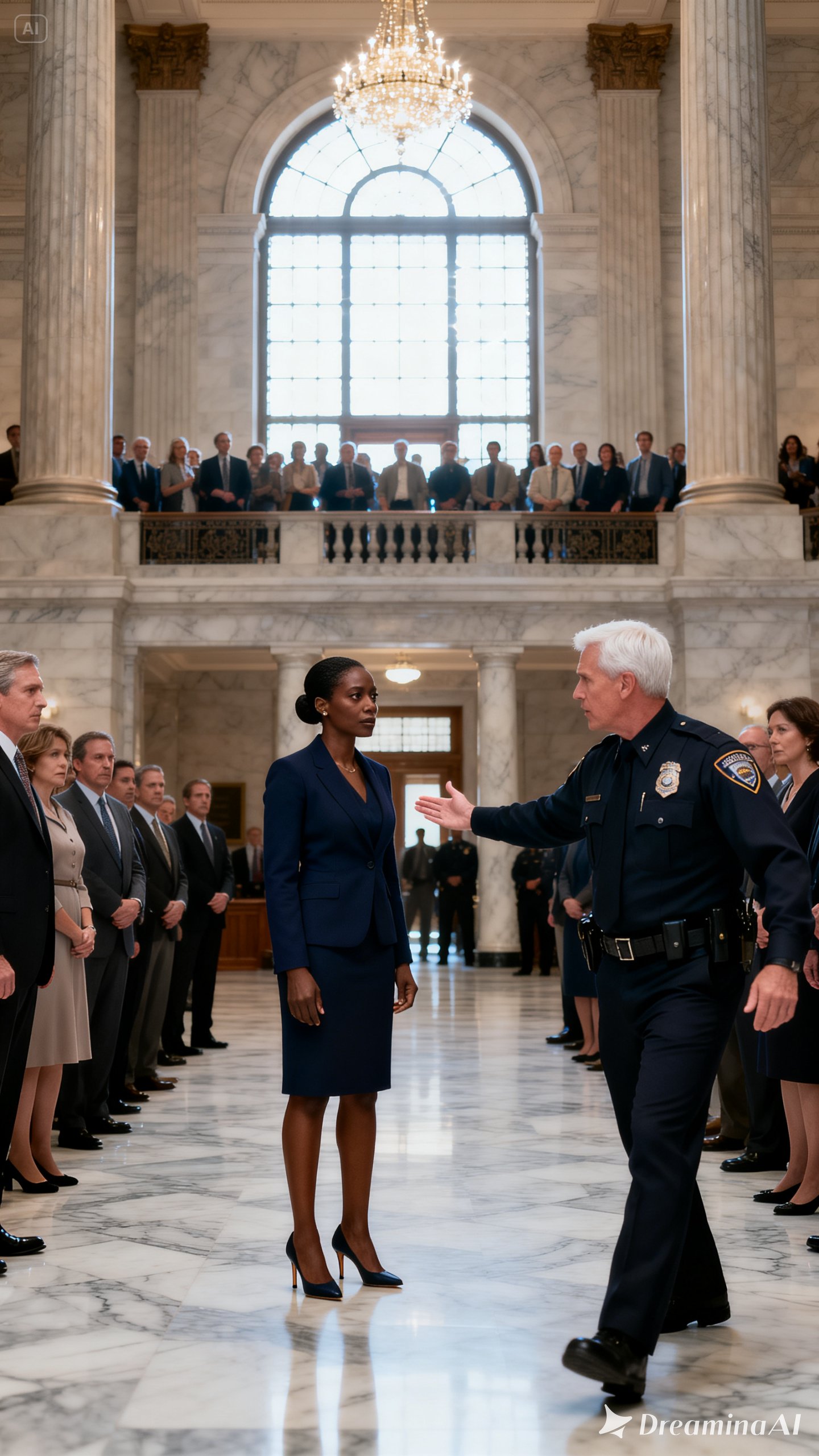
Walsh’s hands went to his belt. They fumbled with the badge holder. It took three tries to uncip it. Rodriguez took it. The weight felt wrong in his hand. All those years Walsh carried it. All those complaints, all those chances to change, gone in 15 minutes. Morrison was crying now. actual tears running down his face. I didn’t know.
I swear I didn’t know who she was. Naomi turned to him. Officer Morrison, you didn’t need to know who I was. You needed to treat me like a human being. That’s the baseline, not the exception. I know. I just Walsh said. Walsh said and you followed. How many times have you followed Walsh into situations like this? Morrison’s silence was answer enough. The elevator dinged.
Mayor Katherine Hartwell burst into the lobby, her assistant struggling to keep up. She saw Naomi and her face went from confusion to horror in seconds. Oh my god, Governor Pierce, I am so She stopped mid-sentence. Naomi stood there, briefcase contents still scattered on the bench, red marks on her wrist. Walsh holding his badge and shaking hands.
Rodriguez looking ready to explode. Citizens with phones out. Mayor Hartwell understood immediately. What happened here? Her voice could have cut glass. Mayor Hartwell’s heels clicked across the marble like gunshots. She took in every detail. The scattered documents, the broken phone, the marks on Naomi’s wrist, Walsh’s pale face.
Someone answer me now. Rodriguez stepped forward. Ma’am, officers Walsh and Morrison attempted to forcibly remove Governor Pierce from the building. They accused her of trespassing, conducted an illegal search, and were preparing to arrest her. The mayor’s face was drained of color. “They what? They didn’t know who she was,” Rodriguez continued.
Walsh refused to properly check her identification, refused to verify with building security, refused to check the visitor log. Hartwell turned slowly to Walsh. Is this true? Walsh’s mouth opened. Nothing came out. Officer Walsh, is this true? I She didn’t. There was no way to It’s a yes or no question.
Walsh’s shoulders slumped. Yes, ma’am. The mayor closed her eyes, took a breath. When she opened them again, her voice was ice. Governor Pierce, I cannot begin to express how deeply sorry I am. This is unconscionable, unacceptable, and it will be dealt with immediately. Naomi picked up her ID card from where it still lay on the bench.
Mayor Hartwell, this isn’t your fault, but this is precisely why I insisted on these surprise inspections. She held up the card for everyone to see. My name is Dr. Naomi Pierce. I’m the governor of Oregon. I was here for a scheduled facility inspection with Mayor Hartwell at 11:30. Murmurss rippled through the growing crowd.
More staff had come down from the upper floors. A janitor stood frozen with his mop. I deliberately arrived early, Naomi continued, her voice carrying across the lobby. Dressed professionally but without my security detail. I wanted to observe how city employees interact with ordinary citizens who don’t announce their titles. She turned to Walsh.
Officer Walsh saw a black woman sitting quietly on a bench, and he decided I was a problem, a threat, someone who didn’t belong. Walsh flinched at every word. He didn’t need to know I was governor to treat me with dignity. That’s not how respect works. Respect shouldn’t require credentials. The young mother started clapping.
then the elderly man, then Jessica Carter from the balcony. Within seconds, the entire lobby erupted in applause. Walsh stood frozen in the center of it, drowning in the sound. Naomi raised her hand. The applause died. 6 months ago, I signed three police accountability bills into law. mandatory bias training, pattern tracking databases for complaints, civilian oversight boards with real authority.
She looked directly at Walsh. This was a test of implementation, and Officer Walsh just failed in the most public way possible. Walsh’s knees looked ready to buckle. Mayor Hartwell pulled out her phone. I’m calling Chief Burke right now. Governor, do you want to press charges? Yes. One word, absolute. Walsh made a strangled sound.
Governor, please. I have a family. I didn’t mean you have a family. Naomi’s voice was quiet. Dangerous quiet. Do you know how many families you’ve terrorized? How many black fathers have you pulled over for nothing? How many children have you scared? She picked up her briefcase, began collecting her scattered documents.
I pulled your file on the plane here. 17 excessive force complaints. 17 all against people of color. All dismissed by your department. Walsh’s face went gray. So, no, Officer Walsh. I don’t accept your apology because you’re not sorry you did it. You’re sorry you got caught. You’re sorry I turned out to be someone with power.
The mayor was already on the phone. Chief Burke, Katherine Hartwell, I need you at city hall immediately. We have a situation involving Governor Pierce and two of your officers. No, she’s fine, but yes, I’ll explain when you get here. 5 minutes. She ended the call. Two state police officers burst through the front doors, hands on weapons.
Naomi’s security detail. Governor Pierce. The lead agent rushed over. Ma’am, are you all right? We got an alert from city hall security. I’m fine, Agent Morrison. Stand down. Ma’am, we have protocols which I deliberately circumvented for this inspection. I’m unharmed. The agent looked at the red marks on her wrist, his jaw clenched.
Ma’am, with respect, you’re clearly not unharmed. He turned to Walsh. Who put hands on the governor? Walsh took a step back. Rodriguez pointed. He did. Officer Brendan Walsh, badge number 742. The state police agents hand went to his cuffs. “Sir, you’re being detained pending investigation of assault on a state official.
” “I didn’t assault anyone,” Walsh’s voice cracked. “I was doing my job.” “Your job is to assault citizens?” Naomi asked. “No, I mean, I thought you thought what? That I was beneath you? That I didn’t deserve basic dignity? that you could treat me however you wanted because I’m black. I never said you didn’t have to say it, Officer Walsh.
Your actions said it loud and clear. The front doors opened again. Chief Raymond Burke entered, his face already read. He saw Naomi and stopped dead. Dear God, he looked at Walsh, at the scattered documents, at the state police with hands-on weapons. Please tell me this isn’t what I think it is. Mayor Hartwell handed him her phone. Security footage already pulled up.
The whole incident from three camera angles. Burke watched in silence. His face went from red to purple. When the video ended, he looked at Walsh. Give me your badge and weapon right now. Chief, I can explain. Badge weapon now. Walsh fumbled with his holster. His service weapon came out, hands shaking so badly, Rodriguez had to take it for him. The badge followed.
19 years on that shield. Gone. Burke turned to Morrison. You, too. Morrison didn’t argue. He handed everything over immediately. Both of you are suspended without pay, effective immediately, pending a full internal investigation and criminal charges. Burke’s voice shook with barely controlled rage.
And when I’m done with you, there won’t be a department in this country that’ll hire you. He faced Naomi. Governor Pierce, I take full responsibility for the culture that allowed this to happen. These men work for me. Their actions reflect my leadership. Naomi studied him. Your next actions will determine whether that responsibility means anything, Chief Burke. I understand, ma’am.
More news vans pulled up outside. Reporters pressed against the glass doors. The story was already spreading, and Walsh’s world was already over. The FBI arrived 12 minutes later. Special Agent Victoria Carter strode through the front doors, badge already out. Two more agents followed, moving like they own the building now.
I’m looking for Governor Naomi Pierce. Naomi stepped forward. That’s me. Agent Carter’s eyes went to the marks on Naomi’s wrist. Her expression hardened. Ma’am, I’m Special Agent Carter, Civil Rights Division. We received an alert from the State Attorney General’s office about a potential federal civil rights violation. She turned to Walsh and Morrison, still standing under Rodriguez’s watch.
Which one of you put hands on the governor? Walsh raised his hand slowly like a school boy admitting guilt. Both of us, Morrison said quietly. I assisted. Agent Carter pulled out her handcuffs, different from police cuffs. Federal, heavier. The sound of them clicking open echoed through the lobby. Officer Brendan Walsh, you’re being detained for suspected violation of Title 18 section 242, deprivation of rights under color of law.
Walsh’s legs finally gave out. He stumbled. Rodriguez caught him. No, no, this can’t be federal. I’m a local cop. This was This was you using your authority as a law enforcement officer to violate a citizen’s constitutional rights. That makes it federal. Agent Carter turned to Morrison. You too. Morrison was already crying.
I just followed orders. Walsh told me the Nuremberg defense didn’t work then, doesn’t work now. Agent Carter gestured to her partners. Cuff them both. The federal agents moved in. Cold efficiency. Walsh’s hands went behind his back. The cuffs clicked shut. He looked at Naomi. Governor, please. I’ll resign.
I’ll do anything. My wife, my kids. Naomi’s voice was still should have thought about your family before you grabbed me. Before you called me people like you. Before you made 17 other families live in fear. I swear I’ll change. You had 17 chances to change. She picked up her phone. Screen cracked from where Walsh threw it. This will be your consequence.
Morrison sobbed. My wife is pregnant. She’s due in three months. Please, Governor Pierce. Kelly, the young officer, spoke up. Sir, with respect, maybe you should have thought about that before you helped Walsh violate someone’s rights. Morrison’s head dropped. Chief Burke was already on his phone with the police union.
His voice carried across the lobby. I don’t care what the contract says, Frank. They assaulted the governor of Oregon on camera with 17 witnesses. No, I will not wait for the union lawyer. They’re done. Yes, I know you’ll fight it. Good luck with that. He ended the call, looked at Walsh. The union president is on his way.
He’ll fight for you. He always does. Burke’s laugh was bitter. But this time, Walsh, you’re on your own. I’m not covering for this. The mayor’s assistant ran over with a tablet. Ma’am, it’s already on social media. Someone posted the video. Hartwell looked at the screen. Her face went pale. It has 50,000 views already.
“Check Twitter,” Jessica Carter called from the balcony. “It’s trending. Number three in the country. Had Governor Pierce.” Walsh made a choking sound. Martinez. The security guard approached Naomi. Governor, I’m sorry I didn’t intervene sooner. I should have. Mr. Martinez, you tried. Officer Walsh shut you down. You’re not at fault here.
But I could have done more. You alerted the mayor’s office. You kept the security footage. You documented everything. Naomi smiled. That’s exactly what you should have done. Martinez’s eyes welled up. Thank you, ma’am. Rodriguez stepped forward. Governor Pierce, I’d like to formally request an assignment to your case as a cooperating witness.
Granted. Walsh looked at Rodriguez with betrayal. You’re testifying against me in a heartbeat. Rodriguez’s voice was cold. I’ve watched you harass people for 12 years, Walsh. Complained to supervisors five times. Nothing ever happened. Well, something’s happening now. Agent Carter began reading.
Miranda writes, “You have the right to remain silent. Anything you say can and will be used against you in a court of law. News cameras pressed against the glass doors. Reporter Amanda Torres held up her microphone broadcasting live. We’re here at Riverside City Hall where Governor Naomi Pierce was allegedly assaulted by police officers during a surprise facility inspection.
The governor appears unharmed but visibly shaken. And two officers are being taken into federal custody as we speak. Walsh listened to his rights like a man in a dream. This wasn’t real. This couldn’t be happening. But the handcuffs were real. The cameras were real. The end of his career was real. Agent Carter finished the Miranda warning.
Do you understand these rights as I’ve read them to you? Walsh nodded numbly. I need a verbal response. Yes. His voice barely worked. I understand. Good. Agent Carter guided him toward the door. Let’s go. The crowd parted. Citizens watched in silence as Walsh and Morrison were led out in federal handcuffs. Outside, cameras flashed like lightning. Reporters shouted questions.
Inside, Naomi stood by the bench where this all started. Calm, dignified, victorious. Justice had just walked through the door and it was wearing FBI badges. Two weeks later, the Department of Justice opened a full civil rights investigation, not just into Walsh and Morrison, into the entire Riverside Police Department.
The team arrived on a Monday morning. 12 federal investigators with boxes of subpoenas and years of experience finding patterns. What they found made national news. Walsh’s 17 complaints weren’t isolated. They were symptoms of a disease infecting the entire department. 47 additional complaints against various officers. All involving racial profiling, all dismissed by supervisors, all buried in files.
The investigators reviewed every arrest record from the past 5 years. Pulled dash cam footage that hadn’t been accidentally erased. They found gold. Officer Walsh’s dash cam from three years ago pulling over a black teenager for suspicious driving. The kid drove his father’s Mercedes to a debate tournament. Suit and tie straight A student.
Walsh made him sit on the curb for 40 minutes while he verified ownership. Called him boy six times. Another video from 18 months ago. Walsh stopping a black woman for rolling through a stop sign. She was a nurse coming home from a double shift. He searched her car without consent, found nothing, still gave her three tickets. Her complaint disappeared until now.
CNN picked up the story on day four. The footage went viral. By day seven, protests surrounded Riverside City Hall. Thousands of people holding signs. Badge doesn’t mean blind justice. Walsh in jail. Morrison cracked first. His lawyer made a deal with federal prosecutors. Full cooperation for reduced charges.
Morrison gave them everything. Text messages with Walsh from 2 years. Racist jokes. Mocking citizens they had harassed. Slurs Morrison couldn’t say out loud in the deposition. Walsh always said we had to keep them in their place. Morrison testified. He meant black people, Hispanic people, anyone not white.
The prosecutor leaned forward. Did you ever object? Morrison’s voice broke. No, ma’am. I laughed along. I thought that’s how you fit in. When Walsh grabbed Governor Pierce, what did you think? I thought he was making a mistake, but I’d seen him do it before to people who couldn’t fight back. This time, he picked the wrong person.
That testimony sealed Walsh’s fate. The trial started 6 months after the city hall incident. Judge Maria Rodriguez presiding. The courtroom was packed. Media circus outside. Walsh pleaded not guilty. His lawyer argued that it was an honest mistake. Split-second judgment. No racist intent. The prosecution brought receipts. Day one.
Security footage from eight angles. The jury watched Walsh kick the briefcase. Grab Naomi’s arm. Ignore her ID. Call her people like you. Three jurors visibly winced. Day two. Walsh’s social media history. Memes about Black Lives Matter. Thin blue line posts. Comments under police shooting articles. Play stupid games. Win stupid prizes. Day three.
Text messages between Walsh and Morrison after traffic stops. Walsh. Another one thinks he’s special. These people never learn. Morrison. Lol. Did you see his face? Walsh. Priceless. This job has perks. Walsh’s lawyer objected repeatedly. Judge overruled every time. Day four. Character witnesses for Walsh collapsed under cross-examination.
His neighbor. He’s a good family man. Prosecutor. Were you aware of 17 excessive force complaints? Neighbor. Well, no. Prosecutor. No further questions. Day five. Naomi testified. The courtroom went silent when she entered. Professional gray suit, hair pulled back. She took the oath, sat down, looked at the jury.
The prosecutor began gently, “Governor Pierce, walk us through that morning.” Naomi’s voice stayed steady. She described every moment, every word Walsh said, every assumption he made. He didn’t see a governor. He didn’t see a doctor. He saw a black woman on a bench and he decided I was a problem. Walsh’s lawyer stood for cross-examination.
Governor Pierce, didn’t you deliberately conceal your identity? I concealed nothing. My ID was in my wallet. My documents were in my briefcase. I simply didn’t announce my title. But you knew that would make Officer Walsh suspicious? Suspicious of what? Sitting on a bench. Is that suspicious behavior, counselor? The lawyer shifted.
You have security detail, yet you arrived without them. Weren’t you hoping for this situation? Naomi leaned forward. I was hoping to see how police treat ordinary citizens without governor’s titles. Citizens who can’t call the FBI when harassed. Officer Walsh showed me exactly what I needed to see. Whispers erupted.
Judge Rodriguez banged her gavvel. What did you need to see? That the bills I signed weren’t being implemented? That officers like your client still believe they’re above the law? That black Americans can’t exist in public without being seen as threats? She looked at Walsh. I came to do my job. Your client decided I didn’t belong because of my skin color. That’s not a mistake.
That’s a pattern. Walsh’s lawyer sat down. The jury deliberated for 4 hours. Guilty on all counts. All federal civil rights violations, assault under color of law, false imprisonment, deprivation of constitutional rights. Walsh sat frozen. His wife sobbed in the gallery. Morrison, who’d pleaded guilty, received his sentence the same day.
6 months federal prison, 3 years supervised release, permanent ban from law enforcement. He’d never wear a badge again. Walsh’s sentencing came 2 weeks later. Judge Rodriguez looked down. Officer Walsh, you were given authority to protect and serve. Instead, you weaponized it against those you swore to protect. Walsh stared at his hands.
17 complaints. Countless victims who never filed because they knew the system wouldn’t listen. A pattern stretching back a decade. The judge’s voice hardened. 7 years in federal prison, 5 years of state charges concurrent, $250,000 fine, permanent ban from law enforcement anywhere in the United States. Walsh’s knees buckled.
Furthermore, mandatory racial bias education during incarceration and a public apology. Walsh’s lawyer whispered to him. Walsh stood. Your honor, I can’t apologize for something I don’t believe I did wrong. Silence crashed through the courtroom. Excuse me. I was doing my job. If she’d told me who she was, Baleiff, remove the defendant.
Walsh was led away, still protesting. Outside, Naomi gave a statement. Today, justice was served not just for me, but for every person Officer Walsh harassed, for Sharon Mitchell, for that debate student. For 17 people whose complaints were ignored. Cameras clicked. But this isn’t over.
Riverside PD is under federal consent decree. 12 officers were terminated. The entire department is being retrained. She paused. I’ve introduced expanded legislation, the Pierce Accountability Act, mandatory body cameras, real civilian oversight, a statewide database tracking officer complaints. A reporter shouted, “Some say you’re too hard on the police.
” Naomi smiled. “I’m not being hard on the police. I’m being fair to citizens. There’s a difference.” One year later, the Riverside Police Department looked different now. Chief Raymond Burke had retired, forced out by the consent decree and his own conscience. The new chief was Maria Diaz, Latina, former civil rights attorney, zero tolerance for misconduct.
She’d fired 12 officers in her first month, retrained everyone else, installed body cameras that couldn’t be turned off, created a civilian oversight board with real power to investigate and discipline. The changes were working. Excessive force complaints dropped 87%. Community trust surveys showed 64% improvement.
Parents stopped teaching their kids to fear the police. Officer Tim Rodriguez became the department’s training supervisor. He taught de-escalation, bias recognition, constitutional rights. Every new recruit watched the security footage from that day at city hall. Eight angles, 15 minutes. Walsh’s voice echoing through the training room.
This is what happens when you let prejudice wear a badge, Rodriguez told each class. This is what we will never be again. James Martinez, the security guard, received a commendation from the mayor. He now served as community liaison, building bridges between police and citizens. Officer Sarah Kelly left Riverside PD.
She joined the state police academy as an instructor. She taught a class called When Your Partner Is Wrong. Morrison served his six months, got out, moved to another state, worked construction now. He’d never touch a badge again. Walsh was still in federal prison. 3 years down, four to go. A journalist visited him last month, asked if he’d learned anything.
Walsh stared at the table between them. I destroyed my life because I couldn’t see past my prejudice. his first real moment of remorse. I think about that day every moment. How differently I would act now. Then he added, “But the system created me. They trained us to see threats, not people.” The journalist pushed back.
“You had 17 chances to change.” Walsh said nothing. The Pierce Accountability Act passed in Oregon, then spread. Seven other states adopted it. Federal legislation citing Naomi’s case as the catalyst. Policemies nationwide use the incident as a training case study. Naomi’s approval rating hit 73%, highest of any governor in the nation.
Late one evening in her office, she reviewed a stack of new policy proposals. A documentary filmmaker sat across from her. “People ask if I’m angry,” Naomi said. “I’m not angry. I’m determined.” She met the camera’s gaze. “That day at City Hall wasn’t about me. I was fine. I had power. But what about the teenager stopped for looking suspicious? The mother searched in front of her children?”
“They don’t have governor’s titles.” Her voice softened, but its strength remained. “Real change comes when we stop requiring credentials for dignity.” The filmmaker asked about Riverside now. Naomi smiled. “They’re a model—town halls between police and the community, youth programs where officers mentor at-risk teens, trust-building that actually works.” She stood and walked to the window.
The Capitol building glowed against the night sky. “If you’ve ever been judged for your appearance, profiled for your race, dismissed because of your identity—you’re not alone.” She turned back to the camera. “If you’ve witnessed injustice and stayed silent, speak up, record it, testify, stand with the vulnerable.” Her gaze didn’t waver.
“And if you wear a badge, remember—your authority is a gift from the people. Respect it. Respect them.” Back at Riverside City Hall, a new plaque hung beneath Naomi’s official portrait: Justice requires no credentials. Dignity is a birthright, not a privilege. Every day, diverse crowds passed through the lobby.
Martinez greeted each person with warmth—no suspicion, no interrogation, just service. This was what America should look like. This was what justice demanded. Naomi looked straight into the camera—into your eyes. “This story is real. It happens every day. But it doesn’t have to.” She leaned forward. “Subscribe if you believe in accountability.”
“Share if you’ve experienced profiling. Comment with your story. Let’s build a movement. Hit like if you believe justice belongs to everyone, regardless of title or skin color. Follow for more stories of systems being held accountable.” Her final question lingered in the air like a challenge.
“If I had been dressed casually instead of wearing a suit, would Walsh’s behavior have been justified? If I didn’t have a title, would I have deserved that treatment? When do we decide someone belongs in a public space?” She paused.
“Be honest—have you ever made assumptions about someone based solely on how they looked? Drop your answer in the comments. The truth might surprise you.” The screen faded to black. White text appeared: Based on composite events, racial profiling affects millions each year. If you’ve experienced discrimination, document everything and report it.
Change begins with witnesses willing to speak the truth.
Naomi’s portrait in City Hall. Martinez smiling as he welcomed visitors. Diverse faces moving freely through marble halls. Her voice, one last time:
“This is what we’re fighting for.”