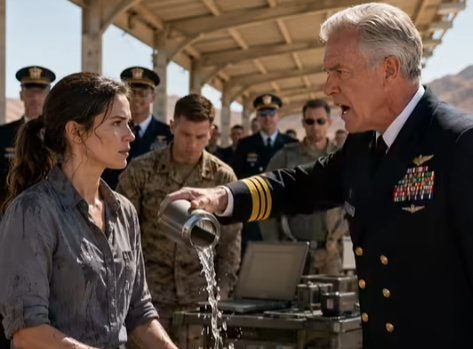
The Woman the Admiral Chose to Humiliate
“Stand down right now!” someone shouted across the range.
Nobody moved.
“Step away from that rifle before you embarrass yourself.”
Admiral Daniel Cross said it loud enough for everyone to hear—then dumped a full canteen of water across Rachel Bennett’s weapons table.
The Arizona firing range fell silent.
Only seconds earlier, the range had been alive with noise.
Rifles cracked across the lanes. Officers barked sharp commands. Empty brass skipped across the concrete. Wind swept pale dust over the black mats beneath the relentless desert sun.
Then came the water.
It splashed across the metal components first.
The bolt carrier group.
The spring.
The receiver.
The retaining pin.
Thin streams spread beneath the rifle parts, flowing across the table as if meant to erase her work before it was finished.
Several drops landed on Rachel’s hands.
Others soaked into the front of her gray work shirt.
Yet she never moved.
She didn’t wipe away the water.
She didn’t flinch.
She simply kept her hands exactly where they were.
Bolt.
Spring.
Pin.
Receiver.
Behind Admiral Cross, a few officers exchanged amused smiles.
Not openly at first.
Just subtle expressions from men waiting to see how much cruelty authority would allow.
Cross lowered the canteen with deliberate satisfaction.
Tall, broad-shouldered, and flawless in his Navy dress uniform, he looked like a man accustomed to entering rooms and watching everyone step aside.
“Tell me something, sweetheart,” he said. “What exactly is your rank?”
One officer laughed.
Then another.
Soon the laughter spread through the group.
Rachel picked up the next component with two fingers, aligned it carefully, and slid it into place.
Click.
The sound was crisp.
Tiny.
Sharper than the laughter surrounding her.
The nearest range officer shifted uneasily but remained silent.
A young Marine at the neighboring table lowered his eyes toward his boots.
Two civilian contractors beside a diagnostic cart suddenly became fascinated with a tablet whose screen had already gone dark.
Everyone had witnessed what Cross had done.
Nobody wanted to be the first to challenge him.
Cross waited for Rachel’s answer.
She gave him none.
Her silence made his smile colder.
“I’m talking to you.”
Rachel checked the rail.
Adjusted the spring tension.
Seated the upper receiver perfectly.
Click.
The admiral’s expression tightened.
“You deaf?”
Only then did Rachel reach for the charging handle.
Her movements weren’t slow.
They weren’t dramatic.
They were precise.
The kind of precision that made everyone else’s impatience seem careless.
She pulled the charging handle back.
Click.
Then she raised her eyes.
They were calm.
Far too calm for someone publicly humiliated before half a command delegation.
“Are you finished?” she asked.
The laughter faded in an odd way.
Not all at once.
Piece by piece.
A captain stopped smiling.
A lieutenant blinked.
The young Marine looked up again.
Cross clenched his jaw.
“I asked for your rank.”
Rachel met his gaze without hesitation.
“I don’t have one.”
A few officers chuckled again, though far less confidently.
Cross turned slightly toward the others, inviting them to enjoy the spectacle.
“There you have it,” he said. “This is an active military range, not a contractor’s hobby bench.”
Rachel glanced at the water spreading beneath the rifle components.
Then she looked back at him.
“You poured water on a diagnostic table because you wanted an audience.”
The silence changed immediately.
It no longer carried amusement.
It carried warning.
A swirl of dust twisted briefly beyond lane twelve before disappearing behind the targets.
Far downrange, a steel plate rocked gently in the wind.
Cross stepped closer.
His shadow fell across her hands.
“You know who I am?”
“Yes.”
His voice lowered.
“And you still think that’s an acceptable way to speak to me?”
Rachel didn’t answer immediately.
She looked at the rifle parts.
The water.
The officers.
The young Marine who still struggled to raise his head.
Then she inserted the final retaining pin.
Click.
Cross narrowed his eyes.
For the first time, uncertainty flickered across his face.
Only briefly.
Not enough for most people to notice.
But Rachel noticed.
So did the range officer.
Because the rifle was no longer a collection of scattered components.
It was assembled.
Wet.
Clean.
Operational.
Rachel lifted it with both hands.
One officer behind Cross stepped forward.
“Ma’am, maybe you should—”
Cross raised a hand and stopped him.
He wanted this.
He wanted the humiliation to continue.
He wanted the civilian woman to fail where everyone could watch.
Rachel rotated the rifle slightly, checking the chamber, the rail, the alignment, and the seating.
Water still glistened across the black metal surface.
Cross smiled again.
“Careful,” he said. “Wouldn’t want the civilians getting hurt.”
Rachel’s expression never changed.
But something in the atmosphere tightened.
The contractors stopped pretending to study the tablet.
The range officer’s hand drifted toward his radio.
The young Marine finally looked directly at her.
Rachel stepped toward the firing line.
Slowly.
Steadily.
Not like someone trying to prove herself.
Like someone returning to a place that already belonged to her.
Cross watched openly with contempt.
The officers watched with curiosity.
The range watched with silence.
Rachel reached the line, raised the rifle, and settled it against her shoulder.
Wind brushed across her face.
Dust drifted between her and the distant targets.
For one long second, nobody breathed.
Then the diagnostic cart behind the officers emitted a sharp electronic chirp.
One contractor stared at the tablet.
His face immediately changed.
The second contractor leaned closer.
His smile vanished.
Cross noticed at once.
“What is it?” he snapped.
Neither contractor answered.
Rachel remained motionless on the firing line, rifle steady, eyes fixed downrange.
The first contractor swallowed hard before turning the tablet around.
A classified authorization banner now filled the screen above Rachel Bennett’s name.
The range officer turned pale.
Cross looked at the display.
Then at Rachel.
Then back at the display.
For the first time that afternoon, Admiral Daniel Cross had nothing to say.
Rachel’s finger settled near the trigger.
And the entire command delegation suddenly realized they might have humiliated the one person they had been ordered to protect.
No one on that firing range was prepared for what would happen next.
It began with the target moving.
Not falling.
Not swinging.
Moving.
Downrange, beyond lane twelve, the steel plate that had rocked in the wind suddenly slid three inches to the left.
A murmur passed through the officers.
Rachel Bennett did not lower the rifle.
Her cheek remained against the stock. Her breathing stayed even. Her eye tracked the shifting plate as if she had expected it all along.
Admiral Daniel Cross turned sharply toward the range officer.
“What the hell is that?”
The range officer’s face had gone bloodless.
“I didn’t authorize movement on that lane, sir.”
The answer made the silence colder.
Then a second plate moved.
This one rose slowly from behind a low barricade, its black surface catching the desert light.
A red indicator blinked at its center.
One blink.
Then another.
The young Marine beside the neighboring table whispered, “That’s not part of the drill.”
Rachel heard him.
So did Cross.
But only Rachel understood the fear in the boy’s voice.
Not confusion.
Recognition.
The Marine had seen this before.
Rachel’s finger stayed outside the trigger guard.
“Clear everyone behind the line,” she said.
Cross snapped his head toward her.
“You don’t give orders here.”
Rachel did not look away from the target.
“Then give it yourself.”
The words struck harder because they were quiet.
Cross’s face darkened, but the diagnostic tablet chirped again before he could answer.
The first contractor looked down.
His hands began to shake.
The screen now showed a second banner beneath Rachel’s name.
LIVE SAFETY OVERRIDE DETECTED.
The contractor whispered, “Oh God.”
Cross heard that too.
“What does that mean?”
The contractor swallowed.
“It means the range system thinks there’s a live breach.”
“Thinks?”
Rachel finally spoke again.
“No,” she said. “It knows.”
Then the first shot cracked from downrange.
Not from Rachel’s rifle.
From somewhere behind the moving target.
The sound slammed across the range like a door kicked open.
Officers ducked.
Someone shouted.
The young Marine froze where he stood, eyes wide, body locked in the terrible stillness of someone remembering a nightmare.
The round struck the concrete barrier ten feet from Rachel’s lane and sparked into dust.
Rachel did not flinch.
She only shifted her stance.
Half an inch.
Enough.
The second shot came.
Rachel fired once.
The wet rifle cracked cleanly.
The moving steel plate snapped backward, but Rachel’s shot had not hit the center.
It had struck the hinge.
The plate collapsed sideways, exposing a black remote firing rig bolted behind it.
The entire command delegation stared.
For a moment, no one understood what they were seeing.
Then the second contractor whispered, “That’s a mounted test barrel.”
The young Marine’s mouth parted.
Cross went rigid.
Rachel fired again.
The second shot severed a cable near the barricade.
The blinking red light died.
Dust drifted over the lane.
No one moved.
No one even breathed.
Rachel lowered the rifle slowly, but not completely.
“Range is still hot,” she said.
Her voice carried across the concrete.
This time, everyone listened.
…
“They Made Her Kneel in Front of Everyone. They Didn’t Realize She Was Building the Case Against Them.”
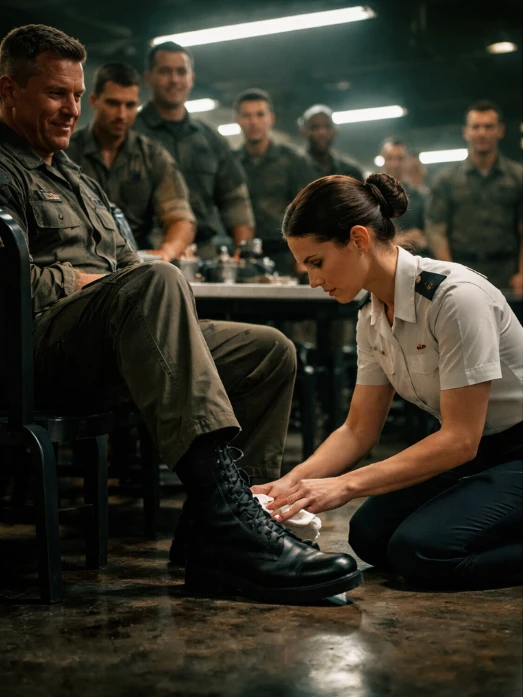
“On your knees. Wipe my boots.”
The words cut across the dining facility before Lieutenant Jade Monroe had even set her tray down, before the door had fully closed behind her, before the room had decided whether she belonged in it.
Forks paused mid-air. Conversations snapped in half. Forty Navy SEALs turned—not dramatically, but with the casual, practiced instinct of men who recognized a moment worth watching.
Jade stopped where she stood.
Commander Knox Dalton leaned back in his chair at the center table, one ankle crossed over his knee, the sole of his boot angled toward her like a command already accepted. Dust clung to the leather, dry and deliberate, tracked in from the motor pool.
“Paper rank earns paper respect,” Dalton said, his voice smooth, carrying easily. “On your knees.”
A few men laughed too early. Others lowered their eyes, suddenly very interested in their food. Some didn’t hide it—they watched openly, waiting for the reaction. Waiting for resistance. Waiting for something human to break.
Jade didn’t give it to them.
She walked forward.
Slowly.
Set her tray down on the nearest table with careful, almost surgical precision.
Then she lowered herself onto one knee.
No hesitation.
No visible anger.
No humiliation in her face—at least, none they could recognize.
She took a napkin, reached forward, and began wiping the dust from Dalton’s boots.
The room detonated.
Laughter slammed into the walls, loud and uncontrolled. Someone coughed beer through his nose. Another man slapped the table hard enough to rattle trays. Dalton spread his arms slightly, soaking it in, the performance unfolding exactly as he’d intended.
“Maybe now you’ll understand how things work around here,” he said. “We need operators, Lieutenant. Not administrators.”
Jade said nothing.
Her movements remained steady. Even. Precise. The napkin moved in clean lines across the leather, as if she were polishing glass instead of submitting to humiliation.
When she finished, she stood.
Folded the napkin once.
And returned to her meal.
No words.
No glance.
No reaction.
That should have ended it.
But in the far corner, Senior Chief Nate Garrett stopped chewing halfway through a bite of pot roast.
Something about it had been wrong.
Not the act.
The execution.
Garrett had spent thirty years watching men under pressure. He knew what submission looked like. He knew what shame looked like.
That hadn’t been it.
The way she knelt—balanced.
The way her shoulders stayed aligned—not defensive, not collapsed.
The way her breathing never shifted.
The way her head angled just enough to keep the entire room in her peripheral vision.
Garrett’s jaw tightened.
That hadn’t been obedience.
That had been control.
The story didn’t die.
By sundown, it had spread.
A photo—taken from across the room—hit the station group chat. Jade on one knee. Dalton’s boot extended. Captioned with cheap humor and faster cruelty.
By midnight, two hundred people had seen it.
Laughing emojis multiplied beneath it like infection.
LIEUTENANT PAPERWORK REPORTING FOR SHOE SHINE DUTY.
By morning, it had evolved into something worse.
A joke.
A label.
A certainty.
At lunch the next day, no one sat near her.
At formation, Dalton made a point of referencing “certain officers” who confused regulations with relevance.
In the admin office, conversations died when she entered.
Jade never reacted.
She worked.
Methodical. Quiet. Efficient.
She filed reports. Reviewed manifests. Cross-checked transit logs. Signed off on maintenance records with a precision that bordered on obsessive.
But it wasn’t just paperwork.
Garrett noticed the pauses.
In hallways.
At intersections.
At doorways.
She didn’t look at people.
She looked at angles.
Camera coverage.
Blind spots.
Distances between exits.
The way a stairwell connected to a supply corridor.
The way reflections moved in glass before footsteps followed.
Garrett felt it settle deeper in his gut.
She wasn’t adapting.
She was mapping.
Three days later, Dalton gave the room another show.
The training grounds buzzed with activity—SEAL candidates running obstacle evaluations, boots pounding dirt, instructors barking time checks. A rope hung above a mud trench, rigged for ascent drills.
Dalton turned toward Jade with deliberate patience.
“Lieutenant Monroe,” he called, voice edged with mock politeness. “Since you’re so interested in operational readiness, why don’t you approve the setup?”
A ripple of smirks passed through the nearby operators.
Jade stepped forward.
She didn’t touch the rope.
Didn’t test it.
She simply looked.
Anchor point.
Support beam.
Alignment.
Then—
“It’s been tampered with,” she said calmly.
The smirks widened.
Dalton folded his arms. “Excuse me?”
“The left anchor sleeve,” Jade said. “It’s been loosened and reset out of alignment. Under load, it’ll pull outward. First hard climb—it could fail.”
A beat.
Then the laughter came again.
Dalton shook his head. “You hear that? The admin lieutenant just saved us all from gravity.”
But Garrett didn’t laugh.
He looked at her.
Then at the rope.
Then at the engineer.
“Check it,” he said.
The engineer hesitated.
Then climbed.
Ten minutes later, the laughter died.
The anchor had been sabotaged.
Cleanly.
Deliberately.
At speed, under weight—it could have snapped free and driven a full-grown operator into the trench below.
For a moment—just a moment—the base hesitated.
Recalibrated.
But Dalton didn’t let it settle.
At formation the next morning, he stepped forward and took control.
“Concerns were raised yesterday,” he announced. “Engineering confirmed minor irregularities. No real threat. But we appreciate excessive caution from support personnel.”
Excessive caution.
That was the phrase that stuck.
By breakfast, Jade wasn’t the one who caught sabotage.
She was the bureaucrat slowing things down with paranoia.
Exactly what Dalton wanted.
Then things changed.
Not louder.
Colder.
Her room was searched.
No log.
No authorization.
Drawers left slightly misaligned—just enough to say: we were here.
The next day, her credentials accessed classified files she had no reason to open.
She denied it.
No one believed her.
Then the final blow.
A locked case—restricted optics, encrypted comm components—was “found” in a utility vehicle assigned to her.
The accusation spread before facts could catch up.
Security breach.
Theft.
Misuse of authorization.
Potential espionage.
By evening, Dalton publicly restricted her pending review.
Her career looked finished.
And most of the base accepted it without question.
Because it fit.
Because it made sense.
Because it confirmed what they already believed.
Only two men didn’t.
Garrett.
And Captain Elias Ward.
Ward had met her twice.
Twice was enough.
The way she checked a weapon without looking.
The way she corrected a safety briefing using language pulled from doctrine most officers had never even seen.
The way she scanned reflections instead of turning her head.
Ward didn’t believe in coincidence.
And Jade Monroe didn’t behave like paperwork.
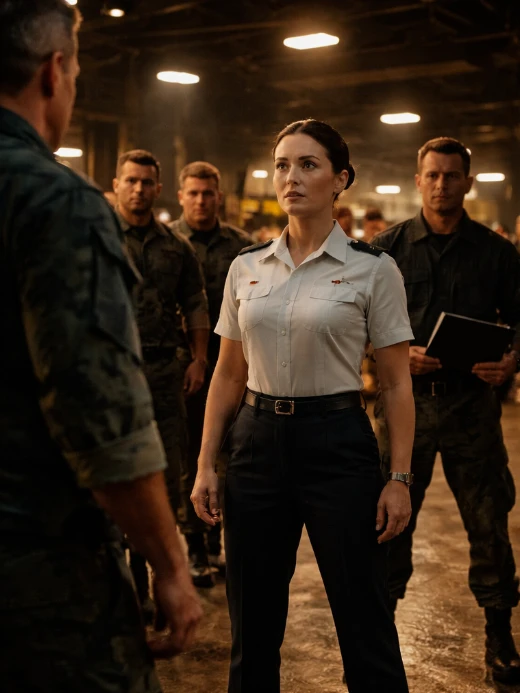
“You thinking what I’m thinking?”
Garrett’s voice cut through the quiet outside the records annex.
Rain slicked the concrete. Floodlights reflected in pale streaks across the ground.
Ward didn’t look at him.
“That Monroe isn’t what Dalton thinks she is.”
Garrett exhaled.
“No,” he said. “Worse.”
Ward turned slightly.
Garrett’s eyes narrowed.
“I think she’s exactly what Dalton should be afraid of.”
The motor pool was already hot when it happened.
Engines ticked. Metal creaked. Heat clung to the air under steel rafters.
Dalton stood at the center, eight SEALs behind him.
Jade stood across from him.
Alone.
“You’ve had a rough week,” Dalton said lightly.
No response.
“Restricted. Under investigation. Evidence in your name.” He tilted his head. “That’s a fast fall.”
Jade stood still.
Dalton took a step closer.
“You want to explain it?”
A pause.
Then—
“Yes.”
The word landed clean.
Dalton smiled faintly. “That almost sounded like a confession.”
Jade shook her head.
“It’s a timeline.”
And then—
Ward stepped forward.
“This facility has been under a controlled internal audit,” he said. “Authorized by Naval Intelligence.”
Silence.
Dalton’s expression hardened. “That’s not possible.”
“It is,” Ward said. “And you weren’t informed. By design.”
A shift moved through the room.
Ward glanced at Jade.
Then back.
“Lieutenant Monroe is not administrative support,” he said. “She is embedded.”
The word hit harder than anything else.
Embedded.
Everything realigned.
Garrett closed his eyes briefly.
Of course.
Ward opened the file.
“Irregularities flagged. Equipment misallocations. Compromised training infrastructure. Manipulated reporting chains.”
Dalton’s jaw tightened. “If there were issues, I would have—”
“You did,” Jade said.
She stepped forward.
“You corrected them,” she said. “Reclassified them. Buried them.”
Garrett spoke quietly. “The rope.”
Jade nodded.
“Not random,” she said.
Ward turned a page.
“Tool marks match restricted access equipment,” he said.
Dalton’s voice dropped. “You’re saying I sabotaged my own training?”
Jade met his eyes.
“No.”
A pause.
“You didn’t do it alone.”
Everything froze.
A man shifted behind Dalton.
Too fast.
Jade’s gaze snapped to him instantly.
“Petty Officer Kline.”
The man went still.
Ward didn’t hesitate. “Step forward.”
MPs appeared at the edge of the motor pool.
Silent.
Waiting.
The truth settled in all at once.
This had been built.
Every humiliation.
Every accusation.
Every setup.
Jade spoke again.
“My credentials weren’t stolen,” she said.
Dalton’s eyes narrowed.
“They were mirrored. Routed through command override.”
Garrett exhaled sharply.
Ward closed the folder.
“Every false accusation,” he said, “was designed to isolate her. Discredit her.”
Jade finished it.
“And reveal who would help bury the truth.”
Dalton stared at her.
“You let it happen.”
“Yes.”
“You let them destroy your reputation.”
“I let you show me how far you’d go.”
Ward stepped forward.
“Commander Knox Dalton, you are relieved of duty.”
No one moved.
No one spoke.
Dalton looked at Jade one last time.
And for the first time—
There was no arrogance left.
Only recognition.
Then he was gone.
That night, the base was quieter.
Not peaceful.
Just… honest.
Jade sat alone at the same table.
Same posture.
Same stillness.
Garrett sat across from her.
Ward beside him.
Silence.
Then Garrett spoke.
“You don’t look like paperwork.”
A small pause.
Jade almost smiled.
Ward leaned back slightly.
“The report will clear your record.”
“I know,” she said.
Garrett nodded.
“Reputation takes longer.”
“Yes,” Jade said.
Across the room, a SEAL approached.
Hesitant.
“…Lieutenant.”
One word.
Different now.
Jade nodded once.
Respect.
Earned.
Not given.
Later, she took a bite of her meal.
Slow.
Measured.
Controlled.
And for the first time—
no one mistook it for weakness.