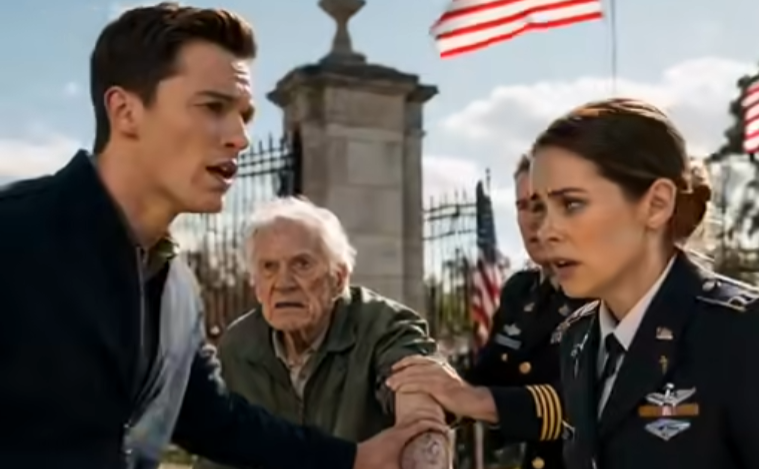
The Old Man Who Kept the Gate Standing
They Tried to Push Him Away, Until the Truth Marched Through the Gate.
“Take your hand off him before you make the worst mistake of your career.”
By the time the black SUV appeared, everyone at the gate knew the old man was not the one in danger.
The trouble started with a rough hand gripping an old man’s arm.
Walter Hayes had arrived early, long before the brass band began warming up and before the stadium speakers rolled through polished speeches about honor, sacrifice, and tradition. Morning sunlight stretched across Fort Wyndham’s front gate, catching the faded green windbreaker hanging loosely from his thin shoulders. The jacket had survived more winters than most cadets had birthdays. In one trembling hand, he carried a folded ticket. In his eyes burned a stubborn determination that somehow made him seem taller than his eighty-four years.
He had not come looking for trouble.
He had come for Mason.
His grandson was graduating that morning. Top of his class. Commissioned into a future Walter prayed would treat him more gently than the past ever had. Years earlier, beside a hospital bed thick with the smell of bleach and endings, Walter had promised Mason’s mother he would never miss a milestone in the boy’s life.
Walter Hayes was many things. Frail. Scarred. Slow on his feet.
But he was not a man who broke promises.
The young lieutenant stationed at the gate knew none of that.
Lieutenant Brooke Mercer only saw an elderly civilian dressed in outdated clothes lingering too close to a restricted section. She saw confusion in his slow movements. She saw someone asking questions while the line behind him kept growing longer. Pressure had sat on her shoulders all week. Generals were attending the ceremony. Wealthy donors were attending. Families were emotional. Cadets were nervous. One public mistake could become an official complaint before sunset.
So when Walter carefully extended his ticket and said, “I was told this entrance would get me to the family seating closest to the field,” Brooke did not hear a grandfather speaking.
She heard another problem delaying her morning.
“You’re at the wrong gate, sir,” she replied briskly. “General admission is around the west entrance.”
Walter glanced past her toward the field, where rows of white chairs gleamed beneath the bright sky. “My grandson asked me to sit where he could see me,” he explained quietly. “He said this gate would be easier on my leg.”
Brooke’s expression never softened. “Then your grandson gave you the wrong information.”
Behind her, Sergeant Caleb Turner was already growing impatient. Broad-shouldered and red-faced, he carried authority like a weapon he enjoyed using.
“Move him along, ma’am,” Caleb muttered. “Line’s backing up.”
Walter frowned slightly. “I’m not refusing to cooperate,” he said. “I’m asking you to read the ticket.”
Brooke barely looked at it. “This section is restricted to authorized family access.”
“I am family.”
Caleb stepped closer, irritation sharpening his voice. “Sir, either you move now or we move you.”
Several heads turned immediately.
People noticed conflict much faster than kindness.
Walter’s jaw tightened. “Young man,” he said slowly, “I fought too hard for this country to get shoved aside at my grandson’s graduation because you’re in a hurry.”
Caleb gave a short laugh dripping with contempt. “Everybody standing at a gate has a story.”
The words hit harder than the hand that followed.
Caleb grabbed Walter’s upper arm, intending only to push him aside, but the sudden force jerked the old man off balance. His cane slipped against the pavement. The ticket fluttered from his hand. Brooke reached toward Walter’s other arm as though helping him, yet to Walter it felt less like help and more like being handled.
His windbreaker sleeve slid upward.
And suddenly everything changed.
On Walter’s forearm, faded beneath age spots and scar tissue, sat an old tattoo inked so roughly it looked carved into his skin by memory and pain itself. Three stars rested above a curved scythe.
The symbol was not flashy. It looked ancient. Wrong somehow. Completely out of place on a man who resembled every forgotten grandfather sitting quietly in small American towns.
But across the gate, Staff Sergeant Nathan Cole saw it.
And all the color drained from his face.
The clipboard slipped from his hands and clattered onto the pavement.
“No,” Nathan whispered under his breath.
Caleb still gripped Walter’s arm. “What?”
Nathan crossed the distance in three quick strides before stopping abruptly, as though he had nearly walked into a live explosive. His eyes locked onto the tattoo. His face had gone pale enough to look sick. When he spoke again, his voice sounded smaller. Stripped bare of rank, confidence, and pride.
“Sergeant,” Nathan said carefully, “take your hand off him. Right now.”
Caleb blinked. “What the hell are you talking about?”
Brooke frowned sharply. “Staff Sergeant, stand down. We’re handling a civilian access issue.”
Nathan stared at her like she had calmly announced she was kicking a grenade across the room.
“Ma’am,” he said, struggling to steady his breathing, “with respect, no, you are not.”
Walter slowly pulled his arm free. Pain flashed briefly across his weathered face. His old bones clearly protested the movement. Then he looked at Nathan with the exhausted eyes of a man who had spent a lifetime watching frightened young soldiers pretend not to be afraid.
“You know what this is,” Walter said quietly.
Nathan swallowed hard. “I know what it means.”
Brooke crossed her arms. “Then maybe you should explain it.”
Nathan did not answer immediately. He looked almost afraid to say the words aloud. Around them, the line had completely stopped moving. Families stood whispering beneath the hot sun. Nearby cadets glanced nervously toward the gate. Somewhere in the distance, the marching band continued tuning instruments with grotesque cheerfulness.
Finally Nathan spoke.
“He’s not unauthorized.”
Caleb scoffed openly. “He doesn’t even have the right pass.”
Nathan never took his eyes off Walter’s tattoo. “He’s a legacy.”
The silence that followed felt strange and heavy, like fabric tearing very slowly.
Brooke’s irritation sharpened into anger. “Legacy isn’t a security classification.”
For the first time, Walter’s voice carried something colder than frustration.
“No,” he said quietly. “It’s the word people use when the real one gets buried.”
Caleb stepped forward again, this time rougher, embarrassed by being corrected publicly. Pride burned visibly across his face.
“That’s enough,” he snapped. “You’re leaving.”
Walter twisted free with startling speed. His voice cracked sharply through the air like an old branch splitting during winter.
“You shouldn’t have touched me, son.”
Every nearby conversation died instantly.
Nathan yanked his phone from his pocket with trembling fingers and turned away to place a call. Brooke stared after him in disbelief.
“What exactly are you doing?” she demanded.
“Saving your career,” Nathan shot back before pressing the phone harder against his ear. “Come on. Come on…”
Walter bent carefully to retrieve his fallen ticket. Pain tightened his face as he stooped. Before he could reach it, a teenage girl from the line hurried forward and picked it up for him. She handed it back gently with both hands, almost like she was returning something sacred.
Walter gave her a tired nod of gratitude.
Brooke could feel control slipping away from her, and she hated every second of it.
“Staff Sergeant,” she snapped, “put the phone away immediately.”
Nathan ignored her completely.
When the call finally connected, he spoke so quickly his words nearly collided together.
“This is Staff Sergeant Cole at east ceremonial gate,” he said breathlessly. “I need immediate verification on a legacy mark. Yes, I said legacy mark. Three stars and a scythe. Elderly male, civilian clothing, name currently unknown—”
Walter interrupted softly.
“Walter Hayes.”
Nathan repeated the name immediately. Then he listened.
His expression changed almost at once.
Fear transformed into something even worse.
His mouth opened slightly before snapping shut again. The voice on the other end of the line must have risen because even Brooke heard the clipped burst of alarm crackling through the tiny speaker. Nathan straightened instinctively, standing at rigid attention without even realizing it.
“Yes, sir,” he answered quickly. “Understood, sir.”
He lowered the phone slowly.
Brooke stepped closer. “Well?”
Nathan looked at Walter first. Then at the officers surrounding him.
His voice came out hoarse.
“No one touches him,” he said. “No one moves him. No one says another word to him unless he speaks first.”
Caleb laughed in disbelief. “You’ve completely lost your damn mind.”
Nathan’s phone crackled loudly again before he could answer. This time everyone nearby heard the voice clearly through the speaker.
A command voice.
Sharp as gunfire.
“Don’t. Let. Him. Move.”
The words sliced across the gate and pinned every person there in place.
At the far end of the road, beyond parked vehicles and fluttering patriotic banners, a black command SUV appeared speeding toward them.
And in that moment, Walter Hayes no longer looked like a harmless old man causing trouble at a gate.
He looked like the center of a storm nobody there had realized was coming.
The SUV did not slow until it reached the gate.
Its tires bit against the pavement with a sharp, ugly sound. Several families stepped back. A cadet dropped his program. Brooke Mercer felt her pulse climb into her throat, though she refused to let it show.
The rear door opened before the vehicle fully settled.
Colonel James Hollis stepped out.
The chatter around the gate disappeared.
He was not dressed for ceremony. His uniform jacket was open at the collar, his face flushed from rushing, and his eyes went straight past Brooke, past Caleb, past Nathan.
They landed on Walter Hayes.
For one suspended second, the colonel looked less like a commanding officer and more like a man seeing a ghost.
Then he removed his cap.
Brooke’s stomach tightened.
Colonel Hollis walked toward Walter slowly, as though every step mattered. When he reached him, he did not salute immediately. He looked at the old man’s face first, searching it with visible strain.
“Mr. Hayes,” he said quietly.
Walter’s expression did not change. “Colonel.”
Hollis swallowed. “Sir, I owe you an apology before I owe you anything else.”
Caleb shifted behind them. “Sir, with respect, this civilian caused a disruption at—”
Hollis turned so fast Caleb stopped breathing.
“Sergeant Turner,” he said, each word flat and dangerous, “you will not speak again unless I ask you to.”
Caleb’s face went red, then pale.
Brooke stepped forward carefully. “Colonel, I take responsibility for the gate procedure. We were not informed of any special status attached to Mr. Hayes.”
Walter gave a faint, humorless smile. “That was the point.”
Hollis looked back at him, and something painful moved across his face.
“Yes,” he said. “It was.”
The words struck Brooke harder than any reprimand could have.
She looked at Nathan, but he would not meet her eyes.
Walter folded his ticket with careful fingers. “I came to watch my grandson graduate. That is all.”
“I know,” Hollis said.
“No,” Walter replied softly. “You knew I might come. That is different.”
The colonel flinched.
The silence around them deepened. Even the band had stopped tuning, as if someone far away had sensed the pressure gathering at the gate.
Brooke’s mind raced through possible explanations. A classified veteran. A protected witness. A disgraced hero. A man too important to ignore and too dangerous to mention.
But none of those thoughts explained the fear in Nathan Cole’s eyes.
None explained why a colonel had nearly run from headquarters to stop an old man from walking away.
Walter glanced toward the field. “How much time before they begin?”
Hollis checked his watch. “Twenty-two minutes.”
“Then you have twenty-two minutes to decide whether this academy still keeps its promises.”
The sentence was spoken quietly.
Still, everyone heard it.
Hollis closed his eyes for half a second. “Mr. Hayes, there are people here who need to speak with you first.”
Walter’s hand tightened around his cane. “No.”
“Sir—”
“I said no.” Walter’s voice did not rise. “The last time people needed to speak with me first, three boys came home in sealed boxes.”
Brooke saw Caleb’s expression shift. Not guilt yet. Confusion first. Then discomfort.
Nathan lowered his head.
Colonel Hollis took one careful breath. “That is why I came myself.”
Walter studied him. “Did you?”
Hollis did not answer quickly enough.
That pause changed everything.
Walter nodded once, as if an old suspicion had just been confirmed. “Who else is here?”
Hollis looked toward the command SUV.
The front passenger door opened.
A woman stepped out.
She was in her late sixties, dressed in a dark navy suit instead of uniform. Her silver hair was pulled back neatly. She carried no folder, no visible badge, no weapon. Yet the moment she appeared, Colonel Hollis seemed to shrink slightly beside her.
Walter went very still.
Brooke noticed it immediately.
The old man’s fingers trembled once against his cane, then locked down hard.
The woman stopped several feet away from him. Her face carried the careful composure of someone who had spent decades controlling rooms full of powerful men.
But her eyes were wet.
“Walter,” she said.
Walter’s voice came out colder than before. “Eleanor.”
The name moved through the air like a hidden door opening.
Nathan inhaled sharply.
Caleb muttered, “Who is she?”
Brooke whispered, “Don’t.”
Eleanor Voss looked at Walter’s sleeve, still pushed up enough to show the tattoo. Her mouth tightened with grief.
“I asked them not to call it a legacy mark,” she said. “I hated that name.”
Walter laughed once, without warmth. “You hated many things after they became inconvenient.”
She accepted the blow without defending herself.
Colonel Hollis spoke carefully. “Ms. Voss chairs the Wyndham Historical Trust.”
Walter’s eyes remained on her. “That is not what she chaired when it mattered.”
Brooke felt the words settle into her bones.
Eleanor stepped closer, but not too close. “I know you do not want me here.”
“I stopped wanting things from you forty years ago.”
Pain flickered across Eleanor’s face.
Then, from beyond the gate, a voice rang out.
“Grandpa?”
Walter turned.
A young man in dress uniform stood near the edge of the staging path, separated from the gate by a low barricade and two startled cadets. His cap was tucked beneath his arm. His face was pale beneath its polished composure.
Mason Hayes had seen enough to know something was wrong.
Walter’s stern expression softened instantly.
“Mason,” he said.
The young man stepped toward him, but an officer blocked him. Mason’s jaw tightened.
“That’s my grandfather,” he said. “Let me through.”
Brooke, moving on instinct now, lifted her hand. “Let him pass.”
Caleb looked at her. “Lieutenant—”
She cut him off. “Let him pass.”
Mason crossed the distance quickly, but slowed when he reached Walter. His eyes moved over his grandfather’s face, the cane, the wrinkled ticket, the exposed tattoo.
“What happened?” he asked.
Walter touched his arm. “Nothing that needs to touch your day.”
Mason looked at Brooke, then Caleb, then the colonel. “That’s not true.”
No one answered.
Eleanor watched Mason with an expression that almost broke.
Walter saw it and shifted slightly, placing himself between them.
That small movement told Brooke more than any explanation had.
Mason noticed too.
“Grandpa,” he said quietly, “who are these people?”
Walter took a breath.
For the first time since the SUV arrived, he looked truly tired.
“They are people who knew me before I became your grandfather.”
Mason’s face tightened. “That doesn’t answer me.”
“No,” Walter said. “It doesn’t.”
Colonel Hollis glanced toward the field. “We cannot do this here.”
Walter’s eyes sharpened. “You should have thought of that before you turned my grandson’s graduation into an ambush.”
Eleanor spoke softly. “It was not meant to be an ambush.”
Walter turned on her. “Then why was Staff Sergeant Cole watching the gate?”
Nathan’s face drained again.
Brooke looked at him.
Nathan’s silence became an answer.
Mason stared at Nathan. “You were watching for him?”
Nathan swallowed. “I was ordered to report if the mark appeared.”
“The mark?” Mason echoed.
Walter pulled his sleeve down.
But it was too late.
Mason had seen enough.
His voice dropped. “Grandpa, what is that tattoo?”
Walter did not answer.
Eleanor did.
“It means he saved this academy.”
Walter’s head snapped toward her.
“Don’t,” he said.
But Eleanor’s voice grew firmer, though her hands shook at her sides.
“No, Walter. I have spent most of my life obeying that one word from you. Not today.”
Hollis stepped in. “Ms. Voss—”
She turned on him. “You called me here because you were afraid of what would happen if he walked away. Now let the truth be spoken.”
The colonel fell silent.
The gate became a courtroom without walls.
Families stood frozen. Cadets watched from the path. The patriotic banners snapped gently in the morning wind, bright and cheerful against the weight of everything unsaid.
Walter looked at Mason. “You do not need this.”
Mason stepped closer. “I need you.”
The old man’s face cracked.
Only slightly.
But Brooke saw it.
So did Eleanor.
Walter looked away first.
Eleanor’s voice softened. “Forty-two years ago, Fort Wyndham nearly closed after a training disaster. The official report blamed mechanical failure, bad weather, and command confusion.”
Walter’s jaw clenched.
“That report was incomplete,” Eleanor continued. “It protected men who had careers to preserve.”
Caleb’s eyes flicked toward Hollis.
Hollis stared at the ground.
Mason said nothing.
Eleanor looked at Walter. “Your grandfather was a civilian contractor then. Former Army engineer. He discovered that the collapse at the south bridge was not an accident waiting to happen. It was negligence buried under signatures.”
Walter’s hand tightened on his cane.
“He warned them,” Eleanor said. “Repeatedly. No one listened.”
Walter’s voice was low. “Some listened.”
Eleanor nodded, grief deepening in her face. “Three cadets listened.”
Mason’s eyes moved to his grandfather.
Walter’s face had turned gray.
“They helped him block the eastern gate during a storm evacuation,” Eleanor said. “They redirected two buses before the bridge gave way. More than eighty cadets survived because of them.”
The wind stirred Walter’s sleeve.
Brooke felt cold despite the sun.
Mason whispered, “What happened to the three cadets?”
Walter closed his eyes.
Eleanor’s voice trembled. “They did not make it back.”
Mason’s face collapsed with understanding.
Walter opened his eyes, and they were wet but furious.
“They were nineteen,” he said. “Nineteen years old. Brave enough to believe an old sergeant with bad knees and a bad feeling.”
Eleanor flinched at every word.
Brooke realized then that Walter had not been angry because someone had stopped him at a gate.
He had been angry because history was repeating itself in miniature.
A uniformed person refusing to listen.
A young man using authority instead of judgment.
A gate becoming more important than the people it was meant to protect.
Mason’s voice shook. “Why didn’t you tell me?”
Walter looked at him. “Because you deserved a grandfather. Not a monument.”
Eleanor whispered, “And because we asked him to stay silent.”
Walter turned toward her slowly.
“No,” he said. “You begged me.”
She nodded. “Yes.”
The admission stunned everyone.
Eleanor took a breath that seemed to tear its way through her. “I was a junior legal officer then. I helped write the sealed addendum to the report.”
Nathan looked up sharply.
Brooke’s mouth parted.
Eleanor did not hide from their reactions.
“I told myself I was protecting the academy,” she said. “I told myself the truth would destroy funding, ruin careers, and dishonor the dead. But the real truth was uglier.”
Her eyes found Walter’s.
“I was protecting my father.”
Walter’s expression hardened.
Mason looked between them. “Your father?”
Eleanor nodded. “General Adrian Voss. He commanded Wyndham then. He ignored the warnings.”
The name passed through several older officers in whispers.
Hollis looked as if he wanted the ground to swallow him.
Walter’s voice came out rough. “He did more than ignore them.”
Eleanor closed her eyes.
“Yes,” she said. “He ordered the maintenance logs altered after the collapse.”
Caleb cursed under his breath.
Brooke felt her stomach turn.
The hidden rot beneath the ceremony had finally surfaced.
Mason stared at Eleanor. “And my grandfather knew?”
Walter answered. “I had copies.”
“Then why didn’t you expose him?”
Walter looked toward the field, where cadets stood in perfect lines beneath the sun.
“Because your grandmother was pregnant with your mother,” he said. “Because men with stars on their shoulders came to my house. Because they said the academy would close, the dead boys would be blamed, and my family would spend years under investigation.”
His voice thinned.
“And because Eleanor brought me a letter from one of the boys.”
Eleanor pressed a hand to her mouth.
Walter continued, each word dragged from somewhere deep.
“Cadet Samuel Price wrote to his mother the night before he died. He said if anything happened, he wanted Wyndham to remain standing. He believed the place could still make good officers.”
Mason listened with tears in his eyes.
Walter looked at the gate.
“So I made a bargain with the devil. They sealed the truth. I kept my copies. And the families of those boys received honors without ever learning why they died.”
Eleanor whispered, “I have regretted it every day.”
Walter’s face twisted. “Regret is a room people build after the house burns down.”
She accepted that too.
Brooke looked at Nathan. “And you knew?”
Nathan shook his head quickly. “Not all of it. Only the warning protocol.”
“What warning protocol?” Mason asked.
Hollis finally spoke. “If Mr. Hayes ever returned to Fort Wyndham and displayed the mark, command was to be notified immediately.”
Walter gave a dry laugh. “Displayed. As if I wave it around for attention.”
Hollis looked ashamed. “The mark was used to identify the four men at the gate that night. Three cadets and Mr. Hayes.”
Mason’s gaze dropped to his grandfather’s covered arm.
“The tattoo?” he asked.
Walter nodded slowly. “A foolish thing done in a supply shed two days before the storm. Three stars for them. The scythe for me.”
“Why a scythe?”
Walter’s eyes grew distant.
“Because they said I looked like death when I warned them about that bridge.”
A fragile silence followed.
Then Walter added, almost smiling, “They thought it was funny.”
Mason wiped his eyes.
Brooke lowered her gaze. Shame spread through her slowly, then all at once.
She had seen an old man.
She had not seen the promise he carried.
Caleb shifted behind her, restless and defensive. “None of that changes the fact that we had procedure.”
Walter looked at him.
The look was not angry anymore.
It was worse.
It was disappointed.
Caleb’s mouth closed.
Mason stepped toward him. “You grabbed him.”
Caleb stiffened. “I followed orders.”
“No,” Brooke said.
Everyone turned to her.
Her voice was quiet, but steady. “No, Sergeant. You escalated before I stopped you. And I dismissed him before I read his ticket properly.”
Caleb stared at her, betrayed.
Brooke looked at Walter. “Mr. Hayes, I am sorry.”
Walter studied her.
For a moment, Brooke thought he would reject it.
Then he said, “Be better when the next old man asks you to read something.”
Her throat tightened. “I will.”
Caleb said nothing.
Colonel Hollis straightened. “Sergeant Turner, you are relieved from gate duty pending review.”
Caleb’s face twisted. “Sir, after everything I’ve done for this ceremony—”
“You put hands on a guest,” Hollis said. “You ignored a lawful correction. You confused force with control.”
Caleb looked around, as if searching for someone to save him.
No one did.
Two military police officers approached quietly from near the SUV. Caleb’s shoulders dropped.
But Walter lifted one hand.
“Do not humiliate him in front of families,” he said.
Hollis hesitated. “Sir?”
Walter looked at Caleb. “Humiliation teaches pride to hide. It does not teach humility.”
Caleb’s face changed, just slightly.
Walter continued, “Walk him away. Let him think about the difference.”
Hollis nodded once.
The MPs guided Caleb aside without spectacle.
Mason watched his grandfather with a mixture of awe and sorrow. “You still protected him.”
Walter’s smile was faint. “No. I protected the boy he might become after today.”
Eleanor’s eyes filled again.
The ceremony announcer’s voice crackled in the distance, asking guests to take their seats.
The ordinary sound felt almost absurd.
Hollis stepped closer. “Mr. Hayes, there is another reason we needed you here.”
Walter’s expression closed. “I knew there would be.”
Mason straightened. “What reason?”
Eleanor reached into her jacket and removed a small envelope. It was cream-colored, old but carefully preserved. Walter stared at it as if it might burn him.
“No,” he whispered.
Eleanor’s voice broke. “His mother kept it. She gave it to me last winter.”
Walter shook his head. “You had no right.”
“She said you would say that.”
Mason looked at the envelope. “Whose mother?”
“Samuel Price’s,” Eleanor said.
Walter seemed to lose strength.
Mason caught his elbow. This time, Walter did not pull away.
Eleanor held the envelope out, but Walter did not take it.
“She died in February,” Eleanor said. “Before she passed, she asked that this be read at the next graduation if you ever came back.”
Walter’s face folded inward with pain.
“She knew?” he asked.
Eleanor nodded. “Not everything. Enough.”
“How?”
Eleanor glanced at Hollis.
The colonel answered quietly. “Because your daughter found the sealed addendum.”
Walter’s head lifted sharply.
Mason blinked. “My mom?”
Walter’s breathing changed.
Hollis continued, carefully. “Before she died, she filed a request under the family archive review process. It was denied twice. Then she appealed.”
Walter looked shattered. “She never told me.”
Mason whispered, “She was sick.”
“She was dying,” Eleanor said. “And still fighting for you.”
Walter’s cane trembled against the pavement.
Mason’s eyes filled again. “What did she find?”
Eleanor’s voice softened. “Enough to know her father was not merely a survivor. Enough to know he carried blame that never belonged to him.”
Walter shook his head, almost violently. “She should have spent that time with her son.”
Mason held his arm tighter. “She did.”
Walter looked at him.
Mason’s voice cracked. “And she spent it making sure I would someday know who you really were.”
That was the reveal Walter had not prepared himself to survive.
For decades, he had believed silence was the last gift he could give his family.
Now he learned his daughter had spent her final strength undoing that silence.
Walter covered his mouth with one shaking hand.
No one moved.
Eleanor held the envelope gently. “There is more.”
Walter looked exhausted. “There is always more.”
“The academy board voted last night,” Hollis said. “The sealed addendum is being released.”
Brooke heard Nathan exhale sharply.
Walter stared at Hollis. “Why now?”
Hollis looked toward Mason. “Because Cadet Hayes submitted his mother’s documents with his ethics thesis.”
Mason went still.
Walter turned slowly toward him.
Mason’s face flushed with guilt. “I didn’t know it was about you. Not at first.”
Walter said nothing.
Mason rushed on. “Mom left me a box. She wrote that I should open it before graduation. There were documents, letters, and names. I thought it was about institutional accountability. Then I saw your name.”
His voice broke.
“I wanted to ask you. But every time I tried, you looked so proud of me. I didn’t want to drag pain into this day.”
Walter’s eyes searched his grandson’s face.
Mason whispered, “I’m sorry.”
Walter touched his cheek with a trembling hand.
“No,” he said. “You are your mother’s son.”
Mason closed his eyes.
Eleanor looked at them both with unbearable tenderness. “The board did not vote out of courage alone.”
Walter glanced at her.
She continued, “They voted because Mason’s thesis forced the issue. Because Samuel Price’s mother left a statement. Because I finally signed my own confession.”
Hollis looked at her with surprise.
Walter’s eyes narrowed. “You signed it?”
Eleanor nodded. “This morning.”
“You’ll lose everything.”
“I should have lost more a long time ago.”
Her voice did not shake now.
“I cannot return those boys. I cannot give you the years I helped steal. But I can stop asking silence to do the work of honor.”
Walter stared at her for a long time.
The anger in his face did not vanish.
But it loosened.
Just enough to reveal grief beneath it.
The announcer called again for families to be seated.
Hollis cleared his throat. “Mr. Hayes, with your permission, the ceremony will include a correction to the academy record.”
Walter laughed softly. “A correction. That sounds neat.”
“It will not be neat,” Hollis admitted. “There will be hearings. Some portraits will come down. Some names will be reviewed. Families will ask painful questions. Reporters will circle.”
“Good,” Walter said.
Hollis nodded. “Yes, sir. Good.”
Walter looked toward the field. “And Mason?”
Mason stiffened.
Hollis faced him directly. “Cadet Hayes graduates today with honors. His thesis has already been accepted. Nothing about the investigation changes that.”
Walter’s voice sharpened. “And his future?”
Hollis met his eyes. “He may face attention he did not ask for. But no retaliation will come from this command.”
Eleanor added quietly, “I have made sure the board knows the whole country will be watching.”
Walter looked at her. “Still good at threats.”
A faint, sad smile touched her mouth. “I learned from men worse than you.”
For the first time, Walter almost smiled back.
Brooke noticed it.
So did Mason.
The tension did not disappear. It shifted. It became something heavier than fear, but cleaner than secrecy.
Then Eleanor extended the envelope again.
Walter stared at it.
Mason whispered, “Grandpa.”
Walter took it at last.
His fingers brushed Eleanor’s.
Both of them flinched.
He opened the envelope slowly. Inside was a single sheet of paper, yellowed with age. His eyes moved across the handwritten lines.
His face changed.
Brooke did not need to read it to understand.
This was not an accusation.
This was mercy.
Walter’s voice failed the first time he tried to speak. He tried again.
“Samuel wrote this?”
Eleanor nodded. “The night before.”
Walter looked down.
His lips moved silently over the words.
Then he read aloud, voice shaking.
“If Mr. Hayes is right, then tomorrow we do what he says. If I am scared, I hope I am still useful. Tell my mother I was not wasted.”
A sound moved through the crowd.
Not a gasp.
Something softer.
Walter pressed the paper to his chest.
Mason bowed his head.
Eleanor wiped her face quickly, but tears kept coming.
Walter read the next line almost in a whisper.
“And tell Mr. Hayes that if he blames himself, he is being an idiot.”
A broken laugh escaped him.
It turned into a sob before he could stop it.
Mason wrapped both arms around his grandfather.
Walter stood rigid at first.
Then the old man leaned into him.
The storm finally broke, not with thunder, but with an old man crying in his grandson’s arms.
No one looked away.
Not because it was spectacle.
Because it was witness.
Brooke felt tears sting her eyes. Nathan stood at attention, his jaw tight. Hollis removed his cap again. Eleanor covered her mouth as if holding back forty years of grief.
When Walter finally pulled back, he looked smaller.
But somehow lighter.
Mason kept one hand on his shoulder. “Do you still want to sit where I can see you?”
Walter wiped his face with a handkerchief. “I promised I would.”
“Then let’s get you there.”
Brooke stepped forward immediately. “Your ticket is valid for the east family section. I should have confirmed that.”
Walter looked at her. “Yes.”
She accepted it.
Then he added, “Walk with us, Lieutenant.”
Brooke blinked. “Sir?”
“You need to learn the route.”
The lesson landed gently, which made it hurt more.
“Yes, sir,” she said.
Nathan moved to collect Walter’s fallen cane tip, which had loosened during the struggle. He fixed it with careful hands and returned it.
Walter studied him. “You knew enough to be afraid.”
Nathan swallowed. “Yes, sir.”
“Next time, know enough to act sooner.”
Nathan nodded, shame plain on his face. “I will.”
Walter looked toward where Caleb had been led away. “And tell that sergeant something for me.”
Nathan straightened. “Anything.”
“Tell him a uniform can make a man stand taller. It cannot make him larger.”
Nathan absorbed the words. “I’ll tell him.”
The walk to the field was slow.
No one rushed Walter now.
Families parted quietly as he passed. Some understood nothing. Some understood enough. A few older veterans stood straighter. One woman pressed a hand over her heart. A small boy asked his father why everyone had gone quiet, and his father whispered, “Because that man matters.”
Walter heard it.
His grip tightened around Mason’s arm.
Mason leaned closer. “You okay?”
“No,” Walter said.
Mason nodded. “Me neither.”
Walter looked at him, and something like gratitude passed between them.
They reached the front family section just as the first formal notes of the ceremony began. Brooke helped guide Walter to his chair, then stepped back.
Walter lowered himself carefully, every joint protesting. Mason remained beside him instead of returning to formation.
“You have to go,” Walter said.
“I know.”
“Stand straight.”
Mason smiled through tears. “Yes, sir.”
Walter touched the front of Mason’s uniform, smoothing an invisible wrinkle.
For a moment, he was only a grandfather.
Not a witness.
Not a survivor.
Not a secret the academy had failed to bury.
Just a grandfather fixing his grandson’s uniform before the world called him forward.
Mason bent and hugged him once more.
Walter whispered, “Your mother would be unbearable today.”
Mason laughed softly. “She’d be crying before my name was called.”
“She would deny it.”
“She would.”
The two shared that small memory like shelter.
Then Mason returned to his place among the cadets.
Walter watched him go, and his eyes never left him.
Eleanor sat two seats away, not beside him. She did not presume forgiveness. Hollis stood at the aisle. Brooke remained near the entrance, hands clasped behind her back, posture formal but face changed.
The ceremony began.
Speeches followed.
Honor. Duty. Service. Sacrifice.
Words Walter had heard polished so often they sometimes lost their shape.
But then Colonel Hollis approached the podium again earlier than scheduled.
A ripple moved through the crowd.
Walter’s body went still.
Mason, standing in formation, looked toward his grandfather.
Hollis placed both hands on the podium.
“Before we commission today’s graduating class,” he said, “Fort Wyndham must fulfill a debt long overdue.”
The crowd shifted.
Hollis continued, voice carrying across the field.
“Forty-two years ago, during the storm evacuation of this academy, three cadets and one civilian engineer acted against confusion, pressure, and fear. Their actions saved lives.”
Walter closed his eyes.
“Cadet Samuel Price. Cadet Andrew Keene. Cadet Luis Romero.”
Eleanor bowed her head.
“And Mr. Walter Hayes.”
A murmur swept across the stadium.
Walter did not move.
Hollis said, “The full record of that day was sealed. That decision was wrong.”
Brooke saw several senior officers stiffen.
Hollis did not soften the words.
“The academy honors courage in public. It must also confess failure in public.”
That sentence changed the air over Fort Wyndham.
Mason stood motionless in formation, tears shining openly now.
Hollis looked toward Walter.
“Mr. Hayes, Fort Wyndham cannot repay you. It can only stop pretending the debt does not exist.”
The audience rose slowly.
Not all at once.
First one row.
Then another.
Then the cadets.
Then the officers.
Soon the entire field stood.
Walter remained seated, overwhelmed, his cane across his knees and Samuel’s letter folded beneath his hand.
He looked almost frightened by the sound.
Not applause exactly.
It was heavier than applause.
It was recognition.
Mason broke formation only after the command was given. His name was called later, clear and proud across the speakers.
“Cadet Mason Hayes.”
Walter stood before anyone could help him.
His knees trembled. Brooke instinctively moved forward, but Eleanor gently touched her arm.
“Let him,” Eleanor whispered.
Walter stood on his own.
Mason crossed the stage, received his commission, and turned.
Before saluting the reviewing officer, he looked out at the front row.
At his grandfather.
Walter lifted his hand.
Not high.
Just enough.
Mason saluted.
To the stage, yes.
To the uniform, yes.
But first, unmistakably, to him.
Walter’s face broke into the smallest, proudest smile.
The kind of smile grief cannot erase.
The kind that survives because love insists on surviving.
After the ceremony, people approached carefully.
Some thanked him. Some apologized without knowing exactly why. A few veterans recognized the look in his eyes and said nothing, which Walter appreciated most.
Eleanor waited until the crowd thinned.
Mason stayed beside Walter, protective but not interfering.
Finally Eleanor stepped forward.
“I do not expect forgiveness,” she said.
Walter looked at her for a long while. “Good.”
She nodded, accepting the wound.
Then he added, “But I expect you at every hearing.”
Her eyes lifted.
Walter’s voice was rough but steady. “Every family deserves the truth from someone who helped hide it.”
“I will be there,” she said.
“No speeches.”
“No speeches.”
“No making yourself brave after the danger passed.”
Eleanor’s chin trembled. “No.”
Walter studied her. “Just the truth.”
She nodded. “Just the truth.”
He looked away, toward the gate in the distance.
“It may not save you.”
“I know.”
“It may not heal them.”
“I know.”
Walter breathed slowly.
“But it might stop another boy from dying under a clean report.”
Eleanor’s tears fell again. “Yes.”
Walter nodded once.
That was all she received.
It was not forgiveness.
But it was a door left unlocked.
Brooke approached next, hesitant. “Mr. Hayes.”
Walter turned.
She held out his ticket. “You left this on the chair.”
He took it.
The paper was creased now, worn soft from his hand.
Brooke said, “I checked the access list. Your grandson arranged the east gate because of your leg. He called twice this week to confirm.”
Mason looked surprised.
Walter glanced at him. “You did?”
Mason shrugged. “I wanted you close.”
Walter’s expression softened.
Brooke’s voice grew quieter. “I should have listened.”
Walter folded the ticket carefully. “Yes.”
She nodded.
Then he said, “You did, eventually.”
Brooke looked up.
“That matters,” Walter said. “Not as much as listening first. But more than never listening at all.”
Her eyes filled. “Thank you.”
Walter gave a faint nod.
Nathan appeared beside her, hands behind his back. “Sergeant Turner asked me to give you this.”
He held out a folded note.
Walter took it but did not open it immediately.
“What does it say?” Mason asked.
Walter unfolded it.
His eyes moved across the page.
Then he handed it to Mason.
Mason read aloud softly.
“Mr. Hayes, I was wrong. I thought authority meant moving people before they became problems. I understand now that sometimes the problem is what authority refuses to see. I am sorry I put hands on you. I will accept the review.”
Mason lowered the note.
Walter looked toward the far side of the field, where Caleb stood alone near an MP vehicle. His posture was stiff. His face unreadable.
Walter folded the note again.
“Good,” he said.
Mason asked, “That’s all?”
Walter’s gaze remained on Caleb. “For today.”
The sun had shifted by then.
The white chairs were emptying. Programs tumbled across the grass. Somewhere nearby, a family laughed too loudly from relief. The band packed away instruments. The great machinery of ceremony began becoming ordinary again.
Mason helped Walter toward the old graduation gate.
This time, no one blocked them.
At the threshold, Walter stopped.
His eyes moved over the ironwork, the stone pillars, the banners, the guards.
Mason waited.
“Grandpa?”
Walter touched the gate with his free hand.
The metal was warm from the sun.
“I hated this place,” he said.
Mason said nothing.
Walter’s voice was barely above a whisper. “Then I missed it. Then I hated myself for missing it.”
Mason stepped closer. “What do you feel now?”
Walter watched a group of new officers embrace their families beyond the field.
“I don’t know yet.”
Mason nodded. “That’s okay.”
Walter looked at him, surprised by the simple mercy of that answer.
Then he reached into his pocket and pulled out the folded ticket.
He stared at it for a long moment.
“I kept thinking this was proof I belonged here today,” he said.
Mason looked at the paper.
Walter smiled faintly.
“But you were.”
He placed the ticket in Mason’s hand.
Mason closed his fingers around it.
Walter touched his grandson’s newly pinned insignia.
“No,” he said softly. “You are.”
Mason’s eyes filled again.
The old man and the young officer stood together beneath the gate, one carrying the past, the other stepping into the future.
Behind them, the academy had begun to change.
Not enough.
Not fully.
Not without pain.
But truth had entered through the gate at last.
Walter leaned on his cane, tired down to the bone.
Mason offered his arm.
This time, Walter took it without pretending he did not need help.
Together, they walked slowly into the afternoon light.
And just before they reached the parking road, Walter looked back once.
The gate still stood.
So did he.
