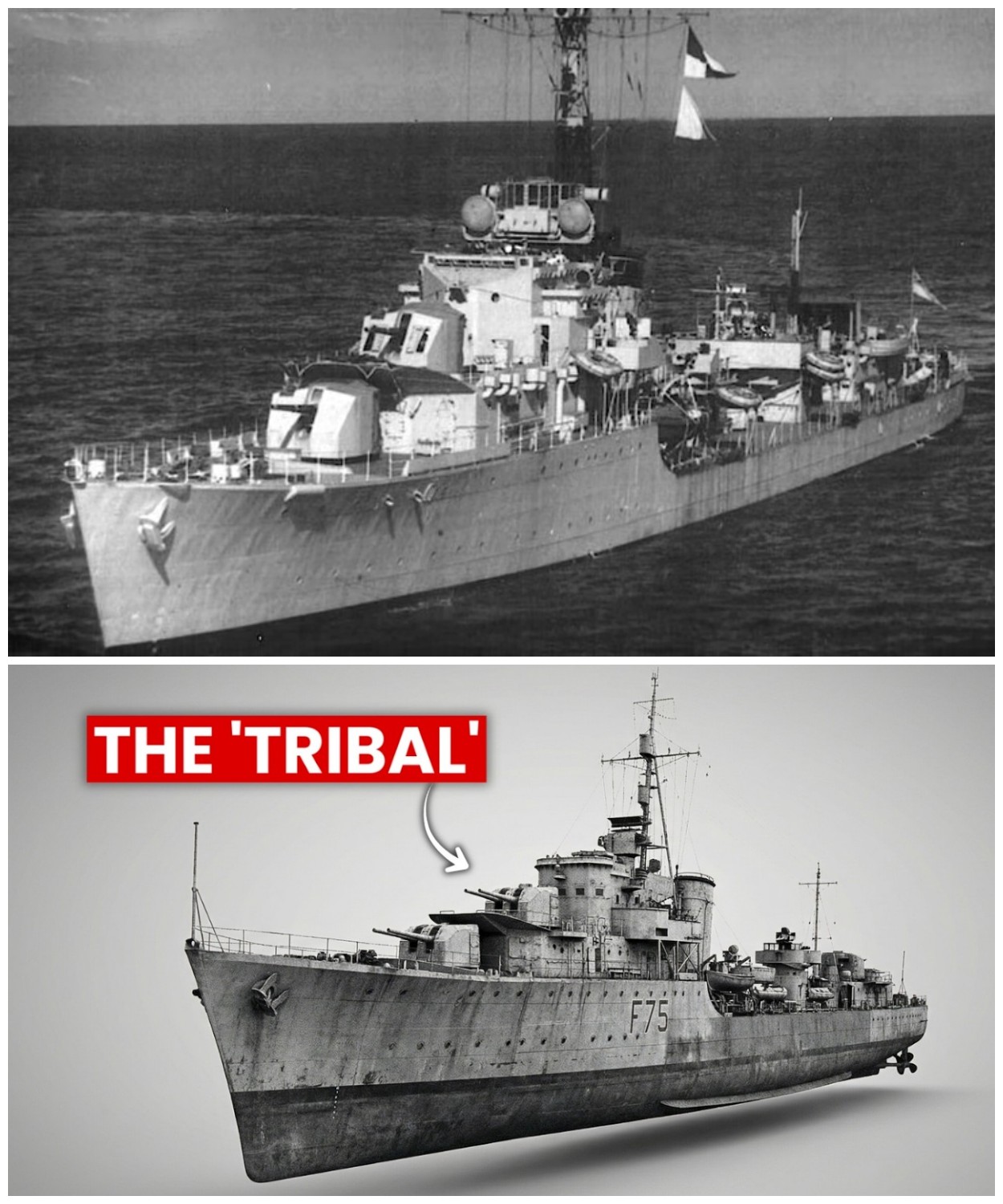
The ‘OVERGUNNED’ British Destroyers Germans Refused To Fight One On One
April 13, 1940.
The offjord, northern Norway.
Five British tribalclass destroyers, HMS Cosac, Bedawin, Punjabi, Eskimo, and seek push into the narrow fjord at 30 knots.
Ahead of them, eight German destroyers are cornered.
Low on fuel, low on ammunition, trapped since the first battle of Narvik 3 days earlier.
HMS Cosac enters Narvik harbor alone.
She rounds the headland and finds the German destroyer Da Vonruda broadside on at point blank range.
Eight 4.7 in guns open fire simultaneously.
The broadside weight is 400 lb of steel every 6 seconds.
Kak takes seven hits in return, runs a ground, but keeps firing.
The German ship exhausts her ammunition first.
Her crew scuttle her and abandon ship.
Deeper in the fjord, HMS Eskimo pursues Herman Quenna into her Youngs and sinks her with gunfire.
Then Eskimo pushes into Romax’s fjord after the last survivors.
A torpedo from Gayog Tila strikes forward and blows off Eskimo’s entire bow.
Everything forward of a turret is gone.
B turret, now the most forward part of the ship, continues firing until its ammunition runs out.
Eskimo withdraws stern first.
She will be rebuilt and fight for five more years.
By the end of the day, all eight German destroyers are sunk, beached, or scuttled.
Combined with the losses from the first battle 3 days earlier, Germany has lost 10 modern destroyers.
Half of the marina’s entire destroyer strength, eliminated in a single week.
The ships that did the killing carried eight guns where every other British destroyer carried four.
They mounted four torpedo tubes where standard destroyers carried eight or 10.
The Admiral Ty called them fleet destroyers.
Their critics called them overgunned.
The Germans who faced them in the fjords of Narvik called them something else entirely.
How did a class of destroyers that broke every rule of British naval doctrine become the most feared surface combatants of the war? By 1934, the Royal Navy had a problem.
Britain’s standard interwar destroyers, the A through classes, displaced around 1,340 tons and carried four single 4.7 in guns.
They were being outclassed by every major navy on Earth.
Japanese Fabuki class destroyers carried six 5-in guns in twin turrets.
Italian Navigatory class ships displaced nearly 2,000 tons.
France was building super destroyers exceeding 2,100 tons.
And Germany’s new type 1934 destroyers were being built at over 2,000 tons with five 5-in guns.
The Admiral T’s director of naval construction, Sir Arthur Johns, initiated at least eight design proposals between 1934 and early 1936.
The concept evolved from a study designated design 5, originally envisioned as a small fleet cruiser, gradually adapted downward into a large destroyer.
The final design pushed the destroyer leader treaty limit of 1,850 tons standard displacement to its absolute maximum.
The first seven ships were ordered on the 10th of March 1936, 3 days after Germany remilitarized the Rhineland.
A second batch of nine followed in June.
The decision that defined the class was deliberate and controversial.
Eight 4.7 in guns in four power operated twin mountings.
Double the gun armament of any previous British destroyer.
The price was equally deliberate.
a single quadruple torpedo launcher, four tubes with no reloads, where standard destroyers carried 8 to 10.
For decades, Royal Navy doctrine held that destroyers were primarily torpedo platforms.
Their purpose was the masked flotilla attack against enemy capital ships.
Guns were secondary for screening and self-defense.
This thinking was embedded from jutland and interwar fleet exercises.
The tribals inverted the equation entirely.
The commander of the Mediterranean fleet was dismissive.
If you wanted that much firepower, he argued, you should build a real cruiser.
Others protested that having the torpedo salvo rendered the ships useless in their core mission.
16 ships were ordered from seven private shipyards across Britain.
At roughly £520,000 per ship, nearly double the cost of a standard H-class destroyer.
The Admiral T was gambling an enormous sum on an unproven doctrine.
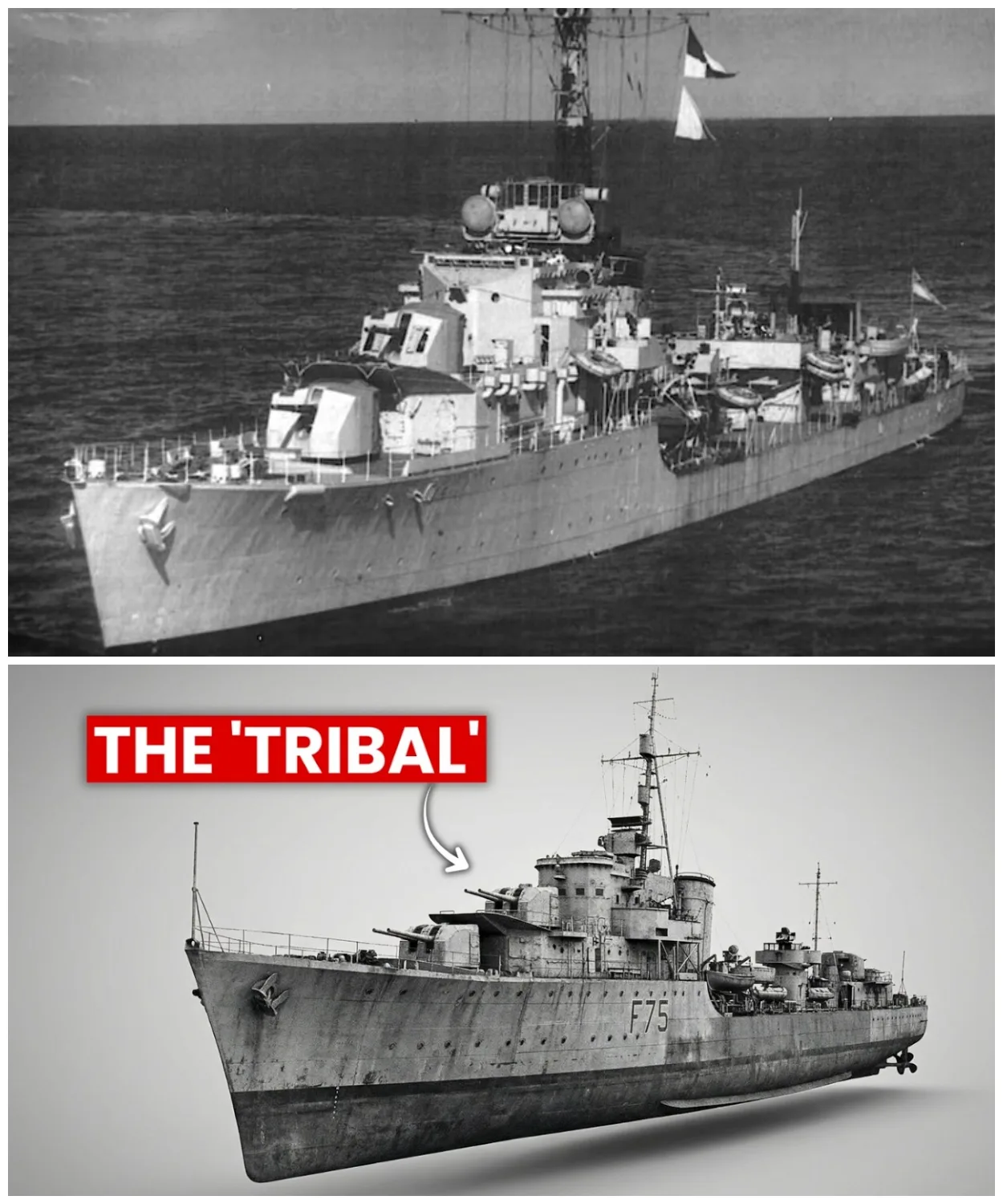
The tribal class displaced 1,870 tons standard and approximately 2519 tons at full load.
Overall length was 377 ft with a 36’6 in beam.
Three Admiral T3 drum boilers drove two Parsons single reduction geared turbines producing 44,000 shaft horsepower through two propeller shafts.
Maximum speed was 36 knots.
HMS Cosac achieved 36.2 and two knots.
On trials, range was 5,700 nautical miles at 15 knots.
Standard complement was 190 officers and men, rising to 219 when configured as a flatilla leader.
The main arament consisted of eight 4.7 in QF Mark12 guns in four twin CP19 mountings, superfiring pairs forward and aft.
Each gun fired a 50 lb shell at 2,650 ft pers with a rate of fire of 10 to 12 rounds per minute.
Maximum range was approximately 17,000 yd at 40° elevation.
Barrel life was around 1,400 rounds per gun.
Standard destroyers carried 8 to 10 21in torpedo tubes in two quadruple or quintuple mounts.
The tribals mounted a single quadruple launcher amid ships.
Four tubes, no reloads.
The torpedo armament was, as one historian noted, squeezed between massive superructures almost as an afterthought.
The original anti-aircraft fit comprised one quadruple two pounder pom pom and two quadruple vicers 50-in machine guns.
After the losses of HMS Girka and HMS Aphrei to air attack in April and May 1940, the Admiral T ordered X turret removed and replaced with a twin 4-in QF mark 16 mounting capable of 80° elevation.
The near useless 50 caliber machine guns were progressively replaced by 20 mm ericons and depth charge capacity increased from 20 to 46.
The tribals were also the first British destroyers to receive the fuseeping clock fire control computer, a mechanical predictor that became standard on every subsequent British wartime destroyer.
A distinctive clipper bow gave them excellent seaeping and a rakish silhouette that made them instantly recognizable from any angle.
The tribal class announced itself to the world before the shooting war had properly begun.
On the 16th of February 1940, HMS Cosc under Captain Philip Vian forced her way into Yossing Ford, Norway to board the German supply ship Altmark.
The Altmark was carrying 299 British merchant sailors captured by the pocket battleship Graphs B.
Acting on direct orders from Winston Churchill, Vian’s boarding party of 33 men armed with rifles and bayonets overwhelmed the German crew in hand-to-hand fighting.
When they opened the hatches where the prisoners were confined, the boarding party shouted the words that became legend.
The navies here.
It was the last major boarding action fought by the Royal Navy.
Two months later came Narvik and the carnage in the fjords.
The destruction of 10 German destroyers across both battles represented half of Germany’s modern destroyer strength, eliminated in a single week.
HMS Eskimo’s refusal to stop fighting after losing her entire bow, became a symbol of the class, often bowless, never bowed, as one account put it.
In May 1941, Vian’s fourth destroyer flotillaa HMS Cosak Murray Seik Zulu and the Polish destroyer OP Puran was detached to hunt the battleship Bismar through the night of the 26th to 27th of May in gale force winds and mountainous seas.
The four tribals harried the crippled battleship.
They illuminated her with star shell and launched 16 torpedoes in nine separate attacks.
Bismar fired her 15-in main battery at the destroyers, but scored no direct hits.
The tribal’s critical contribution was maintaining contact throughout the night, keeping Bismar’s exhausted crew at action stations and confirming her position for Admiral Tovy’s battleships to deliver the final blow at dawn.
HMS Cosac displaced 1,870 tons.
Bismar displaced 41,700 tons, 22 times the size.
In the Mediterranean, the tribals fought some of the war’s most intense surface actions.
On the 16th of April 1941, HMS Mohawk and Nubian joined two J-class destroyers in intercepting an Italian convoy of Tunisia in the Battle of the Targo Convoy.
All five merchant ships and all three Italian escort destroyers were sunk.
But as the Italian destroyer, Luca Trigo went down, her mortally wounded captain, with his leg shot off ordered a final torpedo spread.
One torpedo struck HMS Mohawk, sinking her with the loss of 41 crew.
The Battle of Cape Bon on the 13th of December 1941 was a textbook tribal action.
HMS Seek and HMS Maui with HMS Legion and the Dutch destroyer Isaac Spurs ambushed two Italian light cruisers from a stern at barely 1,000 yd using radar and the dark Tunisian coastline for concealment.
Both cruisers were sent to the bottom within 5 minutes.
Allied casualties were two men wounded.
Italian losses exceeded 800 dead between the two ships.
Two cruisers destroyed by destroyers in 5 minutes.
Gunpower made the difference.
If you’re finding this deep dive interesting, subscribing helps more than you know.
By 1944, the surviving tribals formed the backbone of the 10th destroyer flatillaa, a mixed Royal Navy and Royal Canadian Navy formation that dominated the English Channel before and during D-Day.
HMS Tarta, Ashanti, Eskimo, and Nubian served alongside Canadian tribals HMCS Haidider, Huron, Aabaskcan, and Irakcoy.
On the night of the 28th to 29th of April, 1944, HMCS Haidider and Aabaskcan engaged German torpedo boats T24 and T-27.
A torpedo from T-24 sank HMCS Aabaskcan with the loss of 128 crew.
Haida drove T-27 ground with gunfire, then turned back to rescue 44 of Aabaskcan’s survivors from the freezing channel waters.
3 days after D-Day at the battle of Ushant on the 9th of June 1944, the full 10th flatillaa intercepted the German eighth destroyer flatillaa including Narvik class destroyers Z32 and Z24.
ZH1 was sent to the bottom by combined fire from Tartar and Ashanti.
Z32 was driven ashore and destroyed after Ashant.
The Germans never again attempted a major surface sorty toward the Normandy beaches.
Canadian naval records from the period state that German torpedo boat commanders were under instructions to head toward the coast and avoid combat when they identified tribal silhouettes.
At Ushant, the German flatillaa commander recognized the tribals and immediately ordered his Narvik class destroyers to disengage, attempting to flee toward breast rather than fight.
The comparison with the German type 1936A Narvik class is the most revealing because these were the destroyers specifically designed to counter ships like the tribals.
The Narvik class displaced 2543 tons standard and over 3,500 tons at full load, nearly 1,000 tons heavier than a tribal.
They carried 4 to 5 cm guns firing a 100 lb shell, nearly double the weight of a tribal’s 50 lb round.
On paper, the German ship was the heavier puncher, but weight of broadside per minute told the real story.
Eight tribal guns firing 10 rounds per minute at 50 lb per shell delivered approximately 4,000 lb of steel every 60 seconds.
Four Narvik guns at 8 rounds per minute at 100 lb delivered roughly 3,200 lb per minute.
The tribal threw more steel faster, and the Tribal’s power rammed twin mountings maintained their rate of fire in North Atlantic gales, while German crews had to muscle 100 lb shells into manually loaded breaches in mostly open mountains.
In heavy weather, the gap widened dramatically.
The German ships also suffered from crippling engineering problems.
Their highpress Vagnner boilers operated at over 1,000 per square in compared to 300 for British Admiral T3 drum boilers.
Super heater alloys were brittle and corroded easily.
Feed water quality requirements were impossibly stringent.
Design range was 4,400 nautical miles, but so much fuel had to be retained as ballast for stability that effective range often fell to barely 1,800 nautical miles.
A tribal could cruise three times as far on 1/3 less displacement.
The Italian Soldati class was a near contemporary at similar displacement, but carried only four 120 mm guns, half the tribal firepower with inferior fire control and no radar until late in the war.
The American Fletcher class outperformed the Tribals in nearly every metric, but they were a later design entering service from 1942 with the benefit of four additional years of wartime experience.
Their five 5-in 38 caliber dualpurpose guns capable of 85° elevation and firing 15 to 22 rounds per minute with superb Mark 37 fire control represented the ideal the tribals had been reaching toward.
The tribals were designed in 1934 to 36 when such technologies did not exist.
They got the doctrine right before the technology caught up.
Of 16 Royal Navy tribals, 12 were lost.
A 75% loss rate, the highest proportional casualties of any British destroyer class.
HMS Matabel, torpedoed by U454 in the Arctic on the 17th of January, 1942, sank in under 2 minutes.
In freezing Arctic waters, only two men survived from a crew of 238.
HMS Seek absorbed approximately 80 hits from shore batteries at Tbrook, while her captain refused to abandon ship as long as a single gun could fire.
Six of the 12 ships lost were destroyed by air attack, exposing the one genuine design flaw.
Not too many guns, but guns that could not elevate high enough to fight aircraft effectively.
The four survivors, HMS Ashanti, Eskimo, Nubian, and Tarta, served from 1938 to 1945.
Nubian accumulated 13 battle honors, matching the record for a World War II destroyer.
All four were worn out by continuous service and scrapped between 1948 and 1949.
Today, HMCS Haidider, the Canadian tribal credited with sinking more enemy surface tonnage than any other Canadian warship, rides at anchor at Pier 9, Hamilton Harbor, Ontario.
She’s the last surviving tribal class destroyer in the world.
Designated a national historic site of Canada.
Think back to that morning in Narvik.
HMS Eskimo with her bow blown off, B turret still firing.
HMS Cosac ground in the harbor.
All eight guns hammering a German destroyer into silence.
The critics who said eight guns were too many for a destroyer were wrong.
The doctrine that insisted destroyers existed to launch torpedoes was wrong.
The German commanders who thought their heavier shells could compensate for fewer barrels were wrong.
And the marina flatillaa commanders who received orders to avoid combat with the tribals knew exactly why.
16 ships built, 12 lost in action.
every major theater of the war.
Eight guns per ship, 96 rounds per minute.