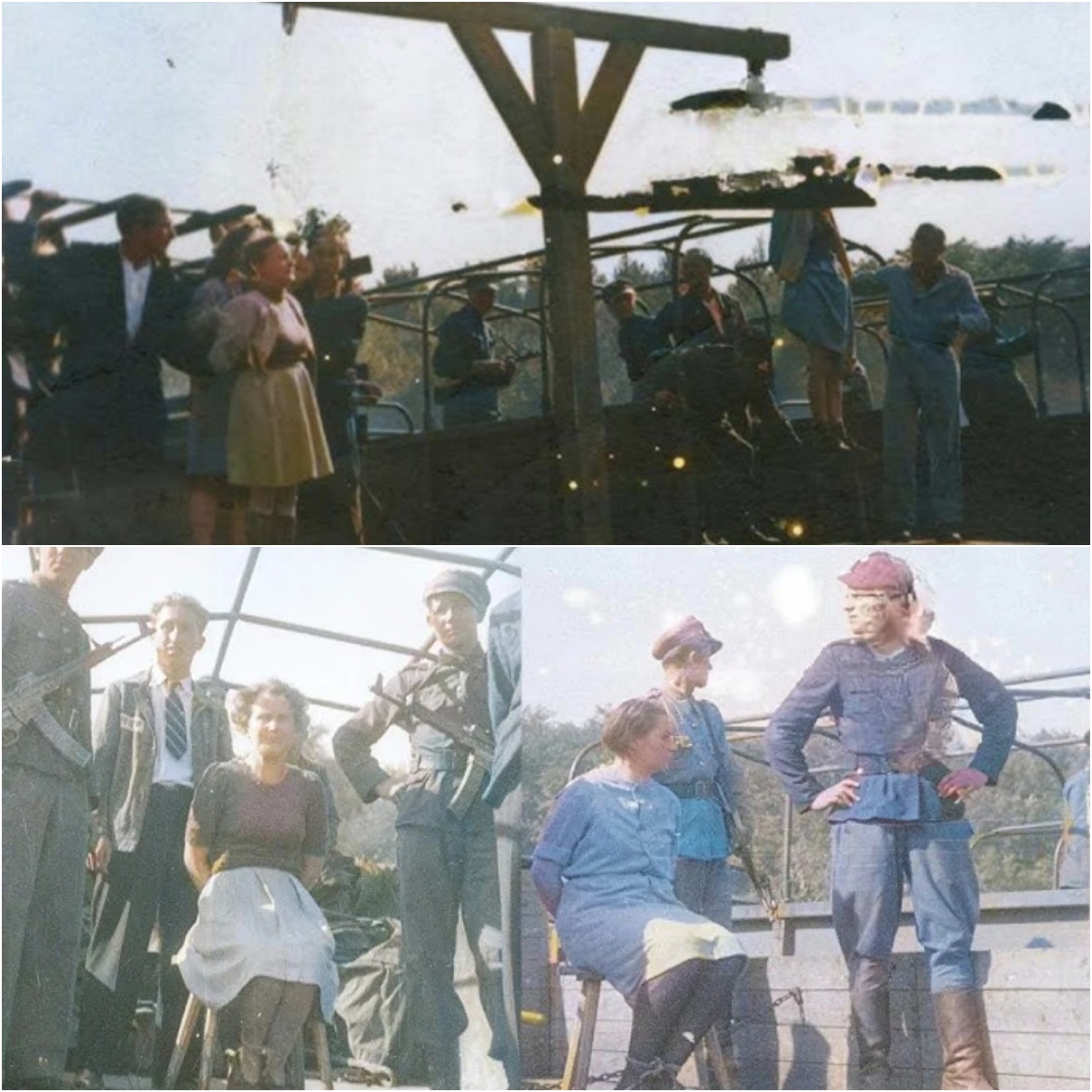
Why 5 FEMALE GUARDS of Stutthof Camp Were PUBLICLY HANGED Before 20,000 People: Giggling, Fixing Hair During Trial — and Crying, Begging Before the Gallows
EXTREMELY SENSITIVE CONTENT – 18+ ONLY
This article discusses a historical event involving war crimes at the Stutthof concentration camp, post-war trials, and the public hanging of female SS guards. It is intended for educational purposes only, to promote understanding of the past, the scale of Nazi atrocities, and the nature of post-war justice, while encouraging reflection on how societies can prevent extremism, ethnic persecution, and systematic violence in the future. It does not endorse or glorify any form of violence, extremism, or crime.
Why The Female Stutthof Guards Were Publicly Hanged: The Public and Humiliating Punishment of Five Brutal Perpetrators
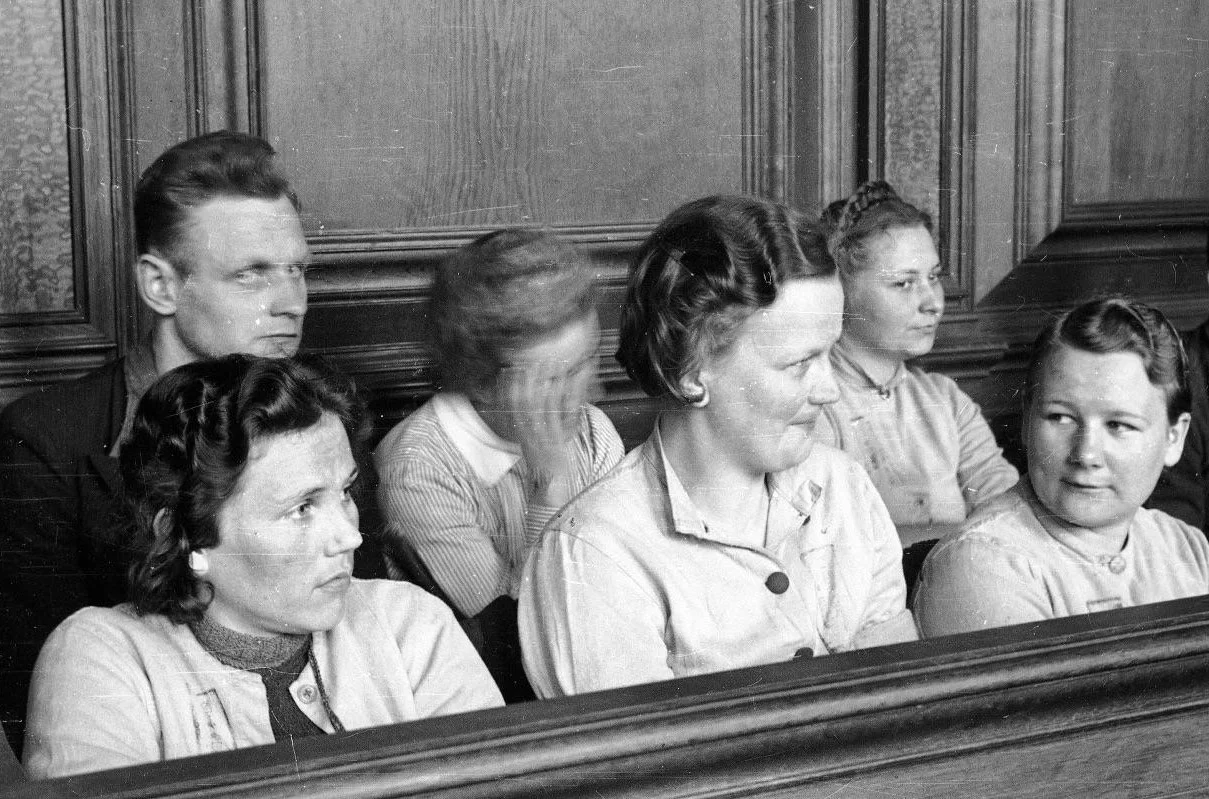
At the end of World War II, as Nazi concentration camps were liberated, hundreds of camp personnel—including many female guards (SS-Aufseherinnen)—were arrested and put on trial for war crimes and crimes against humanity. Among them, female guards from the Stutthof concentration camp (near Gdańsk, Poland) became particularly notorious for their exceptional cruelty. Five of these women—Jenny-Wanda Barkmann, Ewa Paradies, Wanda Klaff, Gerda Steinhoff, and Elisabeth Becker—were sentenced to death in the first Stutthof trial (April–May 1946) and publicly hanged on July 4, 1946, at Biskupia Górka (Biskup Hill) in Gdańsk, in front of thousands to approximately 20,000 spectators. The executions were deliberately staged as a public spectacle, filmed, and photographed for widespread distribution. This analysis examines the context of Stutthof, the role of the female guards, the trial, the reasons for public and humiliating execution, and the historical significance, drawing on documented records and survivor testimonies to provide an objective perspective on post-war justice in Poland.
Background: Stutthof Concentration Camp and the Brutality of the Female Guards
Stutthof was the first Nazi concentration camp established outside Germany proper (September 1939), initially for Polish political prisoners, later expanded into an extermination camp with gas chambers, medical experiments, and mass executions. Over 85,000 people perished there, mainly Poles, Jews, Soviet POWs, and other targeted groups.
Female guards (Aufseherinnen) were recruited starting in 1942–1944, many young (18–25 years old) and trained at Ravensbrück. At Stutthof, they gained a reputation for cruelty that often exceeded that of male guards:
- Jenny-Wanda Barkmann (19 at arrest): Known as the “Beautiful Ghost,” infamous for flogging prisoners with a leather whip, selecting victims for execution, and participating in torture.
- Ewa Paradies (24): Involved in beatings and killings.
- Wanda Klaff (24): Notorious for brutality during labor supervision and executions.
- Gerda Steinhoff (24): Oversaw sub-camps and participated in torture.
- Elisabeth Becker (24): Selected prisoners for gassing and executions.
They were accused of direct involvement in murders, beatings to death, selections for experiments, and mass killings.
The Stutthof Trial and Death Sentences
From April 25 to May 31, 1946, the first Stutthof trial was held in Gdańsk by a Special Court of Poland (under Soviet supervision). Hundreds of survivors testified to their cruelty. The court sentenced 11 defendants to death (5 women and 6 men), with others receiving life or long prison terms.
The women were convicted of war crimes and crimes against humanity. The verdicts were publicly announced to affirm justice for the Polish people—who suffered the heaviest losses at Stutthof.
The Public Hanging on July 4, 1946, and the Reasons
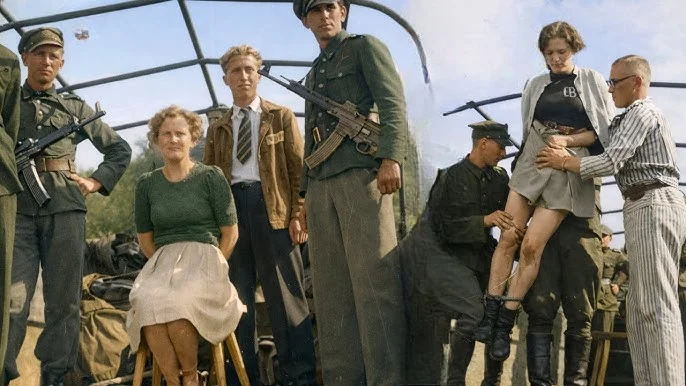
On July 4, 1946, at 5:00 p.m., the 11 condemned prisoners (including the 5 women) were taken to Biskupia Górka hill in Gdańsk. A large gallows structure was erected (four double and one triple gallows). The executions were carried out in public before a massive crowd (estimates range from several thousand to about 20,000 people, including local residents, survivors, and military personnel).
Reasons for the public and humiliating nature:
- Visible justice for the Polish people: Stutthof was on Polish soil; tens of thousands of Poles were murdered there. The post-war Polish authorities (under Soviet influence) wanted the population to witness the perpetrators’ punishment firsthand, to soothe collective trauma and affirm that “justice has been served.”
- Deterrence and catharsis: After six years of brutal occupation, the public needed to see retribution openly to heal psychological wounds. Public execution was a way for society to witness the enemy being punished.
- Political propaganda: The new regime sought to demonstrate its authority, prove it was purging fascist remnants, and protect the people.
- Post-war tradition: In the immediate aftermath of the war, several Eastern European countries held public executions of war criminals to meet public demand and consolidate the new authorities.
The women were brought out one by one, hands tied behind their backs, and hanged by the short-drop method (causing death by strangulation rather than neck break). The entire process was filmed and photographed for wide dissemination.
This was one of the largest public executions of war criminals in post-war Europe.
Controversies and Historical Lessons
Public executions were later criticized for their vengeful and inhumane character, but in 1946 they reflected the profound horror and demand for justice in Polish society after the Holocaust and occupation. Today, the Stutthof female guards are seen as symbols of female complicity in the camp system, and the public hanging stands as evidence of post-war justice in Poland.
The case highlights the consequences of ethnic and ideological extremism, the use of concentration camps for genocide, and the importance of historical accountability in preventing recurrence. Stutthof is now a memorial museum where victims are honored regardless of ethnicity or religion.
The public hanging of five female Stutthof guards on July 4, 1946, before thousands in Gdańsk was a deliberately public and humiliating punishment intended to satisfy the Polish people’s demand for justice after the horrific crimes at the camp. It was not only retribution but also a political statement affirming that justice had been delivered. The event serves as a stark reminder of the brutality of the concentration camp system and the long-term need to document history to prevent similar tragedies.
Sources:
- Wikipedia: Stutthof trials (cross-referenced with historical citations).
- Wikipedia: Jenny-Wanda Barkmann, Ewa Paradies, Wanda Klaff, Gerda Steinhoff, Elisabeth Becker.
- Executed Today: “1946: Eleven from the Stutthof concentration camp” (July 4, 1946).
- Stutthof Museum / JUSP Jasenovac Memorial (official survivor accounts and trial records).
- Capital Punishment UK: Female Nazi War Criminals (detailed section on Stutthof guards).
- Various historical analyses from Polish Institute of National Remembrance (IPN) and academic sources on post-war justice in Poland.
- Contemporary photographs and newsreels from 1946 (archived in Polish and international collections).